
Mindmap
RELATIONSHIPS
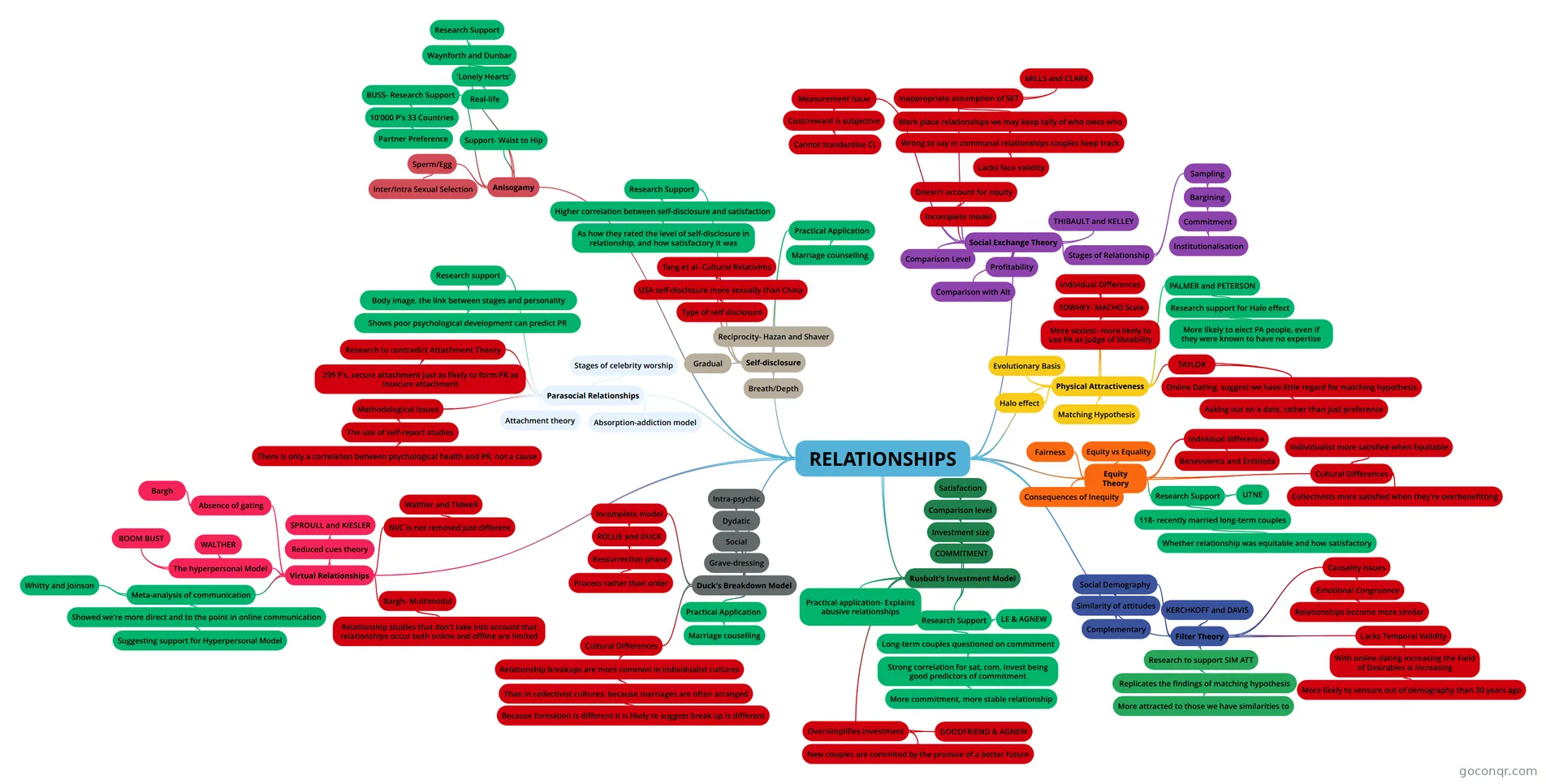
Mind map: Relationships psychology
Inhalt der Mindmap
RELATIONSHIPS
Anisogamy
- Sperm/Egg
- Inter/Intra Sexual Selection
- BUSS- Research Support
- 10'000 P's 33 Countries
- Partner Preference
- 10'000 P's 33 Countries
- Waynforth and Dunbar
- 'Lonely Hearts'
- Real-life
- Research Support
- 'Lonely Hearts'
- Support- Waist to Hip
- Sperm/Egg
Self-disclosure
- Breath/Depth
- Reciprocity- Hazan and Shaver
- Tang et al- Cultural Relativims
- USA self-disclosure more sexually than China
- Type of self disclosure
- USA self-disclosure more sexually than China
- Research Support
- Higher correlation between self-disclosure and satisfaction
- As how they rated the level of self-disclosure in relationship, and how satisfactory it was
- Higher correlation between self-disclosure and satisfaction
- Gradual
- Practical Application
- Marriage counselling
Physical Attractiveness
- Evolutionary Basis
- Halo effect
- Matching Hypothesis
- Individual Differences
- TOWHEY- MACHO Scale
- More sexiest- more likely to use PA as judge of likeability
- TOWHEY- MACHO Scale
- PALMER and PETERSON
- Research support for Halo effect
- More likely to elect PA people, even if they were known to have no expertise
- Research support for Halo effect
- TAYLOR
- Online Dating, suggest we have little regard for matching hypothesis
- Asking out on a date, rather than just preference
- Online Dating, suggest we have little regard for matching hypothesis
Filter Theory
- KERCHKOFF and DAVIS
- Social Demography
- Similarity of attitudes
- Complementary
- Similarity of attitudes
- Causality issues
- Emotional Congruence
- Relationships become more similar
- Emotional Congruence
- Lacks Temporal Validity
- With online dating increasing the Field of Desirables is increasing
- More likely to venture out of demography than 30 years ago
- With online dating increasing the Field of Desirables is increasing
- Research to support SIM ATT
- Replicates the findings of matching hypothesis
- More attracted to those we have similarities to
- Replicates the findings of matching hypothesis
Social Exchange Theory
- Profitability
- Comparison Level
- Comparison with Alt
- Incomplete model
- Doesn't account for equity
- Measurement Issue
- Cost/reward is subjective
- Cannot standardise CL
- Cost/reward is subjective
- Stages of Relationship
- Sampling
- Bargining
- Commitment
- Institutionalisation
- Commitment
- Bargining
- Sampling
- THIBAULT and KELLEY
- Inappropriate assumption of SET
- Work place relationships we may keep tally of who owes who
- Wrong to say in communal relationships couples keep track
- Lacks face validity
- Wrong to say in communal relationships couples keep track
- MILLS and CLARK
- Work place relationships we may keep tally of who owes who
Equity Theory
- Fairness
- Consequences of Inequity
- Equity vs Equality
- Individual difference
- Benevolents and Entitleds
- Cultural Differences
- Individualist more satisfied when Equitable
- Collectivists more satisfied when they're overbenefitting
- Research Support
- 118- recently married long-term couples
- Whether relationship was equitable and how satisfactory
- UTNE
- 118- recently married long-term couples
Rusbult's Investment Model
- Satisfaction
- Comparison level
- Investment size
- COMMITMENT
- Investment size
- Comparison level
- Practical application- Explains abusive relationships
- Research Support
- Long-term couples questioned on commitment
- Strong correlation for sat, com, invest being good predictors of commitment
- More commitment, more stable relationship
- Strong correlation for sat, com, invest being good predictors of commitment
- LE & AGNEW
- Long-term couples questioned on commitment
- Oversimplifies investment
- New couples are commited by the promise of a better future
- GOODFRIEND & AGNEW
- Satisfaction
Duck's Breakdown Model
- Intra-psychic
- Dydatic
- Social
- Grave-dressing
- Social
- Dydatic
- Incomplete model
- ROLLIE and DUCK
- Ressurrection phase
- Process rather than order
- Ressurrection phase
- ROLLIE and DUCK
- Practical Application
- Marriage couselling
- Cultural Differences
- Relationship breakups are more common in individualist cultures
- Than in collectivist cultures, because marriages are often arranged
- Because formation is different it is likely to suggest break up is different
- Than in collectivist cultures, because marriages are often arranged
- Relationship breakups are more common in individualist cultures
- Intra-psychic
Virtual Relationships
- Reduced cues theory
- SPROULL and KIESLER
- The hyperpersonal Model
- WALTHER
- BOOM BUST
- NVC is not removed just different
- Walther and Tidwell
- Absence of gating
- Bargh
- Meta-analysis of communication
- Showed we're more direct and to the point in online communication
- Suggesting support for Hyperpersonal Model
- Whitty and Joinson
- Showed we're more direct and to the point in online communication
- Bargh- Multimodal
- Relationship studies that don't take into account that relationships occur both online and offline are limited
- Reduced cues theory
Parasocial Relationships
- Absorption-addiction model
- Stages of celebrity worship
- Research support
- Body image, the link between stages and personality
- Shows poor psychological development can predict PR
- Body image, the link between stages and personality
- Attachment theory
- Research to contradict Attachment Theory
- 299 P's, secure attachment just as likely to form PR as insecure attachment
- Methodological Issues
- The use of self-report studies
- There is only a correlation between psychological health and PR, not a cause
- The use of self-report studies
Informationen
- Beschreibung
- AS level Psychology (Relationships) Mindmap am RELATIONSHIPS, erstellt von 007842-Stuart Denton am 21/06/2017.
- Erstellt von
- 007842-Stuart Denton
- Aufrufe
- 0
- Bewertung