
Notizen
Learning Theories
Inhalt der Notizen (5)
Seite 1
4.1 CONTENT
4.1.1 CLASSICAL CONDITIONING
The main features of classical conditioning
A stimulus is something in our environment that affects us; a response is our reaction to a stimulus.
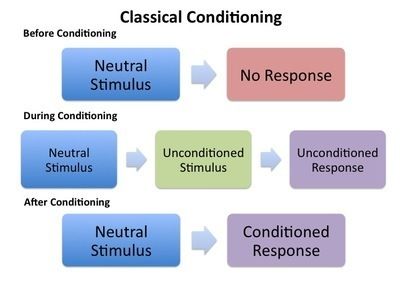
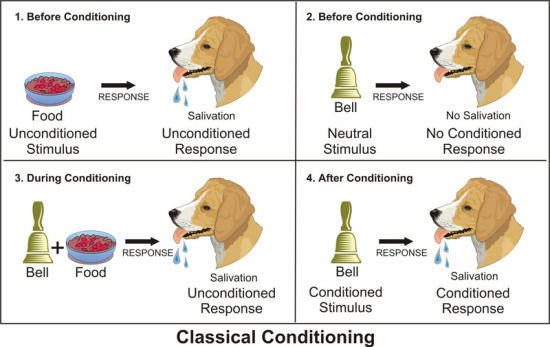
Classical conditioning involves the transfer of an established physiological response to a stimulus to another stimulus that does not normally produce the response, by repeated pairings of the new stimulus with a stimulus that already produces the response.
After a number of such pairings, the previously neutral stimulus will produce the response when presented alone.
Key Terms -
Unconditioned stimulus The stimulus that causes the reflex response before conditioning. It is called the UCS because it has not been conditioned; it is the stimulus that naturally produces the response.
Unconditioned response The innate (reflexive) response to a stimulus that has not been conditioned.
Neutral stimulus A stimulus which does not produce the unconditioned response.
Conditioned stimulus The stimulus which, after repeated pairings with the unconditioned stimulus, produces the response.
Conditioned response The reflexive response that occurs after exposure to the conditioned stimulus.
4.1.2 PAVLOV (192)
Pavlov explains how the brain learns to see the new sound as a "signal" and links the reflex to it.
This is how animals in the wild learn to hunt or escape being hunted: they learn to apply their reflexes to new situations based on experiences they've had before.
Pavlov's research would be seen as unethical today as it could have been distressing to the dogs.
4.1.3 OPERANT CONDITIONING
The main features of operant conditioning
Operant conditioning differs from classical conditioning because it considers the learning of voluntary, rather than involuntary behaviour through consequences.
The basic idea is that when people behave in a particular way and are rewarded for that behaviour, then they will repeat it; if they are punished for it, they will stop the behaviour.
Types of Reinforcement
Reinforcement: when the desired behaviour is rewarded
Positive reinforcement: rewards the desired behaviour by adding something pleasant
E.g. A compliment
E.g. money
Negative reinforcement: rewards the desired behaviour by removing something unpleasant
E.g. Taking away pain or distress
E.g. Cancelling a fine
Types of Punishment
Punishment: when undesirable behaviour produces unpleasant consequences
Positive punishment: punishes the undesirable behaviour by adding something unpleasant
E.g. a criticism
E.g. copying out lines
Negative punishment: which punishes by removing something pleasant
E.g. being 'grounded' (removing freedom to go out)
E.g. Reducing pocket money (removing the amount of money given)
4.1.4 PROPERTIES OF REINFORCEMENT
Primary reinforcement: when the reward is something we want naturally
A basic need
E.g. food and warmth
Secondary reinforcement: a reward we have learned to value
E.g. money
Schedules of reinforcement
This refers to how often and when you are rewarded for a behaviour.
Continuous reinforcement: when behaviour is reinforced every time
E.g. receiving a sticker after overtime you do your homework
Fixed interval: provides reinforcement at set times e.g. getting pocket money every Saturday
E.g. receiving a sticker every Monday morning at school if all homework is complete
Variable interval: reinforcement is given after varying time intervals
E.g. receiving a sticker on Monday morning, then the following Wednesday, then the following Tuesday
Fixed ratio: reinforcement is given after a certain number of responses
E.g. receiving a sticker for every 5th piece of homework handed in
Variable ratio: reinforcement is given after a varying number of responses
E.g. receiving a sticker after two pieces of homework, then after 10 pieces of homework then after 5
4.1.5 BEHAVIOUR MODIFICATION
Shaping behaviour
'Shaping' involves changing the reinforcement to produce very precise behaviours.
Procedure:
At first, you reward any behaviour in the general direction you want
Later, you reward behaviours that are similar to the specific behaviour you have in mind
Eventually, you only reward the specific behaviour you are looking for
Phobias
Phobias can be explained by Operant Conditioning.
If the feared thing is removed when you scream and cry, then fearful behaviour is negatively reinforced (it removes something unpleasant). If other people show concern, share their own fears or even just pay attention, then fear is positively reinforced too (it adds something pleasant).
Token Economy Programmes
TEPs are a treatment based on Operant Conditioning. They involve rewarding and/ or punishing people by awarding or deducting tokens.
Tokens are only secondary reinforces; when there are enough of them, they can be ‘cashed in’ for a positive reinforce, like gifts, luxuries or privileges.
4.1.6 SOCIAL LEARNING THEORY
Bandura proposed SLT, sometimes called “observational learning”, which looks at how we learn by observing other people and imitating them, without conditioning.
Learning by observation
To see whether young children will imitate behaviour they have seen.
Observational learning takes place in 4 steps:
The behaviour must be modelled which means it must be carried out by a role model like a parent, friend or celebrity.
The observer must identify with the role model – normally because they are similar in appearance, gender, interests, etc
The behaviour must be observed
The behaviour is imitated
4.1.7 SOCIAL LEARNING STAGES
Attention: paying attention to a model is a condition for learning
↓
Retention: remembering what the model did is a condition for imitating the models behavior
↓
Reproduction: people must have the capacity (e.g. skills) for imitating the behavior
↓
Motivation: people must be motivated to imitate behavior (e.g. importance of model or reward)
4.1.8 BANDURA (1961,1963) ORIGINAL BOBO DOLL EXPERIMENT
Aim
To find out if children would show more aggressive behaviour if exposed to an aggressive role model and less aggressive behaviour if exposed to a non-aggressive role model.
Hypothesis
Children shown aggressive models will show more imitative aggressive behaviour than those shown non-aggressive or no models.
Children shown non-aggressive, subdued models will show less aggressive behaviour than those shown aggressive or no models. 3.
Children would imitate behaviour of same-sex model more than model of opposite sex, with boys showing more imitative aggression than girls, especially with male aggressive model.
Method
It was a laboratory Experiment at Stanford University. There was 8 experimental groups in 4 conditions (plus control group)
Procedure
72 children aged 3 –5 yrs matched for aggression before the study started.
Some groups watched aggressive behaviour; some non-aggressive behaviour and control group watched neither.
Children were playing in a room when an adult entered and either behaved aggressively or non-aggressively.
Children were then put in a slightly aggressive state by being told they could not play with certain toys.
Then behaviour observed with access to a Bobo doll and child was observed.
The child was observed playing with the toys for 20 minutes through a one-way mirror.
Results
The boys showed more nearly twice as much imitative aggression than the girls.
However, the girls showed similar levels of physical and verbal aggression, while the boys had a tendency to model physical aggression much more than verbal aggression.
On every type of aggression the boys were either two or three times more likely to be influenced by the male model than the female model.
Conclusion
Children watching adults behaving aggressively are more likely to imitate aggression so observational learning does take place. Children also imitated non-aggressive behaviour, which led to less aggression
Evaluation
Generalizability –
Hard to generalise towards adults as results are based on children. The studies may not tell us much about how adults learn new behaviour because role models might less influential to adults
Reliability –
It was a lab experiment making it easy to replicate due to the fact it had a standardised procedure
Application –
It can be applied to parenting and teaching styles. It suggests children observe and imitate adults, so if you want your children to grow up calm and well behaved, you need to keep your temper and keep them away from aggressive role models.
Validity –
The main criticism of all Bandura’s studies is that they lack validity. The children were put in a strange situation, exposed to some unusual adult behaviour and given toys to play with which encouraged them to act unnaturally.
Ethics –
Unethical because the children may have been distressed by the aggressive behaviour they witnessed and, the aggressive behaviour they learned from the study may have stayed with them, going on to become a behavioural problem.
4.1.9 BANDURA (1965) BOBO DOLL EXPERIMENT WITH VICARIOUS REINFORCEMENT
Aim
To find out if children would be more likely to imitate a role model they see being rewarded (vicarious reinforcement) and less likely to imitate a role model they see being punished (vicarious punishment).
Sample
66 children, 33 boys and 33 girls, aged 3-5, recruited from Stanford University Nursery School (an opportunity sample).
Procedure
In the Reward condition, the experimenter arrived a praised Rocky for his “superb aggressive performance” and gave Rocky sweets, which he ate.
In the Punishment condition, the experimenter called Rocky “a big bully” and hit him with a rolled-up newspaper.
In the No Consequences condition, nothing happened to Rocky.
The children were placed in the Observation Room for 10 minutes and secretly observed – this is the No Incentive condition.
Then they were brought juice and told they would get more juice and sticker books if they could imitate Rocky. They were asked to “show me what Rocky did” and “tell me what Rocky said.” If there was imitative aggression in response, they were rewarded straight away. This is the Positive Incentive condition.
Results
The Model Reward condition produced about the same imitation from girls (mean 2.8) and boys (3.5) as the No Consequences condition.
The Model Punished condition produced much less imitation, especially among the girls (mean 0.5).
After Positive Incentive, the imitation increased significantly for girls and boys
Conclusion
Bandura concludes that children will be less likely to imitate role models they see being punished.
When offered incentives, even children who watched the model being punished show that they had in fact learned the aggressive behaviour.
Evaluation (Same as first Bandura study)
Generalizability –
Hard to generalise towards adults as results are based on children. The studies may not tell us much about how adults learn new behaviour because role models might less influential to adults
Reliability –
It was a lab experiment making it easy to replicate due to the fact it had a standardised procedure
Application –
It can be applied to parenting and teaching styles. It suggests children observe and imitate adults, so if you want your children to grow up calm and well behaved, you need to keep your temper and keep them away from aggressive role models.
Validity –
The main criticism of all Bandura’s studies is that they lack validity. The children were put in a strange situation, exposed to some unusual adult behaviour and given toys to play with which encouraged them to act unnaturally.
Ethics –
Unethical because the children may have been distressed by the aggressive behaviour they witnessed and, the aggressive behaviour they learned from the study may have stayed with them, going on to become a behavioural problem.
4.1.10 HOW LEARNING THEORIES EXPLAIN THE ACQUISTION AND MAINTENANCE OF PHOBIAS
Classical conditioning
Pairing of a neutral stimulus with an unconditioned stimulus. This UCS produces a unconditioned response (fear). If pairing of NS and UCS continues, the NS may produce the UCR.
Operant conditioning
Rewards and punishments (through different reinforcement types) can increase or decrease repetition of behaviours. This has been linked to social phobias (fear of interacting with others).
E.g. if scared of social situations e.g. parties, one way of dealing with it would be to avoid going or escape the situation. This would remove or lessen the anxiety felt
Social learning theory
If an individual observes phobic behaviour in others, this may be imitated and if reinforced then behaviour is likely to be repeated.
4.1.11 THREATMENTS FOR PHOBIAS BASED ON THEORIES OF LEARNING
Flooding
Based on classical conditioning and has two components:
Unavoidable exposure: this involves introducing you to the thing you fear in the most immediate and unavoidable way
If the patient can be prevented from escaping the object they fear, then they can learn to stop fearing it.
Extinction: this involves learning to associate the thing you fear with something neutral
When the body's "alarm phase" comes to an end, you feel emotionally drained but unafraid. If the feared object is still present, you will learn to associate it with a lack of emotion, rather than fear
Systematic desensitisation
Based on classical conditioning and has two components:
Counter-conditioning: this involves learning to associate the thing you fear with something relaxing or pleasant
Graduated exposure: this involves introducing you to the thing you fear in stages, starting with brief encounters (a photograph, at a distance, for a second) and building up to longer encounters
Seite 2
4.2 METHODS
4.2.1 HUMAN RESEARCH
Using the observational research method
Quantitative data: numerical data
Quantitative data: descriptive data
Recording of data:
Tallying is where observers write down when and how many times
Time sampling involves making observations at different intervals, e.g. every 30 seconds, and recording what is observed
Event sampling involves recording a certain behaviour every time it happens, e.g. ticking a box overtime someone displays a particular behaviour
Types of observation
Structured observations
Staged observations carried out in a controlled environment, e.g. lab
Records behaviours which would be difficult to gain in naturalistic observations
Strength: moer reliable as can be replicate
Weakness: difficult to ensure all observers interpret the same behaviour so would need a few observers to increase validity
Naturalistic observations
Observing the behaviour of participants within their own environment
Strength: strong ecological validity
Weakness: Less reliable as extraneous variables cannot be controlled
These observations can be a...
Non-Participant observation: where the researcher observes the participants and does not form part of the group used in the study
Participant observation: where the researcher takes an active role the situation being observed
Overt and Covert:
Overt observation: where those being observed are aware of the presence of an observer
E.g. an inspector coming into a classroom to observe teachers/pupils
Covert observation: where the participants do not know they are being observed
Content analysis
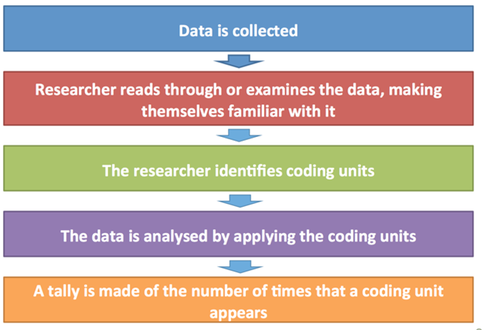
A content analysis is an observation; it studies human behaviour indirectly.
Content analysis is a method used to analyse qualitative data (non-numerical data). Most commonly it allows a researcher to take qualitative data and to transform it into quantitative data
4.2.2 ANIMAL RESEARCH
Arguments FOR the use of animals
Rats have a short gestation period (typically 22 days) and therefore large samples can be bred in a short time frame
Animal research is heavily regulated and regular inspections take place in laboratories to check welfare conditions
Provided significant insight into vital areas of medical research including drug treatments
We share basic nervous system structures and functions that mean we are able to generalise some finding from animals to humans
Argument AGAINST the use of animals
Lacks ecological validity; lab-based animal research produces behaviour that is different from animals' natural behaviour
The benefits of research are not known until after the study, so it is possible that their use in the study has limited effect
Human brains are much more complex, e.g. much larger codex proportionally can other animals, so findings can't be generalised
If animals are so similar to humans why should they therefore not have the same ethical considerations than us?
Ethical issues regarding the use of animals in lab experiments
ANIMALS (SCIENTIFIC PROCEDURES) ACT 1986:
Relates to any scientific procure that may cause pain, suffering, distress or lasting harm to protected animals
Researchers are expected to comply with this act
...based on this act, the British Psychological Society (BPS) published guidelines for working with animals: (5 examples)
Where possible, live animals should be replaced with research alternatives, like videos and computer simulations
Species bred in captivity are ethically preferable to creatures taken from the wild
The number of animals used should be minimised as much as possible
When not being studied, animals must be carefully and ethically looked after
Anaesthetics should be used to minimise pain and distress
4.2.3 ANALYSIS OF DATA
Chi-squared
Reasons for choosing:
Where a hypothesis is predicting a difference or an association
Where your level of measurement is normal
Where you participant design is independent measures
The formula:

4.2.4 SCIENTIFIC STATUS OF PSYCHOLOGY
Objectivity: Scientists try to stay detached from what they are studying and don’t let their feelings or emotions affect their conclusions
Replicability: Other scientists can repeat your research and check your results
Reliability: A reliable procedure should always work the same way whenever you use it, and should produce the same results every time it’s used on the same people
Validity: A valid procedure gives true results because it’s studying what it’s meant to be studying
Internal validity: whether the study is properly controlled; if it lacks internal validity, then outside forces (extraneous variables) may be causing the results instead.
Predictive validity: Whether the study predicts what will happen in similar situations in the future
Ecological validity: Research is valid if the behaviour being studied is natural and realistic and not influenced by outside factors
Reductionism: Means reducing everything to the simplest possible explanation
Falsification: It is thought that the best scientists do not try to prove theories; they try to disprove (falsify) them
Empiricism: The idea that true information comes to us through the 5 senses: stuff we can see, hear, touch, taste and smell
Hypothesis testing: The scientific procedure involves beginning with a research question from which a hypothesis is formed; this hypothesis is tested empirically (with physical evidence) and from this a theory is formulated
Use of controls: Controls make the study more reliable if they rule out "one-off" events occurring
Seite 3
4.3 STUDIES
4.3.1 CLASSIC STUDY
WATSON AND RAYNER (1920): LITTLE ALBERT
Aim
To find out if a fear response can be conditioned into a 9-month-old baby boy
Sample
9-month-old baby boy, called Albert B. Albert's mother was paid $1 for participating.
Procedure
At 9 months, Albert was tested with a white rat, a rabbit, cotton wool and other stimuli to see if he had a fear reaction. He didn’t; this shows these were Neutral Stimuli (NS).
The researchers also checked his fear response by banging an iron bar. Albert cried at the loud noise; this shows the noise was an Unconditioned Stimulus (UCS) and the crying was an Unconditioned Response (UCR).
At 11 months, Albert was conditioned. He was shown the white rat three times. Each time the rat was paired with striking the iron bar. Albert started to whimper. A week later, Albert was conditioned again. The rat was presented 3 times, paired with the noise.
Results
When the rat was later presented alone, Albert whimpered. The rat was paired with the noise again 2 more times. When the rat was presented alone another time, Albert cried.
This suggests that the NS is now a Conditioned Stimulus (CS) and Albert’s crying is a Conditioned Response (CR).
Conclusion
Watson & Rayner concluded that they had successfully conditioned Albert to fear the white rat and that his fear response generalised to other white, furry things.
Evaluation
Generalisability –
The experiment was done on a single child - Albert. Usually a sample of one would be considered very unrepresentative.
Reliability –
This is a great example of a reliable study because it has standardised procedures and it was carefully documented and filmed.
Application –
Allowed other psychologists to investigate phobias in further depth. This has led to treatments such as flooding and systematic desensitisation.
Validity –
The setting for the experiment lacks ecological validity because Albert was away from his playroom and familiar nurses.
Ethics -
It is unethical because Watson & Rayner deliberately caused distress to an infant and continued even though he was upset.
It was also unethical because they brought about a phobia when they didn’t know for certain that it could be removed.
4.3.2 CONTEMPORARY STUDY
BECKER ET AL. (2002): EATING BEHAVIOURS AND ATTITUDES IN FIJIAN GIRLS
Aim
To find out if the introduction of Western TV into a community that has not previously experienced it would lead to an increase in unhealthy eating behaviour
Method
This is an Independent Groups design, since it studies two different groups of Fijian girls
Sample
Fijian schoolgirls in Years 5-7 (equivalent to Y11-13 in the UK), all around age 17 on average. There were 63 participants in 1995 and 65 in 1998.
Procedure
The schoolgirls completed the EAT-26 questionnaire and both groups had measures of height and weights were taken.
30 girls were chosen from the 1998 sample because they scored higher than 20 on EAT-26.
They were interviewed in detail about their eating behaviours and attitudes, their TV viewing habits and their opinions on “American TV”.
Results
The girls’ actual weight didn’t vary much between the two cohorts.
TV viewing increased: 41% came from a household with a television in 1995 compared to 71% in 1998.
None of the girls reported using purging (induced vomiting) to control weight in 1995, but 11.3% reported this in 1998.
Conclusion
Dr Becker concludes that the characters on Western TV shows act as role models for Fijian girls. The girls feel pressure to imitate the slim appearances of actors and models, even if this means going against the Fijian culture
Becker believes TV has brought with it an interest in dieting that was not present before on Fiji
Evaluation
Generalisability –
May be problems generalising from Fijian girls to other cultures, because Fiji has such a strong culture of eating and distinctive notions of beauty and body shape.
Reliability –
Becker's interviews were tape-recorded and transcribed so other researchers can read over what the girls said; this is inter-rater reliability.
Application –
Studies like this may justify banning shows that feature particularly thin models in some cultures in order to reduce mental health disorders.
Validity –
Lots of changes in Fijian society might have gone on alongside the introduction of television, so it’s difficult to be sure that TV is causing the changes in behaviour Dr Becker is reporting.
Ethics –
Introduction has led to eating and mental health disorders into a culture that may have not previously experienced these. Adolescent girls may have been harmed mentally.
Seite 4
4.4 KEY QUESTION
4.4.1, 4.4.2 ONE KEY QUESTION OF RELEVANCE TO TODAYS SOCIETY
IS THE INFLUENCE OF ROLE MODELS AND CELEBRITIES SOMETHING THAT CAUSES ANOREXIA
intro
They are both people who would agree and disagree with this argument, some may say that anorexia is self inflicted, whereas others would argue that people you are surrounded by or look up to can influence you to become anorexic.
Anorexia is an eating disorder that is extremely relevant in today’s society as over 1.6 million people in the UK are directly affected from eating disorders. It is a form of intentional self-starving that begins as dieting but goes to extremes. There was a huge concern about size zero models when in 2006, the model Luizel Ramos died of a heart attack, which was brought on by anorexia, this led to the Madrid and Milan fashion weeks banning size zero models. There are many arguments as to whether or not these models have a strong influence on the young girls of today and I am going to be discussing whether the influence of role models and celebrities are something that cause anorexia
para 1
Firstly, social learning theory provides a theory that supports that role models and celebrities are something that causes anorexia. The social learning theory states that people learn from and look up to their role models, for example when seeing numerous amounts of size zero models on the cover of magazines it may encourage girls who want to be just as slim. These models are not only endangering their own lives, but also by acting as role models, the magazines editors and people working behind the scenes are promoting these models and this is encouraging woman to imitate them and aim for dangerous weight loss, also known as anorexia.
para 2
Secondly, vicarious reinforcement is a learning process that was hypothesised in social learning theory. It refers to the process of learning behaviours through observation of reward and punishment, this gives some evidence that the influence of role models can have an effect on individuals and cause anorexia. Vicarious reinforcement is different when discussing the problem of anorexia, due to the fact that, not only do you see your role models looking extremely thin but they are also getting praise for their dangerous weight, this may encourage others to be in the same position. For example, when an individual sees a celebrity posting pictures on social media looking extremely thin and getting huge amounts of compliments and praise, this may influence them to want to become like their role mode causing them to turn anorexic by dangerously losing weight.
para 3
Research evidence shows that Bandura investigates aggression but also helps to explain anorexia as people learn from watching others and imitate these acts, especially when it comes to role models of the same gender. For instance, in Banduras study, the children who saw adults act aggressively towards a bobo doll imitated these actions. This provides the point that people do learn from others and therefore, may learn that being extremely underweight is the norm, which could lead to anorexia.
para 4
In contrast, people also see anorexia as a self-driven mental disorder. People all have different personalities and natures; some extremely addictive personalities may contribute to anorexia. Even though anorexia may have had a slight influence from others, it is shown that people have a natural predisposition to become anorexia, this is because everyone has a natural desire to be slimmer and once they become involved in this mind-set its extremely dangerous and can cause an individual become extremely anorexic.
conclusion
To conclude, I believe that overall there is a slight influence which role models hold upon individuals that could lead to anorexia. This is because there are lots of arguments and evidence to support the social learning theory, such as bandura’s study. However, there can only be a certain amount of influence over an individual and so it is mostly due to self-influence, this is due to that many individuals who suffer are not comfortable in their own bodies. I also believe that because anorexia comes under the category of mental health it shows that it completely takes over and manipulates the person with the condition. Overall, I would say that there is no definite answer as to the statement as many factors contribute to the disorder occurring.
Seite 5
4.5 PRACTICAL INVESTIGATION
4.5.1 OBSERVATIONAL PRACTICAL INVESTIGATION
introduction
Aim: to investigate differences in males and females prosocial behaviour
Alternate hypothesis: there will be difference in the of prosocial behaviours between male and female staff in the dining room hall at St Georges Ascot school
Null hypothesis: there will be no difference in the number of pro social behaviours between male and female staff in the dining room hall at St Georges Ascot school
sample/methodology
The type of observation I conducted was covert because the teaching staff were not aware i was observing them. The observation was carried out in the school dining hall during the lunchtime slot between 12.10 and 12.45pm. Our participants were both female and male staff at St Georges Ascot school.
The sampling method was opportunity sampling as we used the staff that were convenient and there to observe. We used time sampling as it was all the behaviours we observed in a given time period.
Procedure
In this observation i was observing whether male or female staff would push into the front of the lunch queue during lunch time and the prosocial behaviour, such as table manners and how teachers interact with students and other staff
Conclusion
Observed value = 0.15, critical value =3.4, there is no significance and we can accept the nut hypothesis. This means that there is no difference between male and female prosocial behaviour
Discussion
Strengths of this study:
There was fewer demand characteristics as the participants didn't know they were being observed, this leads to increased validity
High ecological validity as observation took place in a real life environment
Weakness:
Low population validity because SGA is a small private girls school, so would not be ablate generalised to schools such as larger mixed state schools or even small private boys schools
We carried out out observation at the end of the week, this may mean staff were tired and irritable compared to if we did it at the beginning of the week
Ethics:
The staff were unaware they were being observed so we were not able to gain informed consent
Improvements for next time:
Carry out the observation earlier on in the week to see if different results are found, or carry out an observation over the course of a week so the inclusion of different days occurs
Informationen
- Beschreibung
- Psychology Edexcel A Level: Learning theories notes
- Erstellt von
- Molly Burns
- Aufrufe
- 39
- Bewertung