
Developing your questionnaire
Folien in diesem Satz (8)
-
- An introduction to using questionnaires in your Project.
- Read these notes and be able to discuss with another student the advantages and disadvantages of using questionnaires generally, and to gather data for your project.

- Bildunterschrift: "Se poser des questions en regardant plus haut" by Bernard Lamailloux is licensed under CC BY 2.0
-
What are questionnaires useful for?
- They can gather data efficiently from a large sample.
- As the data can be numerical, it is often easy to analyse.
- They can be distributed face to face, on paper, or by email / online.
-
- Have a clear purpose.
- Have enough questions to answer your research questions.
- Contain only questions that are relevant to your research questions.
- Have options which allow participants to give the answer they want.
- Have clear instructions on how to answer each question, perhaps with examples.
- Have a logical sequence and group similar questions, so respondents follow your logic.
- Not be too long eg 2 pages / 5 minutes to complete
- Be anonymous - they must not gather personal data which can identify participants such as their name, date of birth, nationality, or the specific subject that they study.
-
- The questionnaire aims and purpose
- How long it will take to complete
- What you will do with the data
- Who to contact for more information – this should be your university email address
- Clear simple instructions on how to answer the questions
- A deadline for completion
- A thank-you to the participants for taking the time to complete your questionnaire.

-
Different types of questionnaire:
- Structured:
- Many closed questions
- Good for a large sample
- Produces numerical data, e.g.: who, where, when, how
- Can compare groups, answers
- Takes time to write
- Writers need to predict all possible answers = difficult
- Language must be accurate, clear and unambiguous
- Semi-structured and Unstructured
- May follow closed questions with open ones
- Good in smaller study
- Can produce verbal data, e.g.: why, or explanations, personal responses and deeper understanding
- May require less rigorous writing
- Open questions allow for unexpected answers
- Answers / data may be difficult to analyse
- Language must be accurate, clear and unambiguous
-
- Use question types that produce the right kind of data to answer your research question, eg: True / False ; Yes / No; Multiple Choice Questions; rank order; numbers; words.
- To measure attitudes, Rating Scales or Likert Scales may be useful.
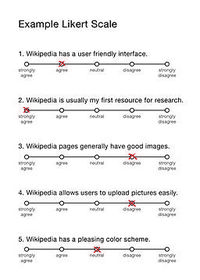
- Bildunterschrift: https://upload.wikimedia.org/wikipedia/commons/thumb/5/54/Likert_Scale.jpg/256px-Likert_Scale.jpg
-
- Respondents only choose answers you provide. If you use open questions, they can write their own answers, but these may be vague and hard to understand. They may also fail to explain their meaning clearly, or provide enough detail.
- The wording of questions and answers must be clear and easy to understand, with no ambiguity. Questionnaires must therefore be piloted before use – this writing and testing process requires care and writing skill.
- Finally, electronic questionnaires may receive a low number of responses.
-
- Cohen, L., Manion, L., and Morrison, K. (2000). Research Methods in Education. (5th Edition). Routledge.
- UCL. Public Engagement Evaluation Toolkit: Questionnaires. Available from: https://www.ucl.ac.uk/public-engagement/documents/evaluationtoolkits/evaluationmethods/Questionnaire Accessed 10.4.16
- Open University. Skills for OU Study: Using a questionnaire. Available from: http://www2.open.ac.uk/students/skillsforstudy/using-a-questionnaire.php Accessed 10.4.16
Informationen
- Beschreibung
- An introductory guide to using questionnaires for your project.
- Erstellt von
- Rachel Elmslie · Apr 2016
- Aktualisiert
- 11 Apr 2023
- Aufrufe
- 542
- Tags
- Bewertung