
Notizen
Social influence
Inhalt der Notizen (8)
Seite 1
Compliance
Conformity:
Compliance: Publicly, but not privately going along with majority influence to gain approval/avoid ridicule. Weak/temporary and only shown in presence of group.
Conformity: results from exposure to the majority position and leads to compliance with that position. It’s the tendency for people to adopt the behaviour, attitudes and values of other members of a reference group.
Internalisation: true conformity Public and private acceptance of majority influence, through adoption of the majority group’s belief system. Stronger, permanent form of conformity, as it is maintained outside of the group’s presence.
Identification: Public and private acceptance of majority influence in order to gain group acceptance. Stronger form of conformity, but still temporary- not maintained outside of the group.
Explanations to why we
conform:
Informational social influence: a form of
influence, which is the result of a desire to be right-looking to others as a
way of gaining evidence about reality.
ISI: Need for certainty. Subjective uncertainty.
Need for information. Refer to social group. Private beliefs are likely to
change along with public behaviour. Internalisation.
Normative social influence: individual conforms
with the expectations of the majority in order to gain approval or to avoid
social disapproval.
NSI: Need for acceptance or approval. Power of
social group to reward or punish. Conflict between self & group opinion/behaviour.
Public behaviour is likely to diverge from private beliefs. Compliance.
Jenness'
study:
First studies by Sherif: people use the behaviour
of others to decide what to do.
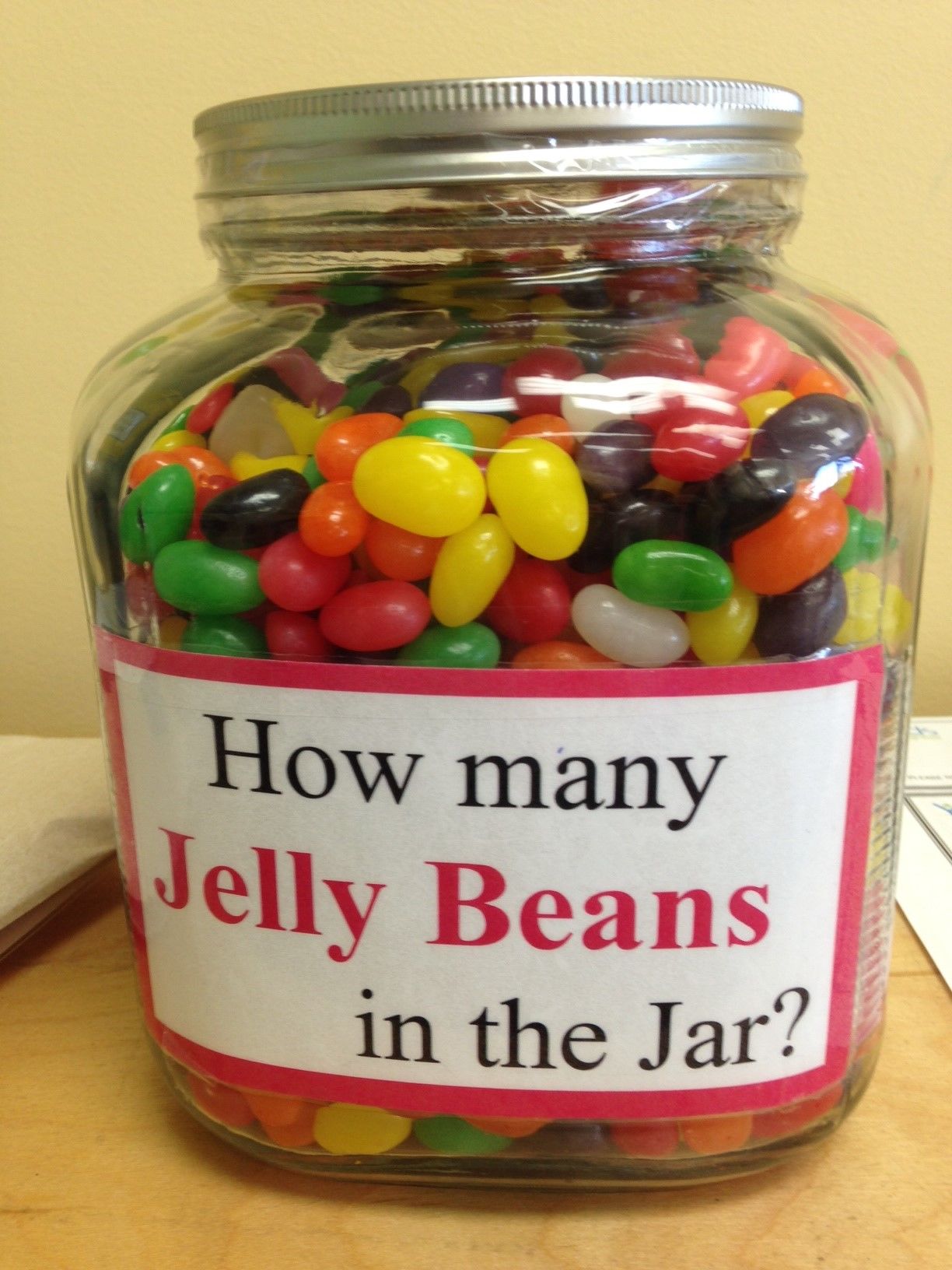
Procedure: He had a jar of jelly beans and asked
participants individually to estimate how many beans the bottle contained.
Jenness then put the group in a room with the bottle, and asked them to provide
a group estimate through discussion.
Pts were then asked to estimate the number on
their own again to find whether their initial estimates had altered based on
the influence of the majority. Jenness then interviewed the participants individually
again, and asked if they would like to change their original estimates, or stay
with the group's estimate. Almost all changed their individual guesses to be
closer to the group estimate.
Aschs study:
Aim: investigate the
effects of social influence on conformity, by seeing how a lone ‘real’ pt would
react to the behaviour of confederates.
Method: 123 American
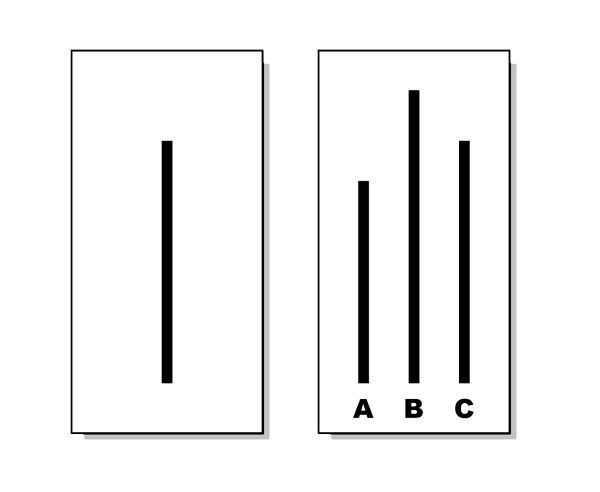
male student volunteers Study on visual perception Groups. 7-9 confederates,
real participant last or last but one. Comparison line A, B, C matched stimulus
line 12 out of 18 trials- confederates gave identical wrong answer. Control
group, 36 participants, tested individually on 20 trials.
Results: Control
group - 3 mistakes out of 720 trials 12 critical trials - 33% (1/3) conformed
to wrong answers ¼ never conformed ½ conformed on 6 or more of the trials 1 in
20 conformed on all 12 of the critical trials.
Conclusion:
Judgements affected by majority opinions, even when wrong. Wide individual
differences in the extent participants are affected due to variables such as
group size, the unanimity of the majority and the difficulty of the task.
Normative social influence – conformed publically not privately. Conformed to gain
acceptance and to avoid rejection.
Variables affecting
conformity: Group size. The unanimity of the majority and the difficulty of the
task.
- Evaluation:
Independent behaviour rather than conformity: 1/3 of the trials where the
majority unanimously gave the same wrong answer produced a conforming response.
2/3 of the trials pt's stuck to their original judgement despite the majority
giving a different answer.
- Evaluation: child of
his time: took place at a time in US history when conformity was high. In 1956
the US was gripped by McCarthyism, a strong anti communist period when people
were scared to go against the majority. Perrin and spencer studies students and
youths of probation. those in probation conformed whereas 1 in 396 conformed in
the students. Conformity is more likely if the perceived costs of not
conforming are high which would have been the case during the McCarthy era.
Seite 2
Conforming to social roles
Zimbardo
Aim: To investigate how readily people would conform
to the roles of guard and prisoner in a role-playing exercise that simulated
prison life.
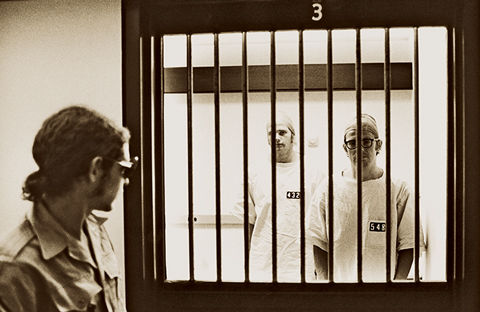
Procedure: A mock prison was set up. He
advertised for students to play the roles of prisoners and guards for a
fortnight. There were 24 male college students (chosen from 75 volunteers who
were tested to be the most physically and mentally stable) who were paid $15
per day to take part in the experiment. they were randomly assigned to play
prisoner or guard.
Prisoners were arrested at home. Given uniform
and an ID number. Prisoners were allowed 3 meals and 3 supervised toilet trips
a day with 2 visits a week. Guards were given uniform, clubs, whistles,
reflective sunglasses.
Zimbardo played the role of prison
superintendent. the study was planned to last 2 weeks.
Findings: stopped after 6 days. Guards became
increasingly cruel and aggressive and the prisoners became passive and accepting
of their role. 5 prisoners were released early due to crying, rage and random outbursts
of screaming.
- Evaluation: Ethics: It followed
the guidelinds of the Stanford University ethics committee that had approved
it. No deception, pt's were told their usual rights would be suspended. Although
it should have been suspended earlier due to emotional distress. He carried
debriefing sessions for several years after. There was no long lasting negative
effects.
+ Evaluation- real
life application: The SPE and its relevance to Abu Ghraib: Zimbado says the
same situation occurred in these cases. Abu Ghraib is a military prison in Iraq
known for torture in 2003/4. He believed the abuses were a result of
situational factors such as lack of training, boredom and no accountability of
higher authority present.
Seite 3
Minority influence:
Moscovici:
Aim: To investigate the effects of a consistent
minority on a majority. This study was a re-run of Asch’s experiment, but in
reverse. Instead of one subject amongst a majority of confederates, he placed 2
confederates together with 4 genuine pts. The pts were first given eye tests to
ensure they were not colour-blind.
Procedure: They were then placed in a group consisting
of 4 participants and 2 confederates. They were shown 36 slides which were
clearly different shades of blue and asked to state the colour of each slide
out loud. In the first part of the experiment the two confederates answered
green for each of the 36 slides. They were totally consistent in their responses.
In the second part of the experiment they answered green 24 times and blue 12
times. In this case they were inconsistent in their answers.
Results: In condition one it was found that the consistent
minority had an affect on the majority (8.42%) compared to an inconsistent
minority (only 1.25% said green). A third (32%) of all participants judged the
slide to be green at least once. A third (32%) of all participants judged the
slide to be green at least once.
Conclusion: Minorities can influence a majority,
but not all the time and only when they behave in certain ways.
Evaluation: It was a lab
study so lacks ecological value.
Evaluation: He used
female students as pts so it would be wrong to generalize his result to all
people- only tells us about the behaviour of female students. Females are said
to be more conformist than males, therefore there might be a gender difference
in the way that males and females respond to minority influence. Another critic
could be that 4 people aren't enough for a group and could not be considered as
the majority.
Seite 4
Social influence processes in social change
Social norms interventions: Attempt to correct
misperceptions of the normative behaviour of peers in an attempt to change the risky
behaviour of a target population.
Social norm interventions: posters and adverts
researchers hope that recipients will moderate their behaviour to bring it more
in line with the behaviour of their peers.
Evaluation: Social
change through minority influence may be very gradual: history challenges the
view that minorities such as the suffragettes can bring about social change
quickly. there is a strong tendency for humans to conform to the majority
position, groups are more likely to maintain the status quo rather than engage
in social change. So the minority influence creates potential for change rather
than actual social change.
Evaluation:
Limitations: social change by the minority is limited because they are seen as
'deviant' by the majority. Members of the majority may resist joining the
minority as they dont want to be seen as deviant themselves. There is little
impact on the majority as the focus is on the source of the message (deviant
minority) and not on the actual message. they face 2 challenges as they need to
avoid being portrayed as deviant and make people directly embrace their
position.
Social change through minority
influence:
1. Drawing attention to an issue: if their views are
different to those held by the majority, this creates conflict that they are
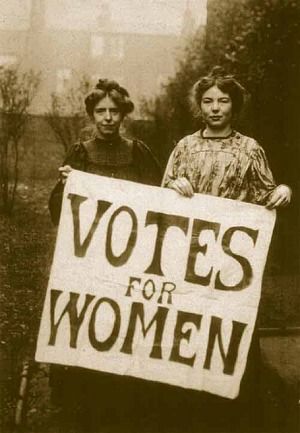
motivated to reduce. The suffragettes used educational, political and militant
tactics to draw attention that women didnt have the same rights as men.
2. Cognitive conflict: Conflict is made between the minority
and the majority. this doesnt cause change but it does allow the majority to
think more deeply about the the issues being challenged. E.g. suffragettes
existing status quo= men voting, position advocated= women voting. some will
move forward with the change others will dismiss it.
3. Consistency of position: arguments are more effective
if done over time and with each other. The suffragettes were consistent in
their views regardless of of the attitudes of those around them.
4. The augmentation principle: if a minority appears willing
to suffer for their views, they are seen as more committed and taken more
seriously. The suffragettes were willing to be put in prison, go on hunger
strikes and kill themselves so their influence became more powerful.
5. The snowball effect: Minority influence has a small
effect but as it spreads more widely and more people consider the issues it
reaches its tipping point at which point it leads to wide scale social change.
Seite 5
Obedience
Milgram:
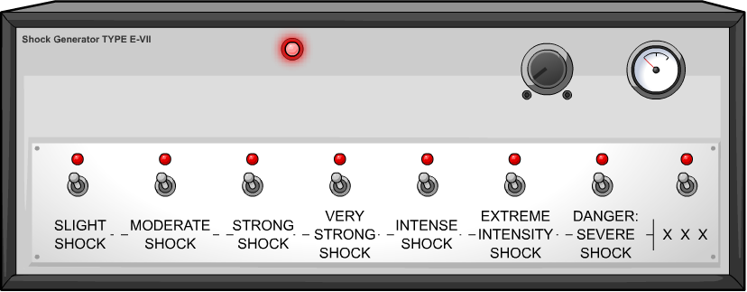
Procedure: Volunteers were recruited for a lab
experiment investigating “learning”. Pt's = 40 males, aged 20-50, whose jobs
ranged from unskilled to professional. They were paid $4.50 for turning up.
Pt's were introduced to another pt, (a confederate of the experimenter,
Milgram). They drew straws to determine the learner or teacher. It was fixed so
the confederate was always the learner. There was also an “experimenter”
dressed in a lab coat, played by an actor. Learner had to learn words, The
teacher is told to administer an electric shock every time the learner makes a
mistake. Learner purposely got them wrong to see how obedient pt's would be.
The procedure put the pts under extreme
pressure. Many pts showed signs of extreme distress such as sweating,
trembling, biting their lip, and digging their fingernails into their flesh.
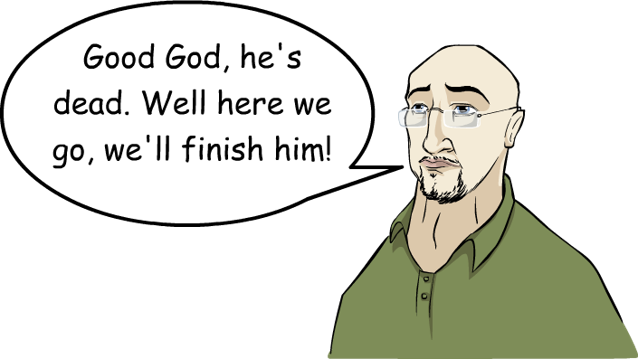
Some even protested and wanted to stop. One pt, before proceeding to give the learner
the full 450V, said:
Findings: Every pt in the experiment gave at least
300V shocks to the ‘learner’. 65% of pts went all the way to administering 450.
Standardised prompts: “please continue” or
“please go on” “the experiment requires that you continue” “it is absolutely
essential that you continue” “you have no other choice, you must go on”.
- Evaluation: Gender differences: women are considered to be more susceptible to social influence than men. Expected to find gender differences in obedience. 9 replications of milgrams study with male and female pt's 8/9 found no gender difference in obedience
- Evaluation: Ethical issue: he deceived pt's by telling them the study was a punishment on learning rather than knowing the true purpose. Although they had to right to leave the study at any time pt's found it difficult due to the prompts. Debriefing was given Obedient pts were reassured their behaviour was the norm and disobedient pts were reassured their behaviour was actually desirable.
Situational factors in obedience: Proximity, Location and
The power of uniform:
Location: Milgram repeated the study in a run
down office. Obedience levels dropped slightly, 48% of pt's went to 450V.
Uniform: experiment was a woman dressed in a 1.
police style 2. business executive or 3. beggar, stopped people in the street
and asked a male to give change for an expired parking meter. 1. 72% obeyed. 2.
48% and 3. 52%. when interviewed people said she appeared to have authority.
Proximity: teacher and learner were seated in
the same room. obedience levels feel by 40% as the teacher was able to
experience the learners anguish more. Teacher was then required to force
learners hand on the shock plate and obedience levels dropped a further 30%. If
the experimenter was out the room or orders were given over the phone then only
21% went to max. shock.
Seite 6
Authoritarian
personality:
F scale: measure authoritarian traits or tendencies.
Definition: A distinct personality pattern
characterised by strict adherence to conventional values and a belief in
absolute obedience or submission to authority.
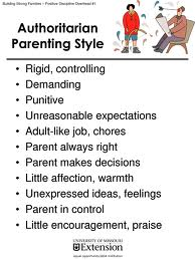
Authoritarian personality theory: person comes
from a strict authoritarian background. when they grow up they want to be the
authoritarian of those around them. so they subject people in an out-group (who
are seen as weaker) to their will.
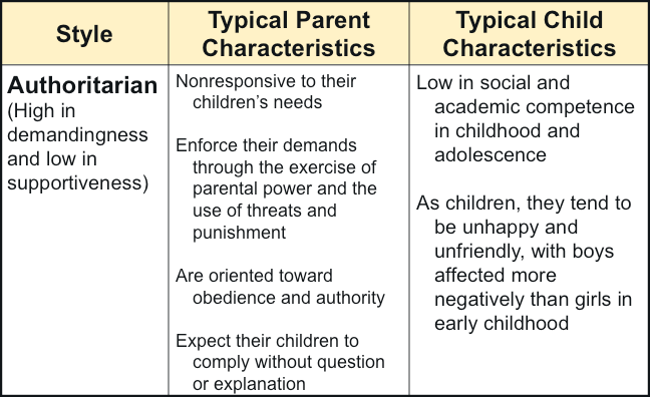
Typical child characteristics: Low is social and
academic competence in childhood and
adolescence. As children they tend to be unhappy
and unfriendly. Boys affected more negatively than girls in early childhood.
Typical parent characteristics: not responsive
to their childs needs. enforce their demands through the exercise of parental power
and the use of threats and punishments. Are orientated toward obedience and
authority. Expect their child to comply without question or explanation.
- Evaluation: P – The
explanation is that there are differences between authoritarian and obedient
participants. E – Elms & Milgram found that many of the fully obedient
participants reported having a good relationship with their parents, rather
than growing up in an overly strict family environment as the authoritarian
explanation suggests. E – Also, given the large numbers of obedient
participants in Milgram’s study it is highly unlikely that they all grew up in
a harsh, overly strict family. L – Therefore, this challenges the explanation
of authoritarianism as determining levels of obedience.
- Evaluation: P – A
weakness is that social context can be more important. E – Milgram’s findings
from his variation studies showed that the social context was most influential
in pts’ levels of obedience,e.g. location and proximity. E – This suggests that
social situations are more likely to determine whether a person obeys an
authority figure, rather than variations in personality. L – Therefore relying
solely on authoritarianism as an explanation of obedience does not fully
account for the reasons why people obey.
Elms and Milgram:
Aim – To investigate
whether pts with authoritarian personalities are more likely to obey an
authority figure.
Method – Follow up
questionnaires used with original pts in Milgram’s study.
Procedure– Selected
20 ‘obedient’ pts (gave 450 Volt shocks), and 20 ‘defiant’ pts (refused to
continue to 450 volts). Each completed questionnaires measuring personality
variables (MMPI scale & California F scale) and asked as series of open
ended questions about their attitude to their parents, the experimenter and the
learner in Milgram’s experiment.
Results – Little
difference found in personality variables on the MMPI scale, HOWEVER there were
higher levels of authoritarianism found in the obedient pts and they also
reported being less close with their fathers during childhood and saw Milgram
as more admirable than the learner, which was the opposite for the defiant pts.
Conclusion –
Therefore, this suggests that higher traits of authoritarianism can lead to
higher levels of obedience.
Seite 7
Agentic state and legitimate authority
Agentic state and legitimate authority:
Agentic state: a
person that sees him/herself as an agent for carrying out another person’s
wishes.
Legitimate
authority: a person who is perceived to be in a position of social control
within a situation.
Blinding factors: In
social situations theres a social etiquette that plays a part in regulating
behaviour. In order to break off an experiment the pt must breach the
commitment he made to the experimenter. He feels he will appear arrogant and
rude. These behaviours will appear along side violence being done to the
learner, helps bind the subject into obedience.
Self image & the
agentic state: one reason to maintain and agentic state is to maintain a
positive self image. A pt may assess the consequences of this action for their
own self image and refrain. But once the pt has moved into the agentic state
they dont evaluate as the action is no longer their responsibility, so doesn’t reflect
their self image. From the pts perspective their actions are guilt free however
inhumane they may be.
Seite 8
Resistance to social influence:
Locus of control:
locus of control:
people differ in their beliefs about whether the outcomes of their actions are
dependent on what they do (internal locus of control) or on events outside
their personal control (external) locus of control.
How does LOC affect
conformity/obedience: High internals are active seekers of info that is useful
to them, so rely less on the opinions of others. High internals are more achievement-
oriented and so more likely to become leaders. High internals are better able
to resist correction from others.
External locus of
control: External locus of control: They believe what happens to them is due to
external factors. They believe that things aren’t controllable and that luck
and fate are important factors.
Internal locus of
control: They believe that what happens to them is down to their own behaviour.
They hold the belief that one can control much of one’s life and succeed in
difficult of stressful situations, because they can control these events.
- Evaluation: To
challenge the link between locus of control and independent behaviour. 30 uni
students who were given a range of conformity tasks based on Asch’s
experimental work. Each student was also assessed using Rotter’s locus of
control scale. Those who conformed the most were significantly less assertive
but didn't score differently on the locus of control scale, implying that
assertion may be more important than locus of control to conformity.
+ Evaluation:
internals are more likely to become leaders than to follow others. Group
members possessing an internal locus of control were more likely to emerge as
leaders in their groups. The reason for this is that individuals who attribute
responsibility for their actions to themselves tend to assume they can cause
changes in their environment, including the behaviour of those around them.
+ Evaluation:
evidence to support the idea that locus of control is linked to independent
behaviour. A meta-analysis of studies, which considered locus of control and
conformity, was carried out and found that those who scored higher on external
locus of control were more easily persuaded and likely to conform than those
with a low score. The average correlation between the locus of control and
conformity was 0.37 which was statistically significant. This suggests that
there are genuinely higher rates of conformity in externals than internals.
Social support: The perception that an individual
has assistance available from other people, and that they are part of a supportive
network.
Social support &
resisting conformity: Asch found that social support enables an individual to
resist conformity. By breaking the unanimity of the majority, they raise the
possibility that there are other, equally legitimate ways of thinking or
responding. The presence of an ally provides the individual with an independent
assessment of reality that makes them feel more confident in their decision and
better able to stand up to the majority.
Social supporting
& resisting obedience: Its difficult to stand against authority because the
obedient behaviour of others makes it seem unacceptable. However disobedience
can change perception. People are generally more confident when disobeying and
authority if they have an ally. Disobedient peers act as role models on which
the individual can model their own behaviour.
+ Evaluation: Real
life application- 1943, German women protested in Berlin where the Gestapo were
holding 2000 Jewish men. The woman stood together and the men were set free. Disobedient
peers allows others to resist authority.
- Evaluation: Social
support may not be valid to be effective: If the support wasnt valid would it
be effective in allowing pt's to resit conforming. it was a vision test.
Condition 1: confederate providing support wore thick glasses so gave invalid
support. Condition 2. support had normal vision and was a valid support.
Results showed a valid support reduced conformity rates more, showing an ally
reduces conformity but more so if they are seen as a valid support.
Informationen
- Beschreibung
- AS - Level Psychology (NOTE VERSIONS AS) Notiz am Social influence , erstellt von briony findlay am 07/05/2016.
- Erstellt von
- briony findlay · Mai 2016
- Aktualisiert
- 24 Nov 2016
- Aufrufe
- 112
- Bewertung