
Notizen
GCSE Biology Module B6
Inhalt der Notizen (1)
Seite 1
module B6
The environment around you is constantly changing. A change in the environment of an organism is called a stimulus. Organisms need to respond to stimuli in order to survive. A single cell organism can just respond to its environment but the cells of multi-cellular organisms need to communicate with each other so the organism can respond to the stimuli.
Nervous system
The nervous system detects and reacts to stimuli & it is made up of different parts
Central nervous system
In vertebrates this consists of the brain and spinal cord only. In mammals the CNS is connected to the body by sensory neurons and motor neurons- these make up the peripheral nervous system
Sensory neurons
The neurons that carry impulses from the receptors to the CNS
Motor neurons
the neurons that carry impulses from the CNS to effectors
Effectors
All your muscles and glands, which respond to nervous impulses.
Receptors and effectors can form part of complex organisms
1) receptors are the cells that detect stimuli
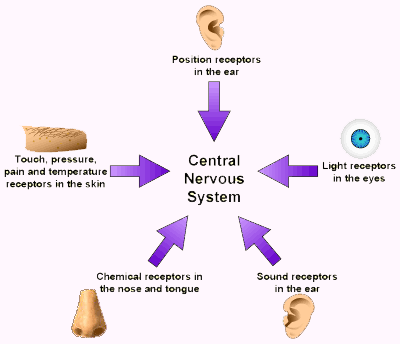
2) there are many different types of receptors such as taste receptors on the tongue and sound receptors in the ears
3) Receptors can form part of larger complex organs, e.g. the retina of the eye is made up of light receptor cells
4) Effectors respond to nervous impulses and bring about a change. Effectors cann also form part of complex organs
5) There are two types of effector. Muscle cells- which make up muscles. And hormone secreting cells, which are found in glands
The central nervous system coordinates the response
The CNS is a processing centre. It receives information from the receptors and then coordinates a response
module B6
Neurones
Information is transmitted around the body by neurones
When stimulated, neurones transmit information around the body as electrical impulses
1) The electrical impulses pass along the axon of the nerve cells
2) Axons are made from the nerve cell's cytoplasm stretched out into a long fibre and surrounded by a cell membrane
3) Some axons are also surrounded by a fatty sheath that acts as an electrical insulator shielding the neurone from neighbouring cells & speeding up the electrical impulse
Electrical impulses carry information around the body really quickly so the responses they cause happen fast, but they are short lived.
Hormones are also used to carry information around the body- they're produced in the glands and travel around in the blood. The responses they cause are brought about more slowly and they are longer lasting that the responses caused by nerve impulses.
Synapses
The
The gap between two neurones is called a synapse
There are billions of neurones in the body, which connect up to form pathways. Neurones aren't attached to each other though- there is a tiny gap between them called the synapse. Information in one neuron needs to be transmitted across the synapse to the next neurone. This is done using transmitter chemicals.
1
1) When an electrical impulse reaches the end of a neuron it triggers the release of transmitter chemicals into the synapse
2) The transmitter chemicals diffuse across the gap and bind to receptor molecules on the membrane of the next neuron.
3) Only specific transmitter chemicals can bind to the receptor molecules on the neuron
4) When the chemicals bind to the right receptors they trigger a new electrical impulse in the next neurone
Some drugs affect transmission across the synapse
Many drugs like ecstasy, beta blockers and PROZAC and toxins can interfere with the transmission of impulses across a synapse.
1) One way in which the drug ecstasy works is to block sites in the brain's synapses where the transmitter chemical serotonin is re-uptaken.
2) Serotonin is thought to affect things like pain, aggression and appetite. It is thought to play a large role in determining a person's mood
3) Because the serotonin cannot be removed the concentration increases which affects a person's mood.
4) Ecstasy is often described as having mood enhancing effects because of the increased concentrations of serotonin it causes.
module B6
Reflexes
Reflexes are involuntary responses
1) Reflexes are rapid, automatic responses to certain stimuli.
2) Reflexes are quick because you do not think about them, they are involuntary
3) The route taken by the information in a reflex is called a reflex arc
The reflex arc goes through the central nervous system
1) The neurons in reflex arcs go through the spinal cord or through an unconscious part of the brain.
2) When a stimulus is detected by receptors an impulse is sent along a sensory neuron to the CNS.
3) In the CNS the sensory neuron passes on the message to another type of neuron, a relay neuron
4) A relay neuron passes the impulse to a motor neuron.
5) The impulse then travels along the motor neuron to the effector
6) The muscle then contracts and moves your hand etc.
7) An impulse always takes the same, direct route through the reflex arc, so no information is ever processed. This is why they are involuntary and rapid.
Simple Reflexes
Simple animals such as jellyfish have no brain and they rely entirely on simple reflex actions
Sea anemones wave their tentacles more when stimulated by chemicals emitted by their prey so they can catch them for food.
Molluscs close their shells when they detect a predator- decreasing chances of being eaten.
Humans also have simple reflexes that may protect them from damage
1) Very bright light can damage the eye- so there is a reflex to protect it. In very bright light the muscles in the eye contact making the pupil smaller allowing less light into the eye.
2) If a person picks up a hot object there is reflex that makes them drop it.
3) New born babies will automatically suckle from their mothers, grasp when their palms are touched and try to step when their feet touch a flat surface.
4) Tapping under the knee makes the knee jerk.
Reflex responses can be modified & learnt
Examples:
1) When you pick up a hot plate you want to drop the plate to protect your skin.
2) Dropping the plate might not be a good idea so reflexes can be modified
3) The response can be over ridden by a neuron between the brain and the motor neuron of the reflex arc - the result is a small bit of pain but the plate does not get dropped.
Reflex responses can be learnt
A stimulus causes a particular reflex response but animals can learn to produce the same response to a new secondary stimulus. This is called conditioning- the new reflex is called a conditioned reflex.
Pavlov's dogs
1) Pavlov studied the behaviour of dogs & noticed that they would salivate when they smelt food.
2) Simple reflex response to a primary stimulus
3) He experimented by ringing a bell just before the dogs got their food
4) After a while he found that the dogs salivated when the bell was rung even if they didnt smell food
5) The dogs responded to a secondary stimulus. This is a conditioned reflex. In a conditioned reflex the final response has no direct connection to the secondary stimulus.
Conditioned reflexes can increase chances of survival
1) Some insects are brightly coloured so that they stand out
2) Insects with bright colouring are often poisonous - their bright colours act as a warning to predators that they will probably be harmful
3) The predators develop a conditioned reflex to the secondary stimulus
4) By learning to avoid poisonous insects the birds are increasing their own chances of survival
module B6
The Brain
T
The brain is complex
The brain is basically a big bunch of neurons all inter connected- it contains billions of the things.
This means that it can modify behaviour as a result of experience and coordinate complicated behaviour.
The environment can affect brain development & learning
The brain develops at an early age
The brain of a new born baby is only partly developed. Most of the neuron connections are not yet formed. It becomes more developed with new experience.
Connections form as the child experiences new things- when a neuron is stimulated by experience it branches out connecting cells that were previously unconnected.
By the age of 3 most of the connections that will ever form have been formed making a huge network of neurons with trillions of possible routes for nerve impulses to travel down. The number of connections remains constant until about the age of 10.
Your
You learn throughout your life
1) When experiences are repeated over and over the pathways that the nerve impulses travel down become strengthened
2) Strengthened pathways are more likely to transmit impulses than others.
3) This is why playing the piano is easier if you practice a lot
4) After the age of ten, the pathways that are not used as often will die off- thats why it is harder for older people to learn new things like a foreign language or how to use a computer. But they still are able to learn.
Learning skills & behaviour
Being able to learn means you can adapt to new situations
1) complex animals are incredibly adaptable- they are able to cope with whatever the environment gives them
2) They are adaptable because of the variety of potential pathways
3) Simpler animals have less flexible nervous systems they don't have anything like as many pathways making their behaviour more predictable and much less adaptable.
Some skills only develop at certain ages
1) the ability to communicate by language depends on a child hearing other people speak
2) It is the thought that they must hear this during a certain critical period. If children have not learnt to talk by the age of ten its likely they wont ever be able to
3) Evidence to back this up comes from studies of feral children.
The cerebral cortex is an important part of the brain
1) the cerebral cortex is the outer part of the brain
2) it has a folded structure
3) the cerebral cortex plays a pretty big role in things like intelligence, memory, language and conciousness
Studying the brain
Scientists use a range of methods to study the brain
1) Studying patients with brain damage
If a small part of the brain has been damaged the effect this has on the patient can tell you a lot about what the damaged part of the brain does
2) Electrically stimulating the brain
The brain can be stimulated electrically by pushing a tiny electrode into the tissue and giving it a small zap of electricity. By observing what stimulating different parts of the brain does it's possible to get an idea of what those parts do
3) MRI Scans
A magnetic resonance imaging MRI scanner is a big fancy tube like machine that can produce a very detailed picture of the brain's structures. Scientists use it to find out what area of the brain is active when people are doing thinks like listening to music or trying to recall a memory.
module B6
Memory
Memory
Memory is the storage and retrieval of information
There are two main types of memory- short and long term
1) Short term memory lasts for anything from a few seconds to a few hours. It's used for information that you're thinking about at the moment
2) long term memory are memories that were stored days, months or even years ago.
Humans are likely to remember things when they can see a pattern in the information. You are more likely to remember things if the information is associated with strong stimuli like bright lights, strong smells or noises. It also helps if this information is repeated, especially if it is over a long time.
memory models try to explain how memory works
1) The problem with memory is that nobody knows for sure how it works
2) There are loads of different models that try to explain it
3) for example, some scientists believe the multi-store model offers a good explanation.
Multi-store model
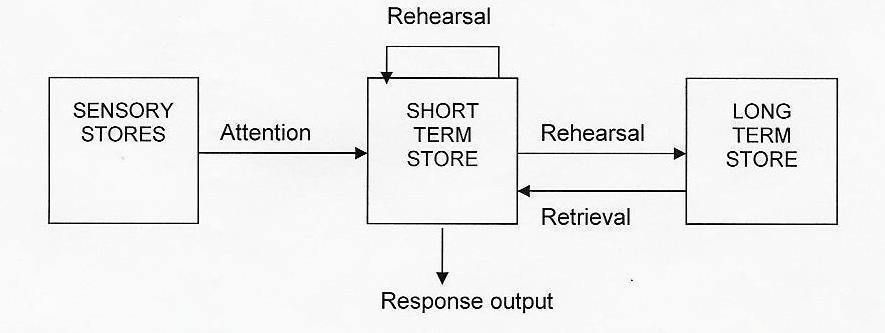
- information that you have paid attention to is temporarily stored in short term memory. If it is repeated enough it is transferred to long term memory and stored there.
- memories that are never transferred from the short term memory to the long term memory are forgotten but the information can be retrieved from the long term memory and remembered.
nervous system
neurons & Synapses
reflexes
brain development and learning
memory
Informationen
- Beschreibung
- Notiz am GCSE Biology Module B6, erstellt von jessmitchell am 27/05/2014.
- Erstellt von
- jessmitchell · Mai 2014
- Aktualisiert
- 6 Apr 2018
- Aufrufe
- 995
- Tags
- Bewertung
Mehr zu Stimuli, Receptors and Responses