
Quiz
Building a Human
Dieses Quiz enthält Fragetypen, die sich im gewohnten Player öffnen.
Fragen in diesem Quiz (33)
1The first cleavage of a zygote occurs immediately after [blank_start]fertilisation[blank_end]. Before the zygote is implanted into the uterine wall at day 7-10, it undergoes a series of subdivisions without [blank_start]growth[blank_end]. The cleavage generates a [blank_start]blastocyst[blank_end] - a hollow ball of cells consisiting of an outer layer of cells known as the [blank_start]trophoblast[blank_end]. This outer layer will interact with the [blank_start]uterine[blank_end] wall. Inside the [blank_start]blastocyst[blank_end] is the [blank_start]inner cell mass[blank_end] which will develop into the embryo.
- Afertilisation
- Bgrowth
- Cblastocyst
- Dtrophoblast
- Euterine
- Fblastocyst
- Ginner cell mass
2After implantation, the cells of the inner cell mass in the zygote rearrange to form what?
- ABlastodisc
- BEpiblast
- CHypoblast
- DTrophoblast
3In what structure of the embryo does the primitive streak develop?
- ATrophoblast
- BEpiblast
- CHypoblast
- DMesoderm
4What is gastrulation?
- AThe organisation of the cells to generate the body plan by differentiation into the primary germ layers
- BThe folding of the neural plate to form the neural tube
- CThe process by which the embryo implants into the uterine wall
- DThe pre-implantation divisions of the zygote
5Fill in the blanks below to describe the process of gastrulation.
1. The primitive streak develops in the [blank_start]epiblast[blank_end].
2. The end of the primitive streak expands to form the [blank_start]primitive node[blank_end].
3. Cells of the epiblast migrate inwards towards the streak, detach from their layer and migrate [blank_start]beneath[blank_end] it.
4. The first cells of the epiblast to migrate invade the [blank_start]hypoblast[blank_end] layer, displacing its cells.
5. Eventually, the hypoblast cells will be entirely replaced by a new layer. This layer is the definitive [blank_start]endoderm[blank_end].
6. Some of the invaginated epiblast cells remain in the space between the layers. This layer is the [blank_start]mesoderm[blank_end].
7. The remaining cells of the epiblast form the definitive [blank_start]ectoderm[blank_end].- Aepiblast
- Bprimitive node
- Cbeneath
- Dhypoblast
- Eendoderm
- Fmesoderm
- Gectoderm
6The epiblast cells no longer migrate after the definitive germ layers have formed.
- ARichtig
- BFalsch
7What is secondary neurulation?
- AThe formation of a tube by the hollowing out of a solid precursor's interior
- BThe formation of a tube by the infolding of its wall
- CThe formation of a tube by the joining of two hollow structures
- DThe formation of a tube by the layering of rings of cells
8What name is given to the formation of the neural tube in the embryo?
- ANeurulation
- BNeurogenesis
- CGastrulation
- DInvagination
9Using the image, fill in the blanks to describe each stage of neurulation.
1. Neuroectodermal cells differentiate to form the [blank_start]neural plate[blank_end] with a border to separate it from regular ectoderm.
2. The neural plate folds upwards with its apex extending [blank_start]dorsally[blank_end]. The two edges join at the [blank_start]neural plate borders[blank_end], forming the [blank_start]neural crest[blank_end].
3. The closure of the tube disconnects the neural crest from the wall. The cells of the neural crest then differentiate to form the [blank_start]peripheral nervous system[blank_end].
4. The [blank_start]notochord[blank_end] degenerates and other mesoderm cells differentiate into the [blank_start]somites[blank_end].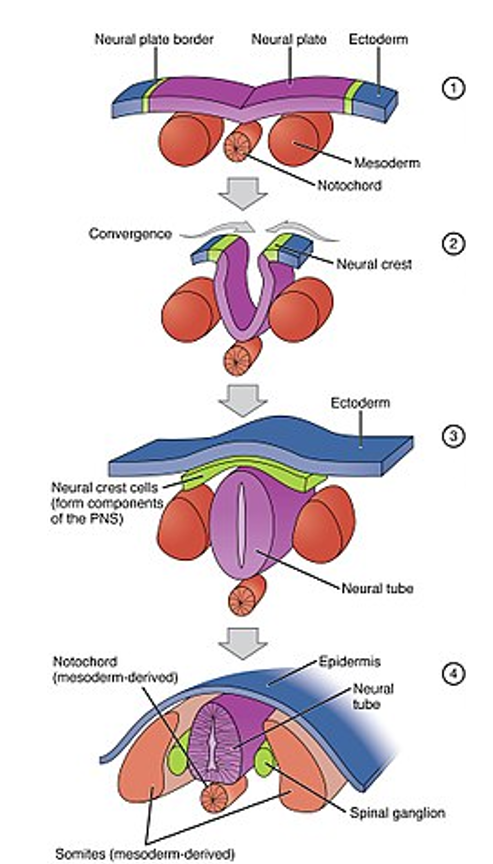
- Aneural plate
- Bdorsally
- Cneural plate borders
- Dneural crest
- Eperipheral nervous system
- Fnotochord
- Gsomites
10What happens to the notochord following the formation of the neural tube?
- ADegenerates completely
- BForms the spinal cord
- CForms the nucleus pulposus of the intervertebral discs
- DForms the peripheral nervous system
11What will result from an absence of joining of the neural folds at the cranial end of the neural plate?
- AAnencephaly - open brain, lack of skull
- BCraniorachischisis - completely open brain and spinal cord
- CSpina bifida - exposure of the spinal cord
- DCyclopia - lack of division of the orbits of the eye into two cavities
12Label this image showing the organisation of the embryo following neurulation.
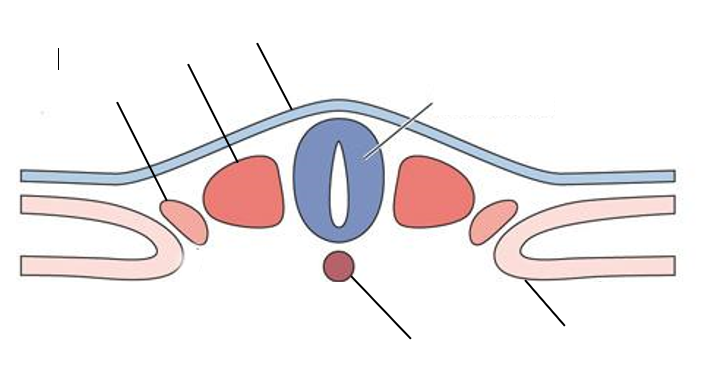
- AEpidermis
- BParaxial mesoderm
- CIntermediate mesoderm
- DNeural tube
- ENotochord
- FLateral plate mesoderm
13Fill in the blanks to describe what each of the primitive tissues will develop into.
The [blank_start]lateral plate[blank_end] mesoderm will form the splanchnic and somatic nerves.
The [blank_start]intermediate[blank_end] mesoderm will form the kidneys and the gonads.
The [blank_start]paraxial[blank_end] mesoderm will form the head and the somites.- Alateral plate
- Bintermediate
- Cparaxial
14Why do the neural crest cells only occur in the anterior half of the vertebral column?
- AThe posterior halves of the somites express inhibitory molecules
- BThe anterior halves of the somites express attracting molecules
- CThe posterior half of the vertebral column is already a solid structure - no other cells can migrate there
15Fill in the blanks to describe the process of neural crest migration.
The first wave of migration forms the [blank_start]autonomic[blank_end] ganglia. The parasympathetic ganglia migrate to the walls of the [blank_start]organs[blank_end]. The sympathetic ganglia migrate in front of the [blank_start]aorta[blank_end].
The second wave of migration forms the [blank_start]posterior root[blank_end] ganglia either side of the spinal cord. It also forms the [blank_start]Schwann[blank_end] cells and satellite cells.
The final wave of migration forms the [blank_start]melanocytes[blank_end] throughout the epidermis. These give pigmentation to the hair, skin, iris etc.
The neural crest cells at the cranial end form the [blank_start]sensory ganglia[blank_end] of the cranial nerves. They also migrate to form the [blank_start]mesenchyme[blank_end] of the face and neck.- Aautonomic
- Borgans
- Caorta
- Dposterior root
- ESchwann
- Fmelanocytes
- Gsensory ganglia
- Hmesenchyme
16Label this image to describe the body axes of the developing embryo.
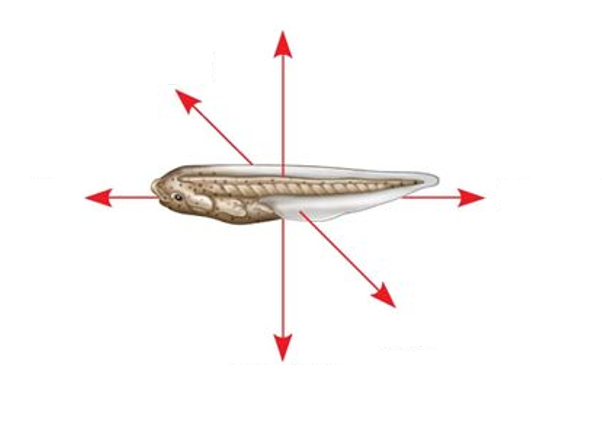
- AAnterior
- BPosterior
- CDorsal
- DVentral
- ERight
- FLeft
17How does a cell in a particular position in the developing embryo 'know' what tissue it will differentiate into?
- AIt responds to a particular type of morphogen
- BIt responds to a particular concentration of morphogen
- CIt responds to a particular pH
- DIt responds to different concentrations of oxygen
18The notochord directs the development of the ventral spinal cord.
- ARichtig
- BFalsch
19The Sonic Hedgehog gene and subsequent protein mediates the development of what?
- AVentral spinal cord
- BDorsal spinal cord
- CLimbs
- DEyes
20What embryonic structure secretes the SHH protein?
- ANeural tube
- BNotochord
- CSomites
- DEpidermis
21Somites do not respond to the SHH protein.
- ARichtig
- BFalsch
22A mutation in the [blank_start]SHH[blank_end] gene can result in holoprosencephaly. This results in a lack of development of the two hemispheres of the [blank_start]forebrain[blank_end]. It often presents with microcephaly and/or a cleft palate/lip. [blank_start]Cyclopia[blank_end] is the most extreme form of this condition whereby the orbits of the eye do not divide into two cavities, leaving a single central eye.
- ASHH
- Bforebrain
- CCyclopia
23These diagrams show the blastocysts at different stages of their development. Label them.
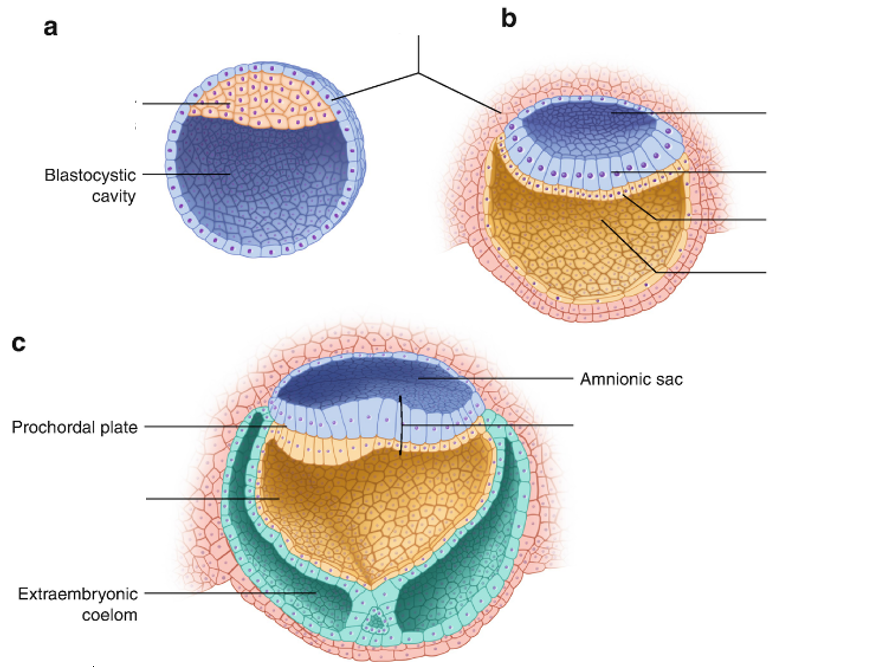
- AInner cell mass
- BTrophoblast
- CAmnioic cavity
- DEpiblast
- EHypoblast
- FYolk sac
- GBlastodisc
- HYolk sac
24Failure of the neural tube to close at a particular point along the spine results in what birth defect?
- ASpina bifida
- BCraniorachischisis
- CCyclopia
- DAnencephaly
25Failure of the neural tube to close at any point results in what birth defect?
- ACraniorachischisis
- BAnencephaly
- CSpina bifida
- DCyclopia
26The paraxial mesoderm forms the head and the somites.
The somites will then differentiate into...
The [blank_start]sclerotome[blank_end] - this will form the vertebrae and the rib cartilage.
The [blank_start]myotome[blank_end] - this will form the muscles.
The [blank_start]dermatome[blank_end] - this will form the skin and connective tissue.- Asclerotome
- Bmyotome
- Cdermatome
27What will cells in the dorsal portion of the neural tube develop into?
- ASensory neurons
- BMotor neurons
28What will cells in the ventral portion of the neural tube differentiate into?
- ASensory neurons
- BMotor neurons
29The different regions of the anterior neural tube receive different morphogens in different concentrations to determine what tissues they differentiate into based on location.
- ARichtig
- BFalsch
30What will you see if you remove the notochord during development?
- ANo motor neurons in the ventral spinal cord
- BNo sensory neurons in the dorsal spinal cord
- CA single set of motor neurons in the ventral spinal cord
- DTwo sets of motor neurons in the ventral spinal cord
31What will you see if you transplant an additional notochord during development?
- ATwo sets of motor neurons in the ventral spinal cord
- BA single net of motor neurons in the ventral spinal cord
- CNo motor neurons in the ventral spinal cord
- DNo sensory neurons in the dorsal spinal cord
32In what direction do somites develop?
- APosteriorly
- BAnteriorly
- CSuperiorly
- DInferiorly
- ELaterally
- FMedially
33The somites organise the peripheral nerves.
- ARichtig
- BFalsch
Informationen
- Beschreibung
- University Functional Anatomy and Embryology Quiz am Building a Human, erstellt von Charlotte Jakes am 16/12/2019.
- Autor
- Charlotte Jakes
- Sprache
- English
- Aufrufe
- 19
- Schlagwörter
- Bewertung
- Noch keine Bewertungen Bewerte dieses Quiz