
Quiz
Multi-Store Model of Memory
Dieses Quiz enthält Fragetypen, die sich im gewohnten Player öffnen.
Fragen in diesem Quiz (10)
1Who created the multi-store model of memory?
- AAtkinson and Shiffrin
- BBaddeley and Hitch
- CLoftus and Palmer
2The MSM is a structural model
- ARichtig
- BFalsch
3Label the components of the MSM
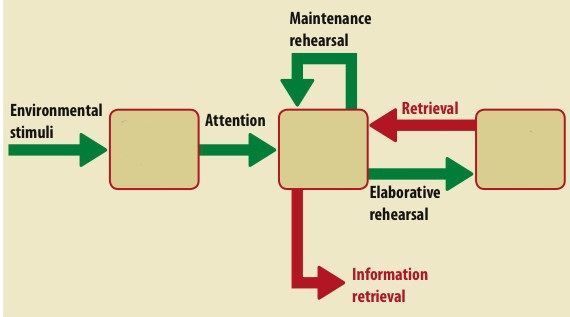
- ASensory Register
- BShort Term Memory
- CLong Term memory
4Sensory Register
• Duration: [blank_start]few milliseconds[blank_end]
• Capacity: [blank_start]very large[blank_end]
• Encoding: [blank_start]either echoic or iconic[blank_end]- Afew milliseconds
- Bup to 30 seconds
- Ca lifetime
- Dvery large
- Ea few items
- Funlimited
- Geither echoic or iconic
- Hacoustic
- Isemantic
5Sensory memory is the information you get from the [blank_start]environment[blank_end] through your [blank_start]senses[blank_end]. Information is then passed to the [blank_start]short term memory[blank_end] through the process of [blank_start]attention[blank_end]. Any information that isnt payed attention to is [blank_start]lost to decay[blank_end].
- Aenvironment
- Bsenses
- Cshort term memory
- Dattention
- Elost to decay
- Fbrain
- Ginstincts
- Hlong term memory
- Irehearsal
- Jforgotten
6Short Term Memory:
• Duration: [blank_start]up to 30 seconds[blank_end]
• Capacity: [blank_start]7 +/- 2 items[blank_end]
• Encoding: [blank_start]mainly acoustic[blank_end]- Aup to 30 seconds (without rehearsal)
- Ba few seconds
- Cforever
- D7 +/- 2 items
- Eup to 10 items
- Fmillers magic number 9
- Gmainly acoustic
- Hechoic
- Isemantic
7Peterson and Peterson- investigated the [blank_start]duration[blank_end] of [blank_start]short-term memory[blank_end], using a [blank_start]lab experiment[blank_end] in which participants had to recall [blank_start]consonant trigrams[blank_end] e.g. TGH. To prevent rehearsal participants were given an [blank_start]interference task[blank_end] e.g. counting backwards in threes from a specified random number . Participants were asked to recall trigrams after intervals of [blank_start]3, 6, 9, 12, 15 or 18[blank_end] seconds.
They found the longer the interval delay the [blank_start]less trigrams[blank_end] were recalled. Participants were able to recall [blank_start]80%[blank_end] of trigrams after a 3 seconds delay. However, after 18 seconds [blank_start]less than 10%[blank_end] of trigrams were recalled correctly. this supports that the short-term memory has a limited duration when rehearsal is prevented.- Aduration
- Bcapacity
- Cencoding
- Dshort-term memory
- Elong-term memory
- Fsensory register
- Glab experiment
- Hfield experiment
- Iquasi experiment
- Jconsonant trigrams
- Krandom letters
- Lgroups of three
- Minterference task
- Ndistraction
- O3, 6, 9, 12, 15 or 18
- P2, 4, 8, 10, 12 or 14
- Q4, 8, 12, 16, 20 or 24
- Rless trigrams
- Smore trigrams
- T80%
- U20%
- V47%
- Wless than 10%
- X94%
- Y30%
8Miller suggested that most people store about [blank_start]seven[blank_end] items in their [blank_start]short term memory[blank_end] e.g. numbers, letters or words he argued that the [blank_start]capacity[blank_end] of the short term memory could be enlarged by grouping items together into meaningful 'chunks' and called this process '[blank_start]chunking[blank_end]'. Miller therefore suggested that about [blank_start]7+/- 2 items[blank_end] can be stored in the STM depending on chunking>
- Aseven
- Bsix
- Cfive
- Dshort term memory
- Elong term memory
- Fcapacity
- Gduration
- Hencoding
- Ichunking
- Jgrouping
- Kpairing
- L7+/- 2 items
- M7 +/- 4 items
- N6 +/- 2 items
9Suggested that encoding in the STM is [blank_start]acoustic[blank_end]. As he found ppt's recalled [blank_start]less[blank_end] when the letters they had to recall were [blank_start]acoustically similar[blank_end] than if they were [blank_start]acoustically dissimilar[blank_end].
- Aacoustic
- Bsemantic
- Cless
- Dmore
- Eacoustically similar
- Fsemantically similar
- Gacoustically dissimilar
- Hsemantically dissimilar
- Ithe same
10Long Term Memory:
• Duration: [blank_start]Unlimited[blank_end]
• Capacity: [blank_start]Unlimited[blank_end]
• Encoding: [blank_start]Mainly semantic[blank_end]- AUnlimited
- Bup to an hour without rehearsal
- C24 hours
- DUnlimited
- E1000 memories
- Fas much as we have room for
- GSemantic
- Hacoustic
- Iiconic
Informationen
- Beschreibung
- A level Psychology (memory) Quiz am Multi-Store Model of Memory, erstellt von chloe 67 am 06/04/2017.
- Autor
- chloe 67
- Sprache
- English
- Aufrufe
- 173
- Schlagwörter
- Bewertung
- Noch keine Bewertungen Bewerte dieses Quiz