L 28.2 Mechanisms of Homeostasis
Folien in diesem Satz (12)
-
L 28.2 Mechanisms of Homeostasis
- * Learning Objectives:
- • Relate homeostasis to the internal
- environment of the body.
- • Explain how negative and positive
- feedback maintain homeostasis.
-
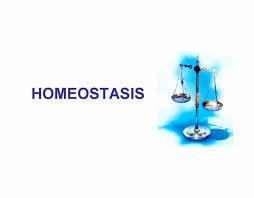
Homeostasis is the regulation and maintenance of the internal environment.
- •Homeostasis involves keeping the internal
- environment within set ranges.
- Homeostasis is the regulation and
- maintenance of the internal environment—temperature, fluids, salts, pH,
- nutrients, and gases—within the narrow ranges that support human life. Your
- internal control systems respond quickly to change, whether from outside
- conditions or internal ones.
-
- https://www.youtube.com/watch?v=XZxuQo3ylII (Einbetten)
- Bildunterschrift: Watch the video, take notes to explain how homeostasis help maintain your internal environment stable
-
Control systems help maintain homeostasis like
- A.. Sensors =
- gather data
- senses
- B. Control
- Center=
- receives data, interprets info, sends messages out.
- Brain receives information from
- the sensors. It then compares this
- information to the set points, or ideal
- values, at which the body functions
- best. When conditions move above or
- below a set point, the control center
- responds by sending messages
- through a communication system.
- C.
- Communication System=
- delivers messages to target organs, tissues
- PNS (e.g. motor neurons)
- D. Targets =
- respond to change.
- muscles, glands (release hormones)
-
- Sensors, control centers, communication systems, and targets work together
- in
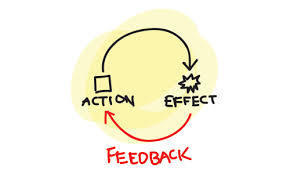
- what is known as a feedback loop. Feedback is information from sensors
- that
- allows a control center to compare current conditions to a set of ideal
- values.
- In a feedback loop, information moves continuously among sensors, a
- control
- center, and a target. Most functions in the body are regulated by
- negative
- feedback loops.
-
- *
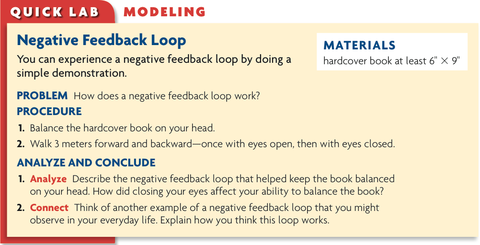
- Negative
- feedback loops are necessary for homeostasis.
- •Feedback compares current conditions to
- the body’s comfort levels (=Set Ranges).
- •Negative feedback counteracts change and brings the body
- back to homeostasis.
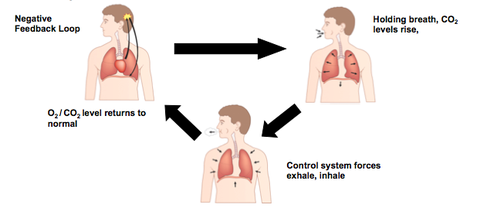
- * Example
- As you hold your
- breath, sensors in the circulatory and respiratory systems send information to
- the brain stem, the body’s respiratory control center. Sensors signal a gradual
- increase in carbon dioxide (CO2) and a decrease in oxygen (O2). The control
- center compares this information with the set points for these gases. When the
- change becomes too great, the control center takes steps to counteract it.
- Messages are sent to the muscles of the diaphragm and the rib cage to relax
- and then contract, forcing you to exhale and then inhale deeply.
-
- * There are many examples of how negative feed back loops help maintain homeostasis:
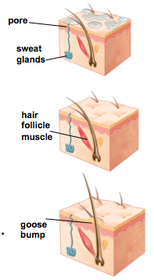
- 1) Thermoregulation
- 2) Regulation of blood glucose levels
- 3) Water levels in the body
- Task-1
- Watch the videos, use the internet
- to describe how your body uses
- negative feedback loop to maintain
- homeostasis. {Groups} 15 min.
- Note: rest of the videos are in the following slides
- https://www.youtube.com/watch?v=YQMgV9pkwwA (Einbetten)
-
- In positive feedback,
- a control center uses information from sensors to
- increase the rate of change
- away from the set points. Though not as common
- in the body, this type of
- feedback is important whenever rapid change is
- needed.
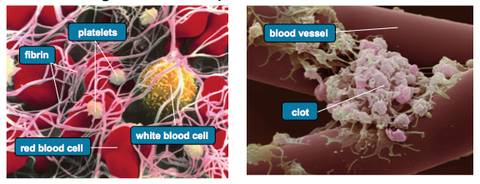
- For example, if you cut your finger, positive feedback mechanisms increase
- the rate of change in clotting factors in the blood until the wound is sealed.
- Once the injury heals, another positive feedback loop occurs as chemicals are
- released to dissolve the clot. Positive feedback also occurs in the release of
- certain growth hormones during puberty. Your body needs higher levels of
- these hormones to accomplish all of the changes that take place at this time.
-
A disruption of homeostasis can be harmful.
- •Homeostasis can be disrupted for several
- reasons.
- 1. sensors fail (don’t detect changes)
- 2. targets do not receive messages (nerve
- issues)
- 3. injury (overwhelm homeostatic controls)
- 4. illness (viruses or bacteria)
- *Disruption of homeostasis can begin in
- one organ and cause a chain reaction in the others therefore causing a major
- body disturbance.
-
Complete the questions in the worksheet and upload to Showbie.
- Use the provided resources to recap the main concepts covered today.
- Homeostasis
-