
Karteikarten
CHAPT 4: THE ROLE OF LEARNING AND ADAPTATION
Karten in diesem Stapel (72)
- 1HabituationDecrease in response strength to a repeated stimulus
- 2Decreased sensory response to a repeated stimulusSensory adaptation
- 3Increase in the strength of the response to a repeated stimulusSensitization
- 4Classical conditioningprocedure in which a formerly neutral stimulus (the conditioned stimulus) comes to elicit a conditioned response by virtue of being paired with an unconditioned stimulus that naturally elicits a similar response (the unconditioned response)
- 5He noticed that with repeated testing, the dogs began to salivate before the food was presented, such as when they heard the footsteps of the approaching experimenter.Pavlov
- 6AcquisitionPeriod when the response is being learned
- 7Neutral stimuliDoes not trigger a response
- 8Unconditioned StimulusStimulus that produces response innately, without it being learned.
- 9Conditioned stimulusNeurtal stimulus that evokes a conditioned stimulus Learned after being associated with an unconditioned stimulus
- 10Conditioned responseAchieved after pairing a conditioned and unconditioned stimuli that produce similar responses.
- 11UCSUnconditioned Stimulus
- 12CSConditioned Stimulus
- 13UCRUnconditioned response
- 14CRConditioned response
- 15Stimulus that innately has a responseUnconditioned stimulus
- 16A stimulus that gains value through learningConditioned stimulus
- 17Reflexive unlearned response to innately important stimulusUnconditioned response
- 18Conditioned responseResponse from a stimulus whose importance results from past learning
- 19Ex: foodUCS
- 20Ex: Sight of Favourite restaurantCS
- 21Salvation in response to foodUCR
- 22Feeling hungry when you see your favourite restaurantCR
- 23ExtinctionAbsence of past reinforcement producing a response; weakened response that eventually stops
- 24Spontaneous recoveryReappearance of previously extinguished conditioned response after extinction and a time interval
- 25a CR occurs to stimuli other than the original CS, based on the similarity of these stimuli to the CSStimulus generalization
- 26occurrence of a CR to one stimulus but not to another stimulusDiscrimination
- 27POSITIVE, NEGATIVE...E.TCSTUDY!!!
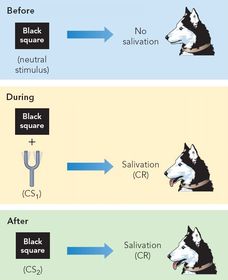
- 28in classical conditioning, when a neutral stimulus becomes a CS after it is paired with another CS (rather than with the original UCS)hIGHER-ORDER CONDITIONING
- 29What does this process represent?Before, during, and after high-order conditioning !
- 30—A: environmental
B: biological
C: Psychological
D: Levels of analysis of learning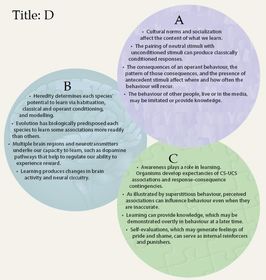
- 31Therapeutic techniques designed to extinguish anxiety responses by exposing clients to anxiety-arousing stimuli or situations while preventing escape or avoidanceExposure therapies
- 32the pairing of a CS that currently evokes a positive but maladaptive response with a noxious UCS in an attempt to condition repulsion toward the CSAversion therapy
- 33ThorndikeInstrumental learning
Law of Effect - 34Thorndike's concept that a response followed by satisfying consequences will become more likely to occur, whereas a response followed by unsatisfying consequences will become less likely to occurLaw of effect
- 35Operant conditioninga type of learning in which behaviour is modified by its consequences, such as by reinforcement, punishment, and extinction
- 36an experimental chamber in which animals learn to perform operant responses, such as bar presses or pecking responses, so that the learning process can be studiedSkinner Box
- 37the strengthening of a response by an outcome that follows itReinforcement
- 38Punishmentresponse is weakened by an outcome that follows it; opposite of reinforcement
- 39Discriminative stimulusan antecedent stimulus that signals the likelihood of certain consequences if a response is made
- 40a response is strengthened by the subsequent presentation of a (positive) stimulusPositive reinforcement
- 41a response is strengthened by the subsequent removal of a (noxious) stimulusNegative reinforcement
- 42the weakening and eventual disappearance of a response because it is no longer reinforcedOperant extinction
- 43occurs when a response is weakened by the subsequent presentation of a (noxious) stimulusPositive punishment
- 44the removal of a (positive) stimulus following an undesired response to weaken it (e.g., TV privileges are taken away from a misbehaving child who wants attention)Negative punishment
- 45Primary reinforcerspositive reinforcers that satisfy biological needs, such as food and water
- 46a stimulus that acquires reinforcing qualities by being associated with primary reinforcersSecondary/ conditioned reinforcers
- 47the ability to forgo immediate rewards for delayed but more satisfying outcomesDelay of gratification
- 48an operant conditioning procedure in which reinforcement begins with a behaviour that the organism can already perform, and then is made contingent on behaviours that increasingly approximate the final desired behaviourShaping
- 49an operant conditioning procedure used to develop a sequence (chain) of responses by reinforcing each response with the opportunity to perform the next responseChaining
- 50an operant response occurs to a new antecedent stimulus that is similar to the original antecedent stimulusOperant generalization
- 51an operant response occurs when a particular antecedent stimulus is present, but not when another antecedent stimulus is presentOperant discrimination
- 52Continuous reinforcement schedulea reinforcement schedule in which each correct response is followed by reinforcement
- 53a schedule in which reinforcement follows some correct responses but not othersPartial reinforcement schedule
- 54a reinforcement schedule in which reinforcement is given after a constant number of correct responsesFixed ratio schedule
- 55a schedule in which reinforcement is based on an average but variable number of responsesVariable-ratio schedule
- 56a reinforcement schedule in which the first correct response occurring after a constant time interval is reinforcedFixed-interval schedule
- 57a schedule in which reinforcement follows the first correct response that occurs after an average (but variable) time interval following the last reinforced responseVariable-interval schedule
- 58a form of learning in which the organism learns to perform a behaviour to escape from an aversive stimulusEscape conditioning
- 59the conditioning of an organism to perform a response to avoid an undesirable consequenceAvoidance conditioning
- 60theory that avoidance learning first involves the classical conditioning of fear, followed by learning operant responses that avoid an anticipated aversive stimulus and thus are reinforced by anxiety reductionTwo factor theory of avoidance learning
- 61a procedure in which desirable behaviours are reinforced with tokens or points that can later be redeemed for other reinforcersToken economy
- 62also called behaviour modification) in which operant conditioning is combined with scientific data collection to solve individual and societal problemsApplied behaviour analysis
- 63The caged animals experimentSTUDY
- 64the notion that evolutionary factors have produced an innate readiness to learn certain associations that have had survival implications in the pastPreparedness
- 65a learned repulsion to a food that formerly was neutral or desired, by virtue of pairing the food with an aversive UCS (e.g., nausea, stomach illness)Conditioned taste aversion
- 66the tendency for innate behaviours to override a conditioning procedure, thus making it difficult to create or maintain a conditioned responseInstinctive drift
- 67in Gestalt psychology, the sudden perception of a useful relationship or a solution to a problem; in psychoanalysis, the conscious awareness of unconscious dynamics that underlie psychological problemsInsight
- 68a mental representation of the spatial layout of an areaCognitive map
- 69learning through observing the behaviour of a modelObservational learning
- 70the view that hypnotic experiences occur because people are highly motivated to assume the role of being “hypnotized”Social-cognitive theory
- 71Bandura's former name for social-cognitive theory.Social learning theory
- 72the conviction that we can perform the behaviours necessary to produce a desired outcomeSelf-efficacy
Informationen
- Beschreibung
- university PSYCH Karteikarten am CHAPT 4: THE ROLE OF LEARNING AND ADAPTATION , erstellt von Susannah Mackenz am 27/10/2014.
- Erstellt von
- Susannah Mackenz
- Aufrufe
- 245
- Bewertung