
Karteikarten
VCE Psychology Units one and two: Unit two- sensation, perception and distortion of perception.
Karten in diesem Stapel (22)
- 1What is sensation?The process by which our sense receptors detect and respond to sensory information that stimulates them.
- 2What is perception?The process by which we give meaning to sensory information.
- 3What are the three stages of sensation?1. Reception - the eye capturing the image and focusing it on the retina.
2. Transduction - process where photo receptors turn light into neural impulses.
3. Transmission - moving the neural impulses via electrochemical energy to the visual cortex of the brain. - 4What are the three stages of perception?1.Selection - identifying the differences in a visual stimulus
2. Organisation - assembling the features in a meaningful way
3. Interpretation - assigning meaning to a visual stimulus detect by photoreceptors - 5What are the structures within the eye?Cornea, Aqueous Humour, Iris, Pupil, Ciliary Muscles, Retina, Blind spot, Optic nerve,Vitreous Humour, Rods and Cones.
- 6What are Rods and Cones?Both are photo receptors within the eye.
Rods are most active in darkened conditions and does not include colour (black and white)
Cones are most active in well lit conditions and allows us to perceive colour. - 7What is Perceptual set?The readiness to perceive visual information in accurate expectations.
We select certain aspects of a image and ignore the rest. - 8What is perceptual set influenced by?Context
Motivation
Culture
Emotional state
Past experiences - 9What are the two ways of processing visual information?Bottom-Up processing - begin with individual information and build up to a final representation. New information only
Top-Down processing - pre-existing information and expectations about what we see help determine the information. - 10What are the visual perception cues?Figure Ground Orientation, Closure, Similarity and Proximity.
- 11What are the monocular and binocular depth cues.Binocular depth cues: convergence and retinal disparity
Monocular depth cues - Accommodation, Texture Gradient, Linear Perspective, Interposition, Height in the visual field and Relative size. - 12What are the perceptual constancy cues?Size constancy, Brightness constancy, and Shape constancy.
- 13What are all the parts involved in taste perception?taste receptors - detect chemical molecules
neural pathways - connect to the brain
thalamus - relay station
gustatory cortex - process the taste
papillae - small bumps on the tongue that contain taste buds
taste buds - located in the papillae
taste pores - connects the surface of the tongue to the taste receptors.
gustatory hairs - extend from the taste pores to the taste receptors to connect them.
tastants - the dissolved chemical molecules that can be tasted. - 14What is a distortion of perception?Involves an inconstancy between the perceptual experience and the physical reality.
- 15What is a visual illusion?A consistent misinterpretation of real sensory information.
It is not a true reflection of what we see.
They occur when length, distance, position and direction is misjudged.
Size and shape constancy help to distort what we see. - 16What is the moon illusion?When the moon is near the horizon it appears bigger then when it is in the sky despite the image on the retina not changing
- 17What is the explanation behind the moon illusion?When the moon is near the horizon, we assume it is further away due to depth and distance in the foreground. When it is high in the sky there are no other cues available, so the moon on the horizon is interpreted as bigger.
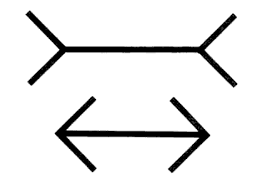
- 18What is the Muller-Lyer IllusionConsists of two equal lines yet the arrow headed line appears shorter.
- 19What is the explanation behind the Muller-Lyer illusion?Occurs using the knowledge of lines and edges an corners, that make us think that the V tipped line is further away and therefore must be longer.
- 20What is the Ames Room Illusion?The Ames room is a distorted trapezium that is longer on one side then on the other, yet we perceive a normal room as our perceptual set tells us that rooms should be rectangular.
- 21How do we detect flavour?Flavour is a perceptual experience produced by a combination of factors such as: pas experience, colour, texture and crunch etc.
- 22What is Synaesthesia?A perceptual experience in which stimulation of one sense produces an additional usual experiences in another sense. It is not bidirectional, automatically and the experience is vivid, highly memorable and consistent.
Informationen
- Beschreibung
- Reference: Jacaranda Psychology VCE Units One and Two, seventh edition, by John Grivas, 2016. chapters seven (sensation and perception) and eight (distortions of perception)
- Erstellt von
- Sherlock Holmes
- Aufrufe
- 74
- Bewertung