
Notes
Atoms, Elements & Compounds
Content of the notes (2)
Page 1
Atoms
All atoms consist of a nucleus and a cloud of electron that move around the nucleus. The nucleus is made up of protons and neutrons.
Subatomic Particle Mass Charge Where
Proton 1 +1 nucleus
Electrons 1/2000 -1 shell
Neutron 1 0 nucleus
0.00013 micron - The size of an atom
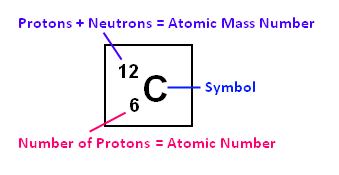
Mass Number
Bigger than atom's number
Changes by irregular amounts
No. of Protons + No. of Neutrons
Atomic Number
Number of protons in an atom
Every atom has an equal number of protons and electrons. Because of thin atoms have no overall change.
Mass number or nucleon number - The number of protons and neutrons in an atom
Electronic Configuration
Rules of filling shells
1st Shell - 2e-
2nd Shell - 8e-
3rd Shell - 8e-
Isotopes
The number of neutrons in an atom can vary slightly. For example, there are three kinds of carbon atom, called carbon - 12, carbon -13 and carbon - 14. They all have the same number of protons (because all carbon atoms have 6 protons - its atomic number), but the number of neutrons varies. These different atoms of carbon are called isotopes.
Isotopes are atoms that have the same atomic number, but different mass numbers. They have the same number of protons, but different number of neutrons.
The fact that they have varying number of neutrons, make no difference whatsoever to their chemical reactions. The chemical properties are governed by the number and arrangement of the electrons and, as you will see shortly, that is identical for all three isotopes.
Ions
Charge atom ie - different no. of e- Eg (1+ has lost e-)
The electrons
Atoms are electrically neutral, and the positiveness of the protons is balanced by the negativeness of the electrons. In a neutral atom. It follows that:
Number of electrons+ Number of protons
So, if an oxygen atom (atomic number = 8) has 8 protons, it must also have 8 electrons; if a chlorine atom (atomic atom = 17) has protons, it must also have 17 electrons.
Page 2
Information
- Description
- GCSE Chemistry (Atomic Structure ) Note on Atoms, Elements & Compounds, created by Shobihan Sutharsan on 07/05/2016.
- Created by
- Shobihan Sutharsan · May 2016
- Updated
- May 23, 2016
- Views
- 1
- Rating