
Quiz
EP Quiz 2
Create a free account to finish this quiz
Save your progress and see your final score.
Already have an account? Sign in
Questions in this quiz (15)
1The two water molecules shown above are electric dipoles. Which direction does the electric field produced by the left molecule point at the position of the right molecule?

- A←−
- B↑
- C−→
- D↓
2Referring to the same figure, in its configuration shown, the water molecule at right will experience its?
- AMinimum possible torque and potential energy.
- BMinimum possible torque and maximum possible potential energy.
- CMaximum possible torque and minimum possible potential energy
- DMaximum possible torque and potential energy
3Electric dipole field strengths are proportional to the inverse cube of the distance from the source. How would the field experience by the water molecule at right change if its distance to the left water molecule decrease by a factor of two?
- AE would decrease by a factor of 8
- BE would decrease by a factor of 4
- CE would increase by a factor of 4
- DE would increase by a factor of 8
4“The whole is the sum of the parts” is a pretty good plain language expression of
- AThe principle of superposition
- BGauss’s law.
- CPotential energy per charge.
- D is minus the gradient of
5Suppose you needed to determine the electric field produced by a uniformly charged cube of charge. Which method below would not work?
- ABreaking the cube up into small parts, finding the piece of the field from each part, and adding them all up component-by-component.
- BApplying Gauss’s law as a field calculator.
- CBreaking the cube up into small parts, finding the voltage from the parts, adding them all up, and then calculating how the voltage changes with position.
- DThis
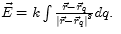
6Suppose you needed to determine the electric field from a set of six uniformly charged concentric spherically symmetric spherical shells. Which method below would be easiest to execute
- ABreaking the shells up into small parts, finding the piece of the field from each part, and adding them all up component-by-component
- BApplying Gauss’s law as a field calculator.
- CBreaking the shells up into small parts, finding the voltage from the parts, adding them all up, and then calculating how the voltage changes with position
- DThis
7The diagram above shows a very long solid conducting cylinder carrying a uniform charge/length +q/L surrounded by a concentric conducting cylindrical shell that carries a charge/length −q/L. The cylinder divides space up into the four regions A, B, C, and D shown in the figure. The only region in space where E is not 0 is?
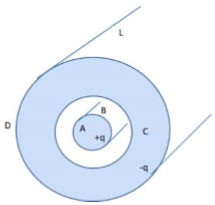
- AA
- BB
- CC
- DD
8The geometry of the last problem screams “cylinder of radius r and length l” as the choice for Gaussian surface. The flux of the electric field E through this surface would be
- A4pi*r^2 E
- B2pi*r^2 E
- C2pi*r*l E
- D(4/3)pi*r^3 E
9Which action below would not increase the capacitance of a parallel plate capacitor
- AFill the inter-plate gap with insulating oil
- BDecrease the plate spacing
- CIncrease the plate area.
- DRaise the voltage on the capacitor
10A 1 uF parallel plate capacitor is connected to a 12 V battery. While remaining connected, the space between the two capacitor plates is filled with a dielectric with k =2 . After the space is completely filled, the voltage V and charge q on the capacitor are?
- AV=12, q=24
- BV=6, q=24
- CV=6, q=12
- DV=12, q=12
11A different 1 uF parallel plate capacitor is connected to a 12 V battery and then disconnected. While disconnected, the space between the two capacitor plates is filled with a dielectric with k =2. After the space is completely filled, the voltage V and charge q on the capacitor are
- AV=12, q=24
- BV=6, q=24
- CV=6, q=12
- DV=12, q=12
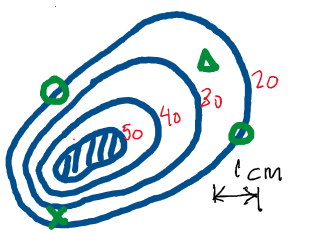
12The figure above shows a sketch of equipotentials. The number next to each curve shows the voltage. All points in the cross hatched area at the center are at the same voltage. A length scale is shown at lower right. The triangle, X, and two circles mark certain positions. Where is the E field largest?
- ARight circle
- BX
- CTriangle
13Referring to the same figure, where does the field point vertically down?
- ARight circle
- BX
- CTriangle
14The region inside the cross-hatched area is?
- APositively charged with electric field lines directed outwards.
- BNegatively charged with electric field lines directed inwards
- CUncharged with zero electric field
15Suppose a proton moving at a speed of 10 m/s at the position of the left circle is guided by the electric field to the position of the right circle. When it reaches the right circle, it will be moving
- A> 10 m/s
- B10 m/s
- C< 10 m/s
Information
- Description
- Engineering Quiz on EP Quiz 2, created by Dustin Wilson on 12/12/2018.
- Author
- Dustin Wilson
- Language
- English
- Views
- 23
- Tags
- Rating
- 3.0 out of 5 · 2 ratings Rate this quiz