
Quiz
Biochemistry Session 1 - Genes to Proteins
Questions in this quiz (54)
1What is "the central dogma?"
- ADNA is transcribed to RNA which is translated into proteins.
- BDNA is translated to RNA which is transcribed into proteins.
- CRNA is transcribed to DNA which is translated into proteins.
- DRNA is translated to DNA which is transcribed into proteins.
2Which of the following terms accurately describes all of the proteins translated from functional mRNA transcripts in a given cell?
- AExome
- BTranscriptome
- CProteome
- DMetabolome
3The human genome is over six feet long and includes 23,000 coding genes. What percentage of intact human DNA actually codes for an expressible protein product?
- A3-4%
- B1-2%
- C6-7%
- D10-12%
4The exome is the RNA component remaining after processing, editing, and splicing together __________ from the original primary transcript of RNA derived from DNA. The intervening sequences are called __________.
- Aexons, introns
- Bcodons, base pairs
- Cintrons, exons
- Dbase pairs, codons
5Proteins need to interact with specific DNA sequences for a variety of reasons. ____________ access specific DNA base-pairing sequences through the ___________ groove. General interactions with DNA occur with the general structural motif of DNA through the ___________ groove. Positively charged amino acids in __________ proteins interact with the negatively charged DNA phosphoribosyl backbone.
- AHistones, major, minor, transcription factor
- BHistones, minor, major, transcription factor
- CTranscription factors, minor, major, histone
- DTranscription factors, major, minor, histone
6The DNA double helix consists of two anti-parallel DNA strands. Which of the following properties listed are responsible for the double helix's stable structure? (Select all that apply)
- AHydrogen bonds
- BResonance stabilization
- CCovalent bonds linking the two strands
- DEach strand's phosphodiester backbone
7Histones come together to form an octomer that is the core of a complex called the nucleosome. Nucleosomes are essential to binding and stabilizing DNA. DNA wrapped around a nucleosome core forms the fundamental unit of __________.
- AChromosomes
- BChromatid
- CChromatin
- DSolenoids
8Transcription factors are effectively competing for specific DNA sequence binding sites, establishing a protein complex on the DNA that is promoting gene expression. This is most likely describing which chromatin modification?
- AEuchromatin
- BHeterochromatin
- CChromatid
9Which of the following is an example of an irreversible reaction that would block the electrostatic interactions between a histone and the phosphoribosyl backbone of DNA, ultimately leading to reduced nucleosome affinity to DNA?
- AHistone methylation
- BHistone acetylation
- CDNA methylation
- DDNA acetylation
10Cell signaling has activated the histone acetyl transferase (HAT) mechanism. What could we expect to observe? (Select all that apply)
- AAcetylation of histone proteins
- BDeacetylation of histone proteins
- CElevated levels of local gene expression
- DInactive gene expression
- EPromoter site exposure by a remodeling engine
11Which of the following could lead to silencing gene expression in DNA?
- AHDAC activation
- BZ-DNA structural conformation
- CChromatin condensation
- DHypermethylated meCG regions
12You are observing a cell and notice transcription and translation are occurring at the same time. This could be a(n) __________ cell. (Select all that apply)
- AProtist
- BPlant
- CBacterial
- DAnimal
13The lactose operon codes for one polycistronic mRNA. Which of the following would NOT result in the expression of this operon?
- AAllolactose binding with the repressor protein.
- BThe spontaneous conversion of lactose to allolactose.
- CReadily available glucose.
- DSigma factor binding to its promoter element.
14Which of the following is NOT a cis-element?
- ATATA box
- BEnhancer
- CSilencer
- DSigma factors
15On this lac operon, what does "o" bind to?
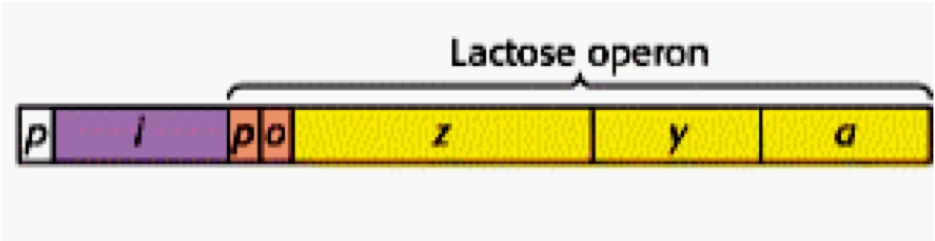
- ASigma factor
- BmRNA
- CRepressor protein
- DPromoter element
16In a eukaryotic cell, signal transduction networks are triggered by environmental influence. Which of the following is true regarding the activation of trans-elements and the induction of gene expression?
- ATranscription factors are already active in the cytosol and require no further intervention to promote gene expression.
- BModification of an inhibitory protein would cause it to activate and bind to a transcription factor, rendering the TF inactive.
- CTranscription factors assemble on enhancer regions to recruit chromatin remodeling complexes.
- DTranscription factors can be activated by direct phosphorylation.
17Neurotransmitters, hormones, growth factors, and environmental stimuli can all activate various signal transduction networks, thereby controlling different specific sets of genes. The CRE-CREB transcription factor is an example of one of these signal transduction networks. Protein kinase, PKA, can play a major role in the expression of this transcription factor. Which of the following best describes how PKA influences this pathway?
- APKA phosphorylates numerous targets, including CREB, causing a conformational change that induces the assembly of a transcriptional complex.
- BPKA stimulates adenylate cyclase to synthesize cyclic-AMP.
- CPKA binds to a receptor on the cell surface, causing a change in receptor conformation.
- DPKA does not influence this pathway, it is an inhibitor.
18There are various mechanisms by which transcription can be initiated. Which of the following involves denaturing DNA in and around the promoter and open reading frame?
- AClosed promoter interaction
- BClosed to open DNA transition
- COpen promoter - RNA polymerase initiation
- DElongation
19Which of the following is NOT required for the RNA polymerase reaction mechanism?
- AMg+2
- B-OH group
- CCa+2
- D4 NTP
20During elongation of an RNA transcript, RNA and DNA form a complex in the active site. Which of the following most appropriately describes this complex?
- AIt consists of the DNA coding strand and the nascent RNA.
- BIt does not rotate during elongation.
- CIt is approximately two turns of an A-type nucleic acid double helix.
- DIt consists of the DNA template strand and the nascent RNA.
21Transcriptional termination can be protein dependent. Which of the following are true regarding rho protein dependent termination? (Select all that apply)
- AThis method involves the formation of a rho hexameric complex.
- BThis method uses ATP to roll along the RNA strand.
- CThis method involves cleaving the nascent RNA strand prior to contacting the RNA polymerase complex.
- DThis mechanism is assisted by the formation of secondary structures in the nascent RNA strand that slow the procession rate of RNA polymerase.
22The formation of a secondary structure that blocks the exit channel in RNA polymerase, ultimately causing stress and shearing the DNA-RNA heteroduplex in the active site, is indicative of what type of transcription termination?
- ARNA sequence-structure dependent, common in eukaryotes
- BRNA sequence-structure dependent, common in prokaryotes
- CRho protein dependent, common in eukaryotes
- DRho protein dependent, common in prokaryotes
23If you accidentally ingested an amanita phalloides mushroom containing 2 uM alpha-amanitin - what could you expect to happen? (Select all that apply)
- AmRNA synthesis would stop
- BtRNA synthesis would stop
- CInhibition of RNApol III
- DDeath
24Transcription in eukaryotes is a compartmentalized process. Which of the following processes would you expect to see in the nucleus?
- AmRNA editing
- BRNA degradation
- CRNA processing
- DRNA silencing
- ErRNA and tRNA post-transcriptional modifications
25The 3'-polyA tail is found in over 80% of all eukaryotic _________.
- AmRNAs
- BtRNAs
- CrRNAs
- DDNA
26Which of the following is NOT true regarding the 5'-cap structure added to the mRNA transcript?
- AThe cap is added almost as soon as the nascent strand of RNA streams out of the RNA polymerase complex.
- BThe cap masks the strand from exonuclease degradation, improving half-life and stability.
- CThe cap has no significant role in translation.
- DThe cap is tightly bound by cap-recognition proteins.
27RNA splicing is a key editing mechanism that removes introns from the primary transcript. This mechanism is dependent on the formation of a stable complex called a spliceosome. Which of the following is NOT correct regarding the functional units of the spliceosome?
- AThere must be at least 5 snRNPs present to form the complex.
- BThe U1 snRNP binds to the donor 5' splice site.
- CThe U2 snRNP binds to the acceptor 3' splice site.
- DThe U4, U5, and U6 snRNPs associate and form a stable complex.
28Which of the following sequences contains splicing information that ensures accurately assembled final processed mRNA and is the source of various important regulatory small RNA fragments generated during processing?
- AExons
- BIntrons
- CCodons
- DSpliceosome
29If splice site sequences are mutated, exon skipping may occur. What is another reason splicing may not occur accurately?
- AThe spliceosome is assembled in a kinetic fashion as RNA emerges from the RNA polymerase complex.
- BProtein factors bound to the splicing enhancer or silencer elements of the intron expose the splicing site for a snRNP to bind.
- CProtein factors bound to the splicing enhancer or silencer elements of the intron affect the overall stability of the spliceosome.
- DThere are no other reasons splicing would occur inaccurately.
30Tropomyosin has a primary RNA transcript of 11 exons. Which of the following processed transcripts can result from tropomyosin's primary transcript?
- AStriated muscle
- BSmooth muscle
- CLiver
- DBrain
31UAA, UAG, and UGA are stop codons on mRNA strands that signal the cessation of translation. Why does this mechanism occur?
- ARNA polymerase does not recognize stop codons, stopping translation.
- BThere are no tRNAs to accommodate these sequences, stopping translation.
- CThe amino acids these sequences code for have a chemical structure that conformationally changes the mRNA, stopping translation.
- DThe tRNAs that accommodate these sequences react with the mRNA and break the amino acid chain.
32What molecule is used to charge a specific amino acid to a specific tRNA?
- AATP
- BGTP
- CcAMP
- DGMP
33Looking at a newly synthesized polypeptide that has not been edited, what amino acid must appear at the end?
- AMethionine
- BSerine
- CGlycine
- DGlutamine
34Select all that apply regarding the genetic code.
- AThe genetic code is a continuous set of triplets from start to finish.
- BThe genetic code is degenerate. There may be more than one codon that codes for any single amino acid, but there is never more than one amino acid per unique codon.
- CThe genetic code is subdivided into codon groups.
- DThe genetic code contains one unique start codon and five unique stop codons.
35Which of the following enzymes attaches specific amino acids to the 3' end of cognate tRNA strands?
- AAminoacyl tRNA synthetase
- BDNA synthetase
- CProtease
- DRNA polymerase
36Which of the following options helps to maintain the genetic code during translation? (Select all that apply)
- AThe quick reversal of mis-acylations by an accurate editing site immediately adjacent to the amino acylation site.
- BHighly specific interactions between protein and tRNA
- CThe unique aminoacyl tRNA synthetases that correspond to their individual tRNA strands
- DRho protein modification
37Which of the following is representative of a typical eukaryotic ribosome?
- AThree subunits - 120S complex
- BTwo subunits - 80S complex
- COne subunit - 60S complex
- DTwo subunits - 60S complex
38What is the first step of prokaryotic initiation of translation?
- AInitiation complex IF-2-GTP-fmet-TRNAi scans mRNA. Interaction between the 16S rRNA and Shine-Delgarno sequence is established, binding the initiator complex tightly to the mRNA.
- BInitiation factors IF-1 and IF-3 bind to the 30S subunit, forcing dissociation.
- CIF-2-GTP-fmet-tRNAi complex and mRNA bind to the 30S subunit, forming an initiation complex.
- DStrong 16S rRNA to mRNA interaction places fmet-tRNAi in an AUG initiation site.
39The protein elongation cycle in prokaryotes is defined by three distinct sites located on the ribosome: A, P, and E. What is the main function of the E site?
- ABinding incoming aminoacyl tRNA
- BHolding the peptidyl-tRNA, which is covalently linked to the growing polypeptide chain
- CTransiently binding to the outgoing deacylated tRNA
- DEditing the outgoing deacylated tRNA
40During prokaryotic protein elongation, numerous ribosomal conformational changes occur. Which process involves GTP hydrolysis inducing a change in Elongation Factor-G, forcing movement of the ribosomal complex by one codon (relative to mRNA)?
- ATranslocation
- BFormation of the peptide bond
- CBinding of specific aa - tRNA to A site
- DExiting the ribosome
41In prokaryotic protein elongation, which elongation factor is involved with the binding of specific aa-tRNA to the A site?
- AEF-Tu
- BEF-G
- CGTP
- DGDP
42Prokaryotic protein termination requires the use of release factors since there are no tRNAs for the termination codons. If a release factor has bound near or at the A site - what can we assume about that RF? (select all that apply)
- AThis release factor is structurally similar to tRNA.
- BIt is bound with GTP and will use this GTP to hydrolyze the peptide bond in the P site.
- CIt has recognized stop codon UAA, UAG, or UGA.
- DIt is RF-3.
43RRF, the ribosomal release factor, works together with EF-G and IF-1 to ___________ the two ribosomal subunits. This releases both tRNA and mRNA from the complex. IF-3 binds to IF-1 and the 30S subunit, blocking 50S re-association. Ultimately, this will _________ a new initiation complex.
- Adissociate, generate
- Bbind, generate
- Cactivate, dissociate
- Ddissociate, dissociate
44Ribonucleic acid - protein complexes (RNP) form in eukaryotes and are essential for mRNA stability and regulation of translation. Which of the following is NOT an example of a structure bound within the closed loop mRNP complex?
- ACap binding stabilization proteins CBP20, CBP80, and CBP220.
- BCap binding translational initiation factors.
- C3'polyA tail binding multiple polyA binding proteins.
- D3'polyA tail binding translational initiation factors.
45In eurkaryotes, translation is extremely efficient and a single activated mRNP complex can produce lots of protein from a single stabilized mRNA transcript. Essentially, this becomes a protein synthesis _____________.
- ATeeter-totter
- BSlide
- CMerry-go-round
- DSwing
46There is an extremely toxic compound that disrupts ribosome function (elongation and translocation), blocking protein synthesis, leading to cell death. It consists of a B chain, which binds to the cells surface for cellular uptake, and an A chain, which depurinates and disrupts a highly conserved EF2 binding domain. Which of the following is NOT an enterotoxin that functions in a similar way?
- AShiga
- BC. Diff
- CMRSA
- DE. Coli O157:H7
47A 1-year-old male with chronic anemia is found to have B-thalassemia. Genetic analysis shows that one of his B-globin genes has a mutation that creates a new splice acceptor site 19 nucleotides upstream of the normal splice acceptor site of the first intron. Which of the following best describes the new mRNA molecule that can be produced from this mutant gene?
- AExon 1 will be too short.
- BExon 1 will be too long.
- CExon 2 will be too short.
- DExon 2 will be too long.
48A 4-year-old child who becomes easily tired and has trouble walking is diagnosed with Duchenne muscular dystrophy, an X-linked recessive disorder. Genetic analysis shows that the patient's gene for the muscle protein dystrophin contains a mutation in its promoter region. Of the choices listed, which would be the most likely effect of this mutation?
- AInitiation of dystrophin transcription will be defective.
- BTermination of dystrophin transcription will be defective.
- CCapping of dystrophin mRNA will be defective.
- DSplicing of dystrophin mRNA will be defective.
49A mutation to this sequence in eukaryotic mRNA will affect the process by which the 3'-end poly-A tail is added to the mRNA.
- ACAAT
- BCCA
- CGGGGCG
- DAAUAAA
50A 20-year-old anemic man is found to have an abnormal form of B-globin that is 172 amino acids long, rather than the 141 found in the normal protein. Which of the following point mutations is consistent with that abnormality?
- AUAA -> CAA
- BUAA -> UAG
- CGAU -> GAC
- DGCA -> GAA
51A pharmaceutical company is studying a new antibiotic that inhibits bacterial protein synthesis. When this antibiotic is added to an in vitro protein synthesis system that is translating the mRNA sequence AUGUUUUUUUAG, the only product formed is the dipeptide fMet-PHe. What step in protein synthesis is most likely inhibited by the antibiotic?
- AInitiation
- BBinding of charged tRNA to the ribosomal A site
- CPeptidyltransferase activity
- DRibosomal translocation
52Which of the following is required for both prokaryotic and eukaryotic protein synthesis?
- ABinding of the small ribosomal subunit to the Shine-Dalgarno sequence.
- BfMet-tRNA
- CRecognition of the 5'-cap by initiation factors.
- DTranslocation of the peptidyl-tRNA from the A site to the P site.
53Which of the following is best described as being trans-acting?
- ACAP site
- BOperator
- CPromoter
- DRepressor
54The ZYA region of the lac operon will be efficiently transcribed if:
- Aglucose and lactose are available.
- BcAMP levels are low.
- Cthe operator is mutated and can't be bound by the repressor.
- Dthe repressor is mutated and can't be bound by the inducer.
Information
- Description
- Biochemistry Quiz on Biochemistry Session 1 - Genes to Proteins, created by Kathleen Lonergan on 06/06/2019.
- Author
- Kathleen Lonergan
- Language
- English
- Views
- 394
- Tags
- Rating
- No ratings yet Rate this quiz