
Quiz
Scientific Inquiry Exam 2
Questions in this quiz (42)
1Which of the following is NOT a characteristic that is typical of qualitative research?
- Ageneralizability
- Bsubjectivity
- Crichness of data
- Dsmall number of participants
2Mech et al. (2010) used which of the following to obtain data for their paper "Eavesdropping on Happiness?"
- Aa confederate
- Ba camera hidden behind the mirror
- Ca device that records sounds
- Dtranscripts of phone records
3Research done on "Genie" (who had limited language development) & H.M. (who had amnesia) tend to involve what sort of research?
- Aparticipant research
- Barchival research
- Ccase studies
- Dpsychobiography
4Which of the following is an ADVANTAGE of systematic observation?
- AInterrater reliability is never a concern
- BIt allows the researcher to focus on specific behaviors
- CIt records all of the participant's actions during the study period
- DThe data is anonymous, so data are always confidential
5In which of the following types of study would reactivity be the GREATEST concern?
- Aanonymous surveys
- Bparticipant observation
- Carchival research
- Dmeta-analysis
6Which of the following IS a match between a type of survey & a limitation of that type of survey?
- Aonline survey: possible sampling bias due to limited access to technology
- Bpersonally administrated survey: reactivity
- Cmail-in survey: long response times
- Dall of the above are correct matches
7Which of the following scales is demonstrated below?
- ALikert scale
- BSemantic differential scale
- CRatio scale
- DWong-Baker scale
8What flaw does the question demonstrate? "Are you not satisfied with your online service provider?"
- ALeading questions
- BDouble-barrelled questions
- CNegative wording
- DYea saying
9What flaw does the question demonstrate? "Do you support government-provided health care for children & senior citizens?"
- ALeading questions
- BDouble-barrelled questions
- CNegative wording
- DYea saying
10What flaw does the question demonstrate? "Do you believe that Candidate X deserves to be removed from office after the many scandals that he was involved in?
- ALeading questions
- BDouble-barrelled questions
- CNegative wording
- DYea saying
11What flaw does the question demonstrate? The "national service" video from the Yes Minister TV show clip in class.
- ALeading questions
- BDouble-barrelled questions
- CNegative wording
- DYea saying
12__________ is a low-cost sampling technique that runs the risk of introducing bias, while __________ costs more but is less prone to bias.
- Astratified random sample : simple random sampling
- Bhaphazard sampling : purposive sampling
- Cquota sampling : simple random sampling
- Dcluster sampling : haphazard sampling
13Which of the following is MOST clearly a risk of pretest-posttest designs?
- Anon-random assignment
- Bpractice effects
- Clow inter-rater reliability
- Dsampling error
14In a matched-pairs design:
- Athe value of one dependent variable is matched with the value of another
- Ba member of the control group is matched with a member of the experimental group
- Cthe score on a pretest is matched with the score of a posttest
- Da score provided by one rater is matched with a score provided by a different rater
15In which of the following designs is assignment to groups a concern?
- Awithin-subjects
- Bbetween subjects
- Cpsychobiography
- Dmultiple baseline
16Suppose that you are evaluating a smoking cessation program in your community. At the same time, the city puts up anti-smoking advertisements all around the laboratory. This would be an example of which of the following problems?
- Arestrictions of range effects
- Bmortality effects
- Chistory effects
- Dhaphazard sampling
17Suppose that a researcher uses a post-test only design to investigate the effects of a mediation technique on mood. The researcher recruits 40 participants, randomly assigns them to 2 groups. One group receives meditation training before taking a questionnaire on their mood. The other sits in a quiet room for the same length of time before taking the questionnaire. As it happens, the experimental group is in a spacious area for the meditation training, while the control group is in a cramped classroom. The clearest potential problem with this design is:
- Aa practice effect
- Ba ceiling effect
- Ca confounding variable
- Dattrition
18What is the purpose of a Latin Square design?
- Ato prevent sampling bias
- Bto ensure random assignment to groups
- Cto control for order effects
- Dto reduce the effect of within subject variability
19Which of the following describes a procedure that counterbalances for order?
- AWhen conducting an interview, call the participants into the interview room in a random sequence that is not known in advance by the experimenter.
- BWhen conducting an online survey, present the questions in a random order.
- CRecruit 30 participants. Expose them to condition A first, then condition B, then condition B again, and then condition A again.
- DRecruit 30 participants. Expose 15 to condition A first, then condition B. Expose 15 to condition B first, then condition A.
20Which of the following is NOT involved in a staged manipulation? (Choose the best answer)
- Athe behavior of the other "teacher" in Milgram's obedience study
- Bthe Bringing in the Bystander program used in Banyard et al.'s study on sexual violence
- Cthe Monopoly game rules in Piff's "Does Money Make You Mean?" study
- Dtaking away the lucky charm for photographing in the superstition study
21Identify the dependent & independent variable.
Compared to children, adults are bad at learning language. This is counterintuitive; adults outperform children on most measure of cognition, especially those that involve effort (which continue to mature into early adulthood). The present study asks whether these mature effortful abilities interfere with language learning in adults & further, whether interference occurs equally for aspects of language that adults are good (word-segmentation) versus bad (Grammar) at learning. Learners were exposed to an artificial language comprised of statistically defined words that belong to phonologically defined categories (grammar). Exposure occurred under passive or effortful conditions. Passive learners were told to listen while effortful learners were instructed to try to 1) learn the words, 2) learn the categories, or 3) learn the category order. Effortful learners showed an advantage for learning words while passive learners showed an advantage for learning the categories. Effort can therefore hurt the learning of categories.
Q: A dependent variable in this study is:- Aeffort expended
- Bhow well the words are learned
- Cwhether the participants are instructed to learn words or categories
- Dthe age of the participants in the experiment
22Consider the following paragraph from the Method section of the paper on page 3.
After exposure, participants completed 2 forced choice tests: (1) a word-level test in which they were asked which of two words was more likely to belong in the language they just listened to, and (2) a sentence-level test in which they were asked which sentence was more likely to belong in the test were randomized separately for each subject. In these 2 tests, there were 3 types of interest: word segmentation, order & category structure. All word segmentation items occurred in the first, word-level, test and all of the order & category structure occurred in the second, sentence-level test.
Q: Which of the following best describes the design of this study?- Aindependent groups
- Brepeated-measures
- Clongitudinal
- Dpretest-posttest
23Consider the following paragraph from the Method section of the paper on page 3.
After exposure, participants completed 2 forced choice tests: (1) a word-level test in which they were asked which of two words was more likely to belong in the language they just listened to, and (2) a sentence-level test in which they were asked which sentence was more likely to belong in the test were randomized separately for each subject. In these 2 tests, there were 3 types of interest: word segmentation, order & category structure. All word segmentation items occurred in the first, word-level, test and all of the order & category structure occurred in the second, sentence-level test.
Q: If the word-level test was always carried out first, this could potentially lead to:- Atwo-way interactions
- Bexpectancy effects
- Ccarryover effects
- Ddemand characteristics
24The Solomon four-group design is a compromise between which types of design?
- Apost-test only & pretest-posttest
- Bquantitative & qualitative
- Cstaged & straightforward
- Dthree-group & five-group
25Which of the following is most clearly a way to overcome a floor effect?
- AReduce the number of levels of the independent variable
- BIncrease sample size
- CChange the range of the manipulation of the independent variable
- DMeasure the dependent variable with a ratio scale
26The double-bind design reduces the likelihood of:
- Asampling error
- Bexpectancy effects
- Cdemand characteristics
- DA & B
- EB & C
27Early studies of childhood development by Jean Piaget underestimated the rate of development because participants could not express that they knew or understood something. Which of the following best describes the problem with Piaget's studies?
- AAttrition
- BSensitivity of the dependent variable
- CCeiling effects
- DCarryover effects
28Which of the following is an example of a pilot study (based on the definition of the term from class?)
- AA researcher tests children's reading levels before assigning them to groups in an experiment
- BA researcher has participants rate the scariness of movie clips before using them as stimuli in a study of the psychological effects of movie violence
- CA researcher replicates and experiment with an additional control condition in order to remove a potential confound
- DA researcher recruits a small number of participants for a study but stops collecting data after the first few participants do not conform to the researcher's hypothesis
29Which of the following is NOT a typical role of debriefing in experimental research
- Ato reveal deception used in the study
- Bto answer the participant's questions
- Cto understand the participant's experience during the experiment
- Dto encourage the participant to discuss the study with others
30According to the text, which of the following is the final step in conducting research?
- Atesting the hypothesis
- Bdebriefing the participants
- Ccommunicating the findings to others
- Dconducting follow-up studies
31Filler questions in some psycholinguistics studies serve to:
- Alengthen the study in order to give participants more experience with the task
- Bdisguise the manipulation in order to reduce demand characteristics
- Ccontrol for differences between individual words (which would otherwise be confounds)
- Densure that each participant is exposed to the full range of experimental stimuli
32The following 3 questions is a table i will take photo and send to you on whatsapp!
- AThis one
- B-
33Which of the following would most likely be a PV in a PV x IV design?
- Aa personality trait
- Bthe dosage of a psychoactive drug
- Creaction time in response to stimuli
- Dtype of psychotherapy received during the experiment
34Which of the following is a correct description of the graph shown on the right? Assume that differences between conditions reflect differences in the population.
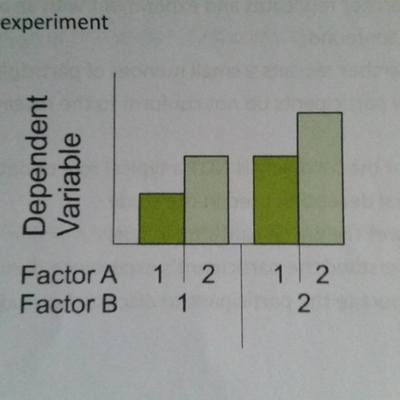
- Aa crossover interaction
- B2 independent main effects
- Ca main effect of Factor A
- Da main effect of Factor B
35Suppose that the owner of a coffeeshop introduces a promotion where they offer a coupon for discounts on a movie ticket with every cup of coffee. The owner runs the promotion for one month in May. The shop sold 1000 cups of coffee per day in April, 1250 cups of coffee per day in June. The owner interprets this as a sign that the promotion was effective. This procedure is most similar to the:
- AABA reversal design
- Bsequential method
- Cpretest-posttest control group design
- Dmultiple baseline design
36Which of the following points did Kathryn Shultz make about how it feels to be wrong?
- AIt is a useful tool for solving scientific debates
- BIt results from irresponsibility and poor preparation
- CIt motivates us to avoid mistakes in the future
- DIt feels the same as being right
37Bonus: In class, I described an experiment that I conducted which had a 2x2x2x3x3 factorial design. What was the result of this experiment?
- AIt served as a pilot study for a series of other experiments
- BMy advisor would not let me run the experiment
- CI published the study in a peer-reviewed journal
- DI had a 5 way interaction, so I gave up
38Which of the following best describes what to do when you find significant main effects & significant interactions in a 2x2 factorial design?
- AIgnore the interactions & focus on the main effects
- BDescribes the effects separately for each level of one of your variables
- CRemove levels of the variables from the design until there are no more interactions
- DGive up, since the experimental data are not interpretable.
39Which of the following is NOT a plausible rationale for using a quasi-experimental design instead of a conventional experimental design?
- AYou are studying a life-saving intervention & do not want to turn away anybody for treatment
- BYou are studying an intervention that affects the whole community, so a control group is impractical
- CEach participant has a different standard for "success" or "failure", so the effectiveness of your treatment cannot be measure quantitatively
- DEach participant in treatment voluntarily signed up for the program, so selection bias may make your sample different from the rest of the population
40In the sequential method, you would collect data from:
- Aparticipants who were all the same age, and follow them for an extended time
- Bparticipants who were all the same age, but only once during the study
- Cparticipants who were a range of ages, and follow them for an extended time
- Dparticipants who were a range of ages, but only once during the study
41The purpose of propensity score matching is to deal with potential confound introduced by:
- Ahaphazard sampling techniques
- Bnon-equivalent control group
- Cdemand characteristics
- Dexpectancy effects
42Which of the following is an example of a situation where regression to the mean could MOST plausibly provide an alternative explanation for my result?
- AIn one year, I do not conduct review sessions for my PSY250 class. Students in that class do worse on average than students in previous years. Conclusion: I should offer review sessions every year from that point in.
- BI ask students during Midterm 2 if they are confident that they will do well. There is no correlation between confidence & performance. Conclusion: Students should attend review sessions even if they think they are doing well in class.
- CI ask the 10 students with the lowest grade on Midterm 1 to attend a compulsory review session before Midterm 2. Their scores on Midterm 2 are on average better than Midterm 1. Conclusion: My review session was effective.
- DI ask my students if they have any questions about the exam during a review session. None of them says anything in response to my question. Conclusion: None of the students have any questions.
Information
- Description
- -
- Author
- Zaneta Chan
- Language
- English
- Views
- 64
- Tags
- Rating
- 5.0 out of 5 · 1 rating Rate this quiz