
Flashcards
Technical Terms
Cards in this deck (29)
- 1Attenuation/LossReduction in the strength of a signal, occurs over distance or time.
- 2Propagation DelayTime taken for the head of the signal to travel from the sender to the receiver
- 3LatencyThe time delay between data input into a system and the desired outcome.
- 4LogisticsThe detailed organization and implementation of a complex operation
- 5Mission CriticalA factor of a system essential to business operation. Failure/disruption of such factors can cause social turmoil and catastrophes for the organisation.
- 6Nyquist RateTwice the bandwidth of a bandlimited function (ie. the lower bound for the sample rate required to reproduce the signal accurately).
- 7Nyquist FrequencyHalf the sampling rate fs of a discrete-time system (ie. the maximum frequency that can be recovered by sampling at a rate of fs)
- 8AliasingOccurs when the observed signal reconstructed from samples differs from the original signal (aliases another 'incorrect' waveform) due to insufficient sample rate.
- 9What is represented by h(τ,t)?The response of the channel at time t to an impulse transmitted at time t-τ.
- 10Channel state information (CSI)Known properties of a communication link including the combined effect of:
scattering
fading
power decay with distance etc. - 11Instantaneous CSI (short term CSI)Current channel conditions ie. the impulse response of a digital filter.
- 12Statistical CSI (long term CSI)A statistical characterization of the channel including, eg:
fading distribution type
average channel gain
line-of-sight component
spatial correlation - 13Frequency spectrumThe representation (by Fourier theory) of a waveform by a summation of a (possibly infinite) number of sinusoids, each with a particular amplitude and phase.
- 14Delay SpreadThe difference between the arrival times of the first (typically line-of-sight) and last significant multipath component.
- 15Coherence DistanceThe distance from peak to valley in the spatial pattern of constructive and destructive interference, as a function of the distance r between transmitter and receiver.
- 16Impulse ResponseA system's output when presented with a brief input signal, called an impulse.
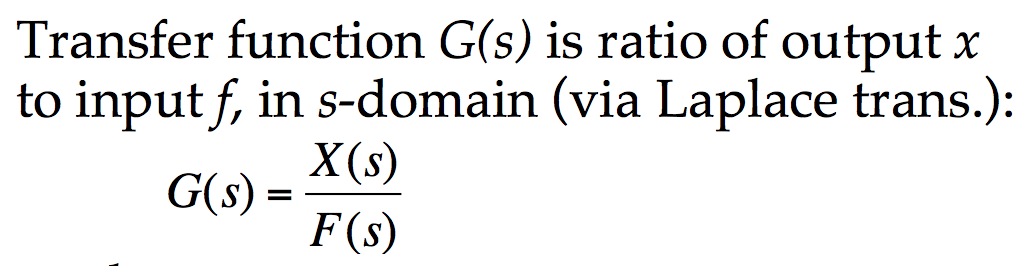
- 17System Function/Transfer FunctionRatio of Laplace transform of system's output to that of its input. Generally denoted as G(s) or H(s).
- 18Large scale fadingDue to path loss of signal as a function of distance and shadowing by large obstacles
Occurs as the mobile moves through a distance of the order of the cell size.
Frequency independent. - 19Small scale fadingDue to constructive and destructive interference of multiple signal paths.
Occurs at the spatial scale of order of the carrier wavelength.
Frequency dependent. - 20CoverageThe largest distance between the base-station and a mobile at which
communication can reliably take place. - 21CapacityThe number of mobiles that can be supported simultaneously within a
cell so that reliable communication can still take place. - 22ShadowingThe effect of the received signal power fluctuating due to objects obstructing the propagation path between transmitter and receiver
- 23ScatteringDeviation of a wave from a single straight trajectory to many multidirectional paths due to localized non-uniformities eg. in reflections from very rough objects.
- 24FilterA device or process that removes some unwanted components or features from a signal (eg. certain frequencies).
- 25Frequency spectrumThe representation (by Fourier theory) of a waveform by a summation of a (possibly infinite) number of sinusoids, each with a particular amplitude and phase.
- 26Frequency responseThe quantitative measure of magnitude and phase of a system's output as a function of frequency, in comparison to its input.
- 27BasebandThe original frequency range of a transmission signal before it is converted, or modulated, to a different frequency range.
- 28PassbandThe frequency range of a transmission signal AFTER it is up-converted, or modulated, from the baseband range, to travel across the wireless channel between transmit and receive antennae.
- 29—
Information
- Description
- PhD Comms (Basics) Flashcards on Technical Terms, created by L H on 30/01/2018.
- Created by
- L H
- Views
- 1
- Rating