
Flashcards
Earth Systems Lecture Test #3
Cards in this deck (114)
- 1Where do earthquakes occurAlong faults
- 2What is the hypocentreThe spot within the earth where earthquake waves originate
- 3What is an epicentreLand surface above the hypocentre
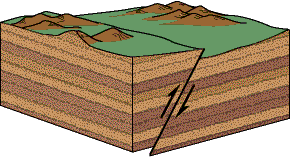
(focus) - 4What is a reverse faultAlong a reverse fault one rocky block is pushed up relative to rock on the other side.
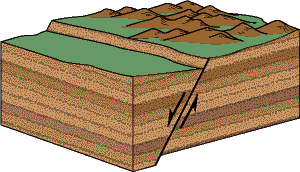
- 5What is a normal faultA normal fault drops the rock on one side of the fault down relative to the other side.
- 6What is a thrust faultHanging wall goes up relative to footwall
Slope (dip) of fault is not steep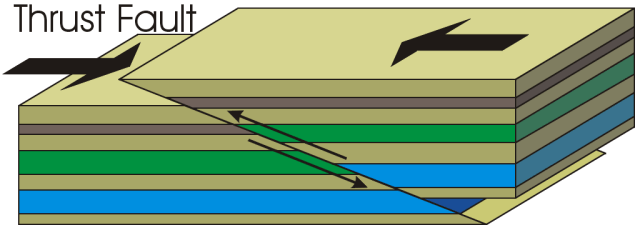
- 7What is a strike-slip faultScrape along side-by-side.
Movement is horizontal
Rock layers haven't been moved up or down on either side of the fault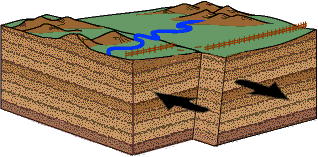
- 8What are foreshocksA mild tremor preceding the violent shaking movement of an earthquake
- 9What are aftershocksA smaller earthquake following the main shock of a large earthquake
- 10What are the two types of earthquake scalesMagnitude: The Richter Scale
Intensity: The Mercalli Scale - 11What is a Mercalli scaleThe Mercalli scale measures the intensity of an earthquake by quantifying the effects of an earthquake on the Earth's surface
- 12What are the main plate boundary types at which earthquakes occurConvergent
Divergent
Transform - 13Where do 5% of earthquakes occur5% of earthquakes occur in the intra-plate setting
Volcanic activity that occurs within tectonic plates - 14What types of damage can earthquakes causeFire
Liquefaction
Landslides
Mudslides
Avalanches
Ground Displacement
Flooding - 15How can we predict earthquakesOn probability scales but not an absolute time scale
- 16How does a tsunami occurCaused by sudden movement of the ocean due to:
Earthquakes
Landslides on the sea floor
Land slumping into the ocean
Major volcanic eruptions
Large meteorite impacts - 17How does a tsunami propogate from its sourceas tectonic plates slip, energy is released into the water and travels to the surface. This displaces the water and raises it above the normal sea level. but gravity pulls it back down, which makes the water ripple horizontally. thus a tsunami is born and travels over 500 miles per hour
- 18What is a volcano?An erupting vent through which molten rock surfaces
A mountain built from magmatic eruptions - 19What is the architecture of a volcano
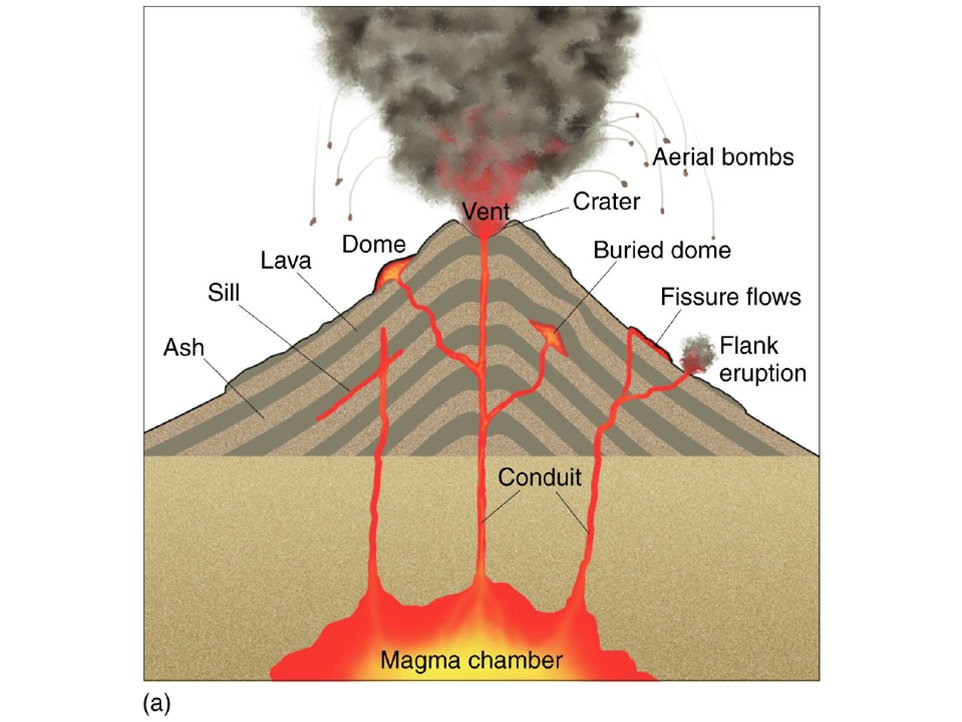
- 20what are the products of a volcanoLava flows - Molten rock that moves over the ground
Pyroclastic debris - fragments blown out of a volcano
Volcanic gases - Vapor and aerosols that exit a volcano - 21What is lava? How does it vary in physical and chemical propertiesLava can be thin and runny or thick and sticky
Flow type depends on viscosity via composition
Composition depends on silica (SiO2), Fe, and Mg - 22What is pyoclasticFragmental material ejected from a volcano
Glass shards, fragmented lava in a range of sizes - 23what are the pyroclastic productsAsh
Lapilli
Blocks - pre-existing rock tore from the volcano
Bombs - streamlined fragments of ejected lava - 24what are the volcanic gasesH2O
CO2
SO2
CO
H2S - 25What are the different shapes and sizes of volcanoesShield volcanoes - Largest
Cinder cones - Smallest
Stratovolcanoes - Intermediate in size - 26Sketch the shape of the different volcanoes
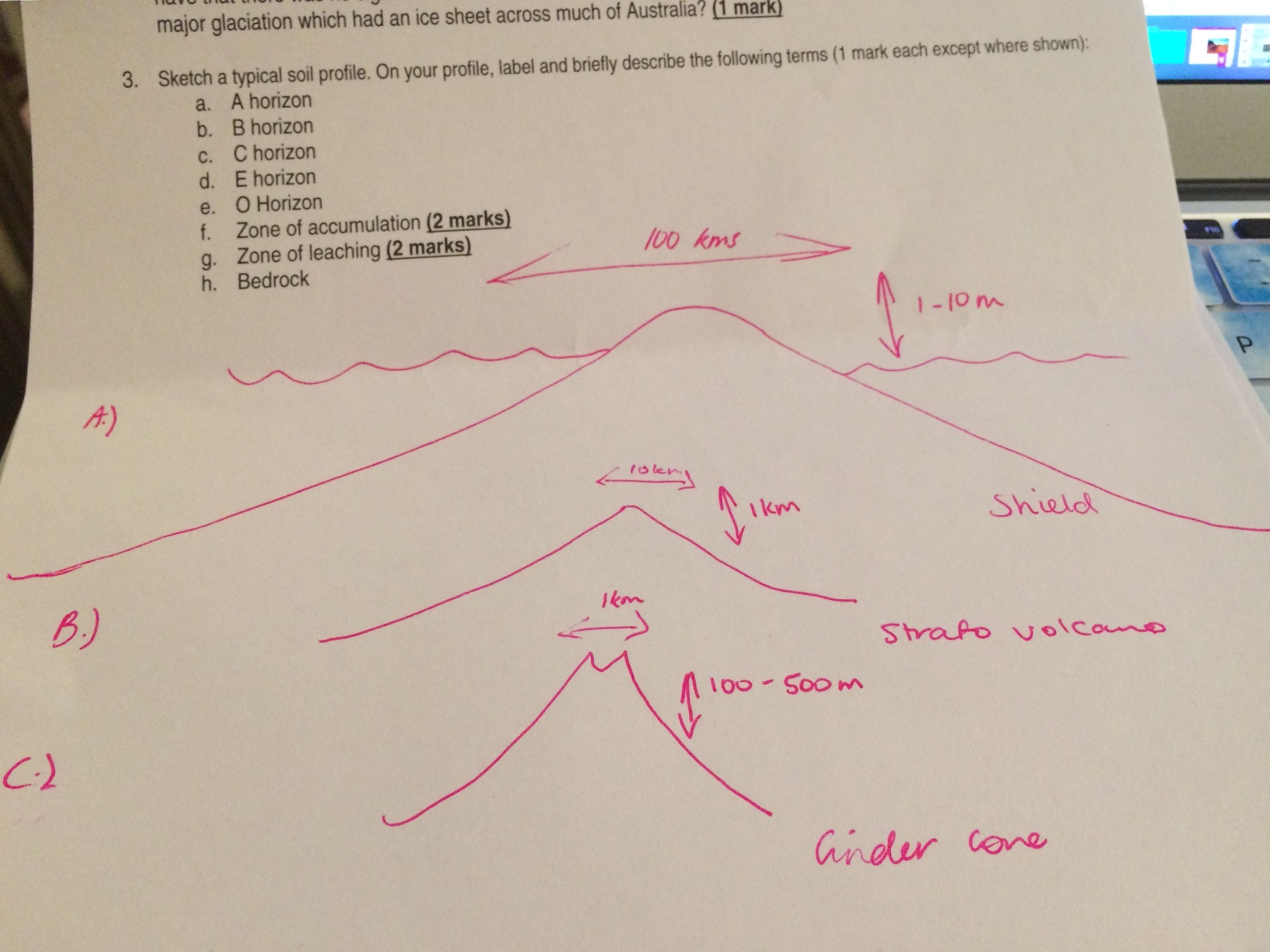
- 27How do effusive eruptions occur and what rock type do they form fromLava flows stream away from vents
Lava lakes can form around the vent
Can produce huge lava fountains
Basalt and these eruptions create shields - 28How do explosive eruptions occur and what rock type do they form fromgas pressure in the viscous magma
Pressure released explosively
Create stratovolcanoes
Blanket landscape with tephra
Andesitic and rhyolitic compositions - 29What is a phreatomagnetic eruptionmagma interacts with water
can be cataclysmic
magma chamber breaches and admits water
Water flashes to steam and blows volcano apart - 30what are the controls on eruptive styleViscosity - controls ease of lava flow
Basalt - Low-viscosity lava flows away from the vent
Felsic - High-viscosity lava builds at vent - 31second control on eruptive styleGas Pressure - Greater P favours explosive style
Basalt - Low-viscosity allows gas release
Felsic - High-viscosity prevents gas release - 32third control on eruptive styleSubaerial lava flowing on land cools slower
Submarine lava, which is quickly quenched - 33What is an Oceanic hot spot?Plume under an oceanic plate
Basalt erupts at sea floor and forms mound
Volcano builds above sea level forming island
Lava builds up and out and island grows - 34What is a continental hot spotcuts a continental plate
erupts basaltic and rhyolitic material
Basalt makes up mantle plume
Basalt melts the granitic crust it passes through (Rhyolitic) - 35what is lavahot molten or semi-fluid rock erupted from a volcano or fissure
- 36what is tephrarock fragments and particles ejected by a volcanic eruption.
- 37what are pyroclasticsComposed of rock fragments
Materials include:
Obsidian
Ash
Pumice - 38what is a blasta destructive wave of highly compressed air spreading outwards from an explosion
- 39what are landslidesa collapse of a mass of earth or rock from a mountain or cliff.
- 40what are laharsa destructive mudflow on the slopes of a volcano.
- 41what is an earthquakesudden violent shaking of ground
causing destruction,
from movements within earth's crust or volcanoes. - 42what are tsunamislong, high sea wave caused by earthquake or other disturbance.
- 43what are gas emissionsGreenhouse gases trap heat from the sun and warm the planet's surface
- 44what is an angle of reposethe steepest angle at which a sloping surface formed of loose material is stable
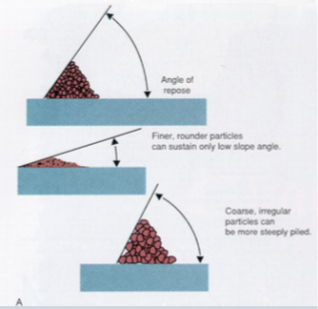
- 45what is cohesioncomponent of shear strength of rock or soil
- 46what are the three types of slope profiles
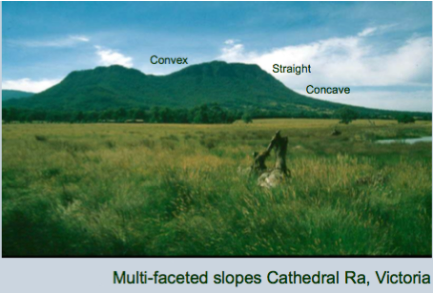
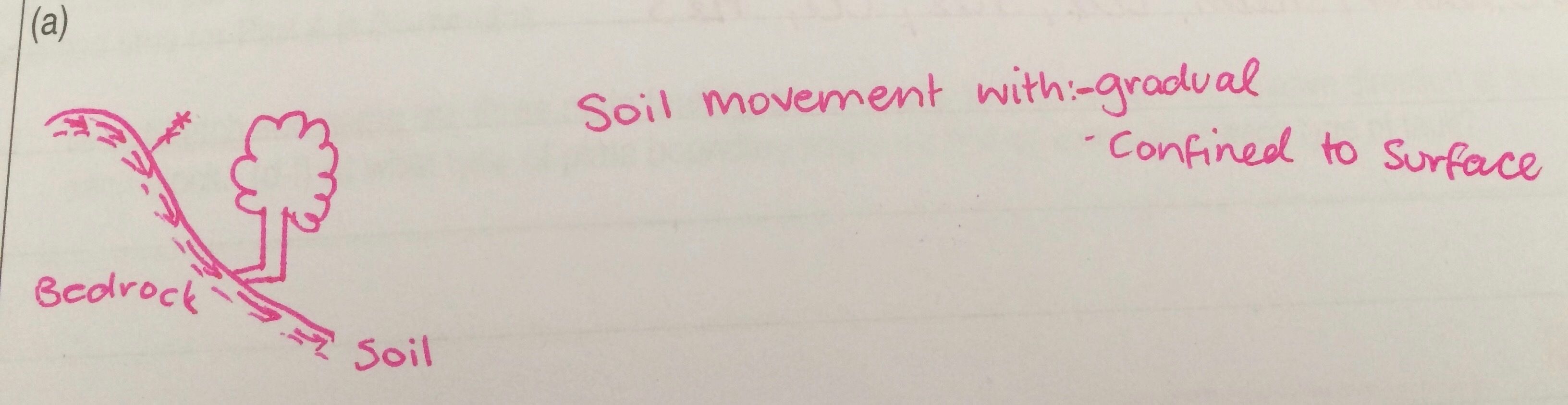
- 47what is a creep
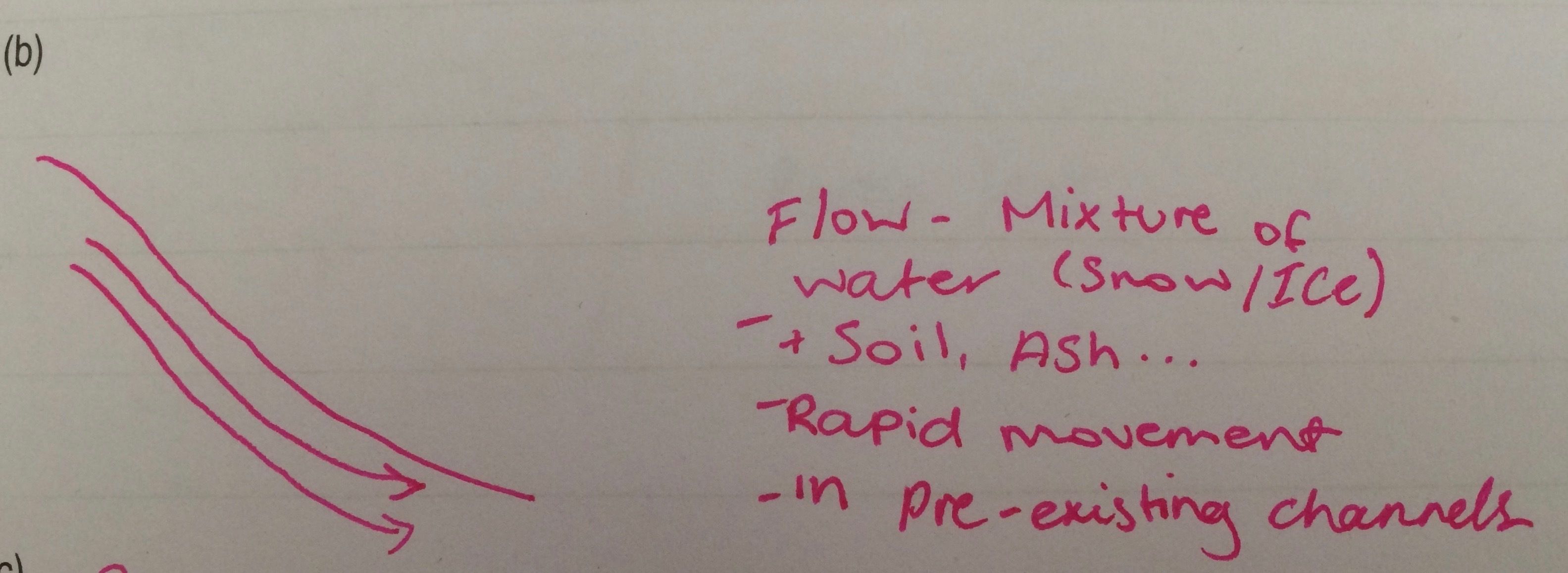
- 48what is a flow
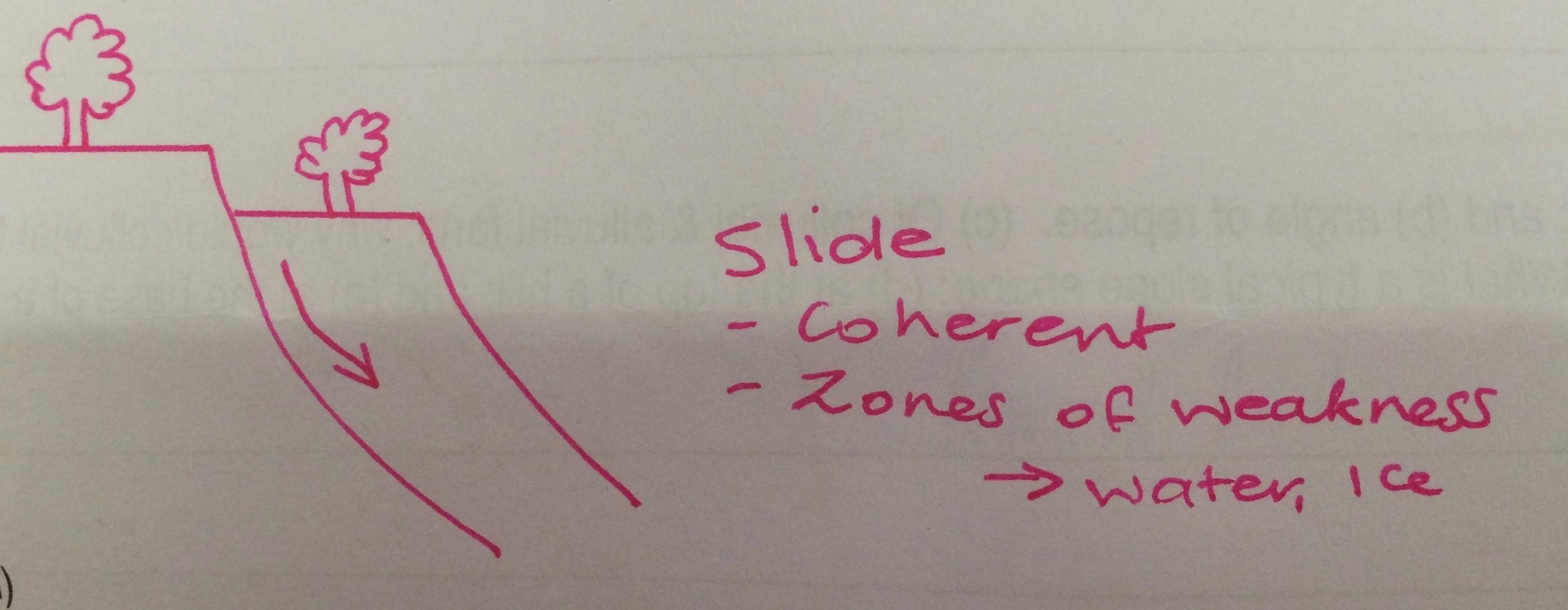
- 49what is a slide
- 50what is a heave→ Slope materials experience cycles of expansion and contraction (buckling)
Caused by
Wetting and drying
Freezing and thawing
Crystallisation (e.g. salt)
forms patterned ground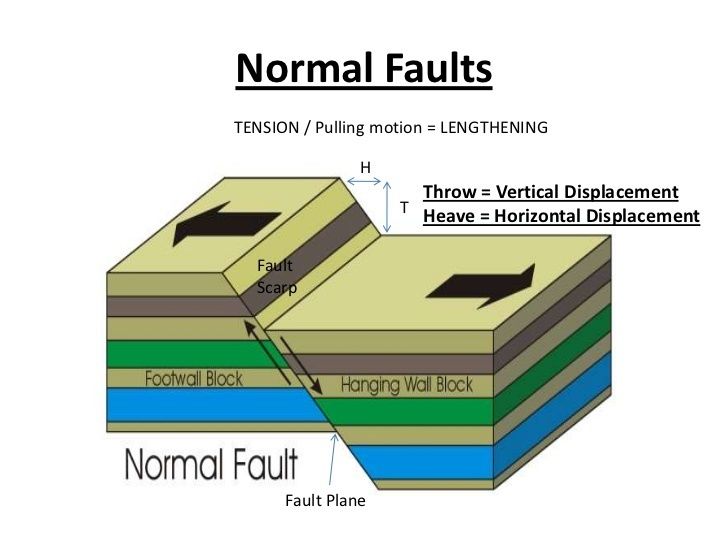
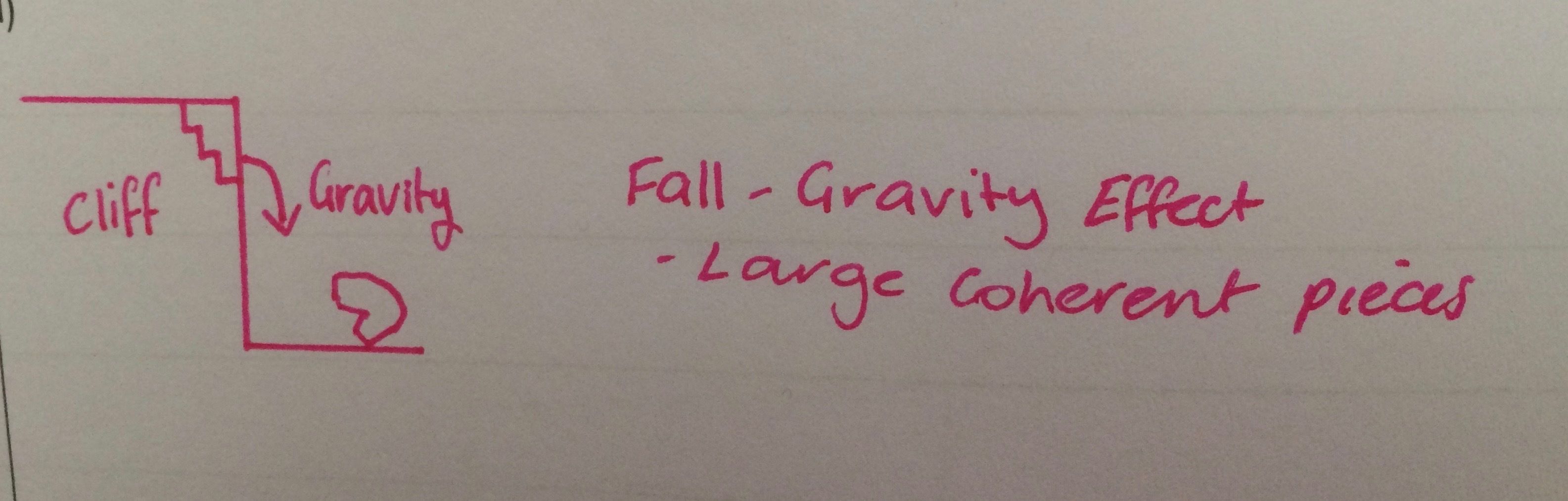
- 51what is a fall
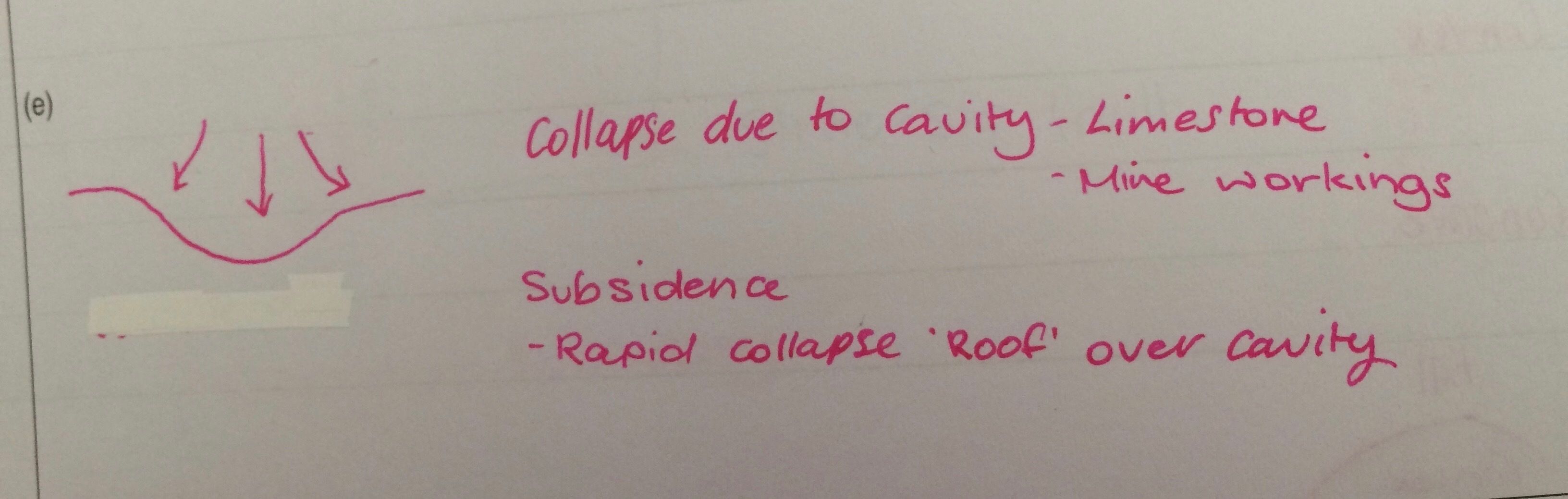
- 52what is a subsidence
- 53How can mass movement be predictedPast events
knowledge of vulnerable areas
watch for secondary hazards - 54How do rock materials influence weatheringWeathering typically accesses a rock through water and gases
Many rocks are impervious to access of these except along their surface - 55how do joints and fractures influence weatheringincrease access to weathering solutions to a rock
Their presence increases the potential for a rock to weather - 56What are primary and secondary mineralsPrimary minerals are those that occur in the original rock
Secondary minerals develop from weathering e.g. clays and oxides - 57what is mineral stability for olivine and quartzOlivine is much less stable and chemically weathers
Granite > Quartz - 58what is the process of weathering for graniteThe biotite undergoes hydrolysis to form clay, oxidation forms iron oxides.
Quartz will remain as residual minerals.
Quartz grains may be eroded, becoming sediment. - 59what is the process of weathering for basaltBasalt is composed of minerals with little resistance to weathering.
e.g. SO2, Al2O3
Hence, basalt as a whole also tends to disintegrate faster than granite and other felsic rock types. - 60what is the process of weathering for sandstonesandstones are composed resistant minerals (e.g. quartz)
resistant features controlled by joints and fractures - 61what is the process of weathering for limestoneDissolves in slightly acidic waters
Dissolved cavities (e.g. caves) and channels are common - 62What is a regolithEverything between fresh rock and fresh air
Weathered mantle and all within it - 63what is a saproliteAbove bedrock, base of regolith (weathered)
Materials, retains physical and chemical characteristics of bedrock - 64what is a weathering frontInterface between weathered and fresh materials
- 65What are duricrustsSurface, hard, indurated
(water-based solution, precipitation) - 66What is the main mineral constituent for ferricreteiron induration
- 67What is the main mineral constituent for silcretesilica induration
- 68What is the main mineral constituent for calcretecalcium induration
- 69What is the main mineral constituent for bauxiteAluminium
- 70What is the main mineral constituent for gypcreteGypsum crust
- 71What is the main mineral constituent for haliteSodium Chloride (Salt)
- 72What is a desertlow evaporation rate
vegetation ground shrubs
low rainfall <10'', 25cm - 73what are the five types of desertsSubtropical - Sahara, Simpson
Rain shadow - Eastern Oregon
Coastal - Atacama
Continental - Gobi
Polar - Antarctica - 74What are sand duneswindblown accumulations of sand
- 75How do sand dunes formDune form depends on variation in…
Wind - velocity and consistency of direction
Sediment supply - Is sand scarce or abundant? - 76What are the three types of sand dunesTransverse, parabolic and linear
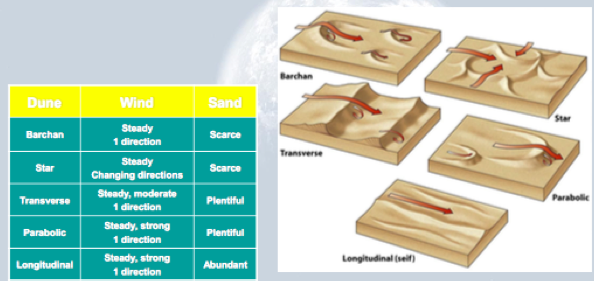
- 77What is the principal dust migration path across south/north Australia*insert photo*
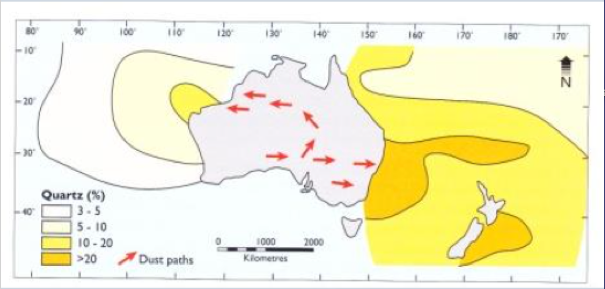
- 78What are the main coastal interaction effects with waves and tidesSediment movement and deposition
The erosion of coastal landforms
Land-derived sediment
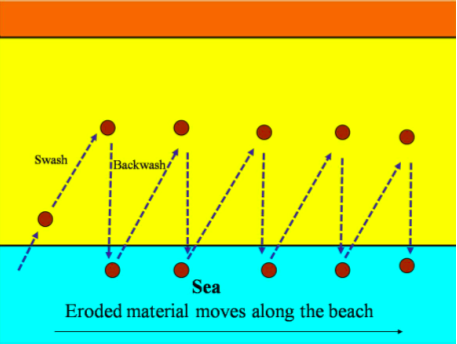
Onshore transport - 79What is swashWhen a wave breaks and water is washed up the beach
Constructive wave is stronger - 80What is backwashwhen the water runs back down the beach
Destructive wave is stronger - 81Swash and Backwash
- 82What is refractionWave crest closer to shore is shallower therefore moving slower
The wave crest in deeper water catches up so the wave crest tends to become parallel to the shore.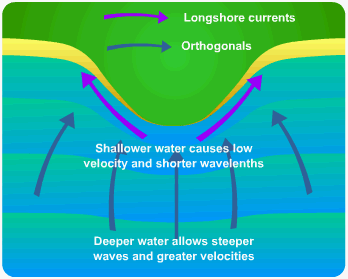
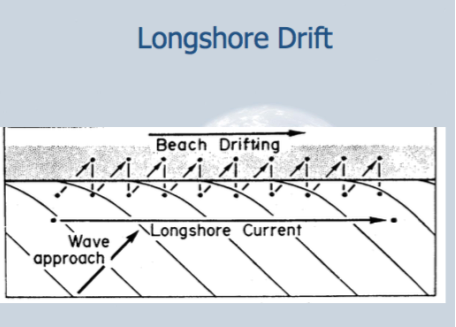
- 83What is longshore drift
- 84What is the main periodicity of tides and how do they formMost coasts experience two lows and two high tides every 24 hours
The moon pulls most strongly on water on the side of the earth facing it - 85What is a neap tideWhen the sun and moon are pulling at right angles to each other the difference between high and low tides is minimised.
- 86What is a spring tideTidal extremes are greatest when sun, moon and earth are all aligned, and the sun and the moon are thus pulling together.
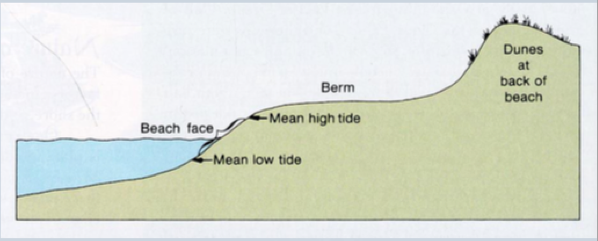
- 87What is a beach face and how does it formTHE BEACH FACE IS BETWEEN THE HIGH AND LOW TIDES
- 88What is a berm and how is it formedzone of vertical accretion formed by backwash deposition and its elevation is therefore limited by the upper limit of the swash
- 89what is a dune profile and how does it formPrimary dunes (foredunes) are fed directly by beach sand. Dune grasses are common
Secondary dunes develop through erosion of primary dunes, secondary dunes can arise from reduction in sediment supply, vegetation cover, or from increase in wind velocity - 90What are the seasonal patterns of beach developmentswell waves in the summer is due to deposition from swash & beach construction, with berm development
Winter storm waves cut back or completely destroy the berm
eroded sediment is transported offshore into longshore bars, before returning to the beach next summer - 91What is GondwanaGondwana is the great southern supercontinent formed from the original Pangaea supercontinent
- 92What is Pangaeaa hypothetical supercontinent that included all current land masses, believed to have been in existence before the continents broke apart during the Triassic and Jurassic Periods.
- 93What is the approximate ages of breakup of Gondwana150 million years ago
- 94What are paleo-surfaces and how long have they been preservedANCIENT LAND SURFACE, PRESERVED BACK TO PERMIAN
- 95How do we recognise paleo-surfaces in AustraliaUSUALLY HIGH AREAS THAT ARE FLAT
- 96What are the major phases of rifting and what are the ages of these riftsFOR SOUTHERN AUSTRALIA, RIFTING WITH ANTARCTICA STARTED ABOUT 150 MA
- 97How are rift sequences seen in the geological record of AustraliaPASSIVE MARGINS, OFTEN WITH EVIDENCE OF VOLCANISM
- 98What are the different plate boundaries that surround the Indian-Australian PlateCONTINENTAL COLLISION BETWENE INDIAN AND EURASIA, MOSTLY OCEAN-OCEAN TO THE NORTH OF ASUTRALIA, DIVERGENT MARGIN TO THE SOUTH.
- 99How is stress transmitted across the India-Australian PlateTRANSMITTED ACROSS THE PLATE DUE TO COLLISION OF INDIA WITH EURASIA
- 100How is Australia tilting and what are the landscape features that show thisContinental margin width, onshore marine sediments, exposed paleo-coastlines
- 101Why are there no marine sediments in the Eyre Basin despite it being currently below sea levelITS CURRENTLY BELOW SEA LEVEL BUT SEA LEVELS IN THE PAST (= CRETACEOUS AND EOCENE ) WERE MUCH HIGHER
- 102What is the last major glacial event in the Permian 270 MaNO MAJOR GLACIATIONS IN AUSTRALIA SINCE THE PERMIAN
- 103What are the other indicators of glacial events since thenSMALL GLACIAL FEATURES IN MOUNTAINS
- 104Why is there little evidence of ice from the Cretaceous period, despite Australia being at high altitudesAt this time temperatures, CO2 and sea levels were higher
- 105What is the K-T boundary and mass extinctionK stands for Cretaceous and T for Tertiary
Caused by a 10km wide meteorite at Yucatan Peninsula, Mexico
Debris from the impact caused months of darkness and cold plus acid rain therefore breaking food chain - 106Why was the Eocene a thermal maximumthere was an increased aridity as Australia has moved north
- 107How do rivers and lakes react to glacial and inter-glacial eventsIN GLACIAL TIMES, SEA LEVEL IS LOWER AND RIVERS CUT DEEPER INTO THE LANDSCAPE
- 108What is the difference between local (tectonic) and global (eustatic) sea level changeLocal changes
departures from global sea-level records
Resulting from local tectonics (uplift and subsidence)
Global
Derived from large global data sets from different settings.
e.g. regression and transgression - 109What is a transgressionWhen sea-level rises the coast migrates inland
- 110What is a regressionWhen sea-level falls the coast migrates seaward
- 111Why was there a major sea level maxima in the Cretaceous and the Tertiarythe Cretaceous sea level high was earlier than in other parts of the globe, therefore Australia was uplifted during mid to late Cretaceous
- 112How does the Eucla Basin geomorphology show significant regressions over the last 45 Mapaleoshorelines
- 113Why are paleo-shorelines across South Australia generally higher than the sea-level fall particularly in eastern AustraliaRECENT UPLIFT OF THE LAND, PARTICULARLY IN EASTERN AUSTRALIA
- 114How can paleo-shorelines of the coorong be shown to have regressed (moved sea wards)SUCCESSION OF DUNES THAT GET OLDER INLAND
Information
- Description
- Earth Systems Flashcards on Earth Systems Lecture Test #3, created by Olivia Gniadek on 04/06/2018.
- Created by
- Olivia Gniadek
- Views
- 47
- Tags
- Rating