
Flashcards
13.) Syntax 3
Cards in this deck (16)
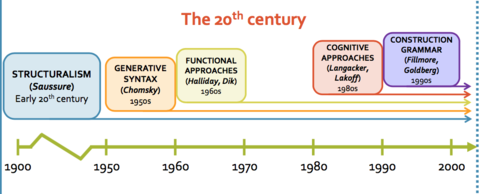
- 1Linguistic approaches & paradigms The 20th century timeline
- 2Parameters How are these approaches different from one another?• Different focus of attention (i.e. do they focus on syntax? Or more?)
• Modular or non-modular (see focus of attention)
• Lexical-grammar distinction (list vs. rule)
• Generative or not (i.e. predictability)
• Relevance of linguistic context / co-text
• Also language acquisition - 3Focus of attention What do the approaches focus on?• Syntax/form only
= modular
• All areas of linguistics as they all interact
-So not just syntax
-Pragmatics / meaning is central focus
= non-modular - 4Modular or non-modular Why go for a non-modular approach? example?Why go for a non-modular approach?
• Formal aspects may depend on semantic / pragmatic factors
We may use different word orders etc. depending on what we want to convey
For instance:
• Now THAT I can believe! (I can believe that)
• In came Count Dracula (Count Dracula came in) - 5Lexicon vs. Grammar Traditional view and more recent view
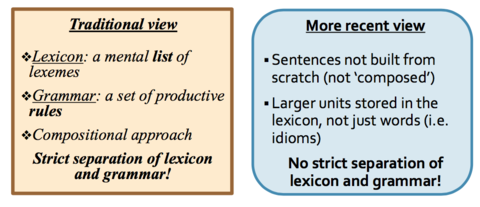
- 6compositional approach?(word+word= what we want to say)
- 7Predictability (Generative or not?)How predictable is the behaviour of a word?
Can we always tell what complementation pattern a verb requires?
-->Conflict of predictability and creativity
Take the verb ‘to whistle’ – what complementation pattern(s) might you expect?
• Intransitive (She whistled. The kettle whistled.)
• Transitive (She whistled a song.)
But what about the following sentence?
• He whistled me out of the room. - 8Generative theories are linguistic theories or models which are based on the idea that....can explain how all the.... ....a single set of rules ..... possible sentences of a language are formed.
- 9Relevance of co(n)text what's co-text? what's context?Context: Conditions/circumstances relevant to anina event
Co-text: The text that appears around the thing we’re looking at - 10Relevance of co(n)text• Does the context/co-text affect the way we express things?
• One event can be described using different words / constructions depending on the context.
• E.g. The co(n)text is relevant in the choice of article (definite or indefinite) - 11Generative grammar Who? Language as? Quick factsLanguage as expression of thought
Noam Chomsky
Quick facts:
• Focus of attention: Syntax, form
• Modular or non-modular? Modular
• Lexical-grammar distinction: Strict distinction; compositional
• Generative or not? Well, yesEither grammatically correct or incorrect
• Relevance of linguistic context / co-text: Context is irrelevant - 12Functional approaches Who? Language as? Quick factsLanguage as a means of communication
Simon Dik, Halliday
• Focus of attention: Communicative function (syntax secondary)
• Modular or non-modular? Non-modular
• Lexical-grammar distinction: Lexicon and grammar separate, but distinction not
always clear cut (e.g. idioms)
• Generative or not? No. Language isn’t static.
• Relevance of linguistic context / co-text: Yes, if it influences the linguistic form (e.g. given-before-new) - 13Cognitive approaches Who? Language as? Quick factsLanguage as reflection of conceptualisation
Ronald Langacker, Lakoff
• Focus of attention: Meaning (then communicative use)
• Modular or non-modular? Non-modular
• Lexical-grammar distinction: No strict distinction
• Generative or not? No. Language isn’t static, but dynamic.
• Relevance of linguistic context / co-text: Context is essential to meaning; no
such thing as ‘core meaning’ - 14Construction grammar Who? Language as? Quick factsLanguage as anina inventory of construction
Adele Goldberg, Fillmore
• Focus of attention: Construction
• Modular or non-modular? Non-modular
• Lexical-grammar distinction: No strict distinction; all constructions have meaning
• Generative or not? No. Language isn’t static, but dynamic. There are patterns, but
creative use and change is possible.
• Relevance of linguistic context / co-text: Context is important - 15What is a construction?A stored pairing of form and meaning
- 16For example, not only words have their own fixed meaning, but also:• Fixed expressions (e.g. No way! How’s it going? etc)
• Semi-fixed expressions (e.g. The Xer the Yer)
• Abstract constructions (e.g. Subject-Verb-Object)
• Abstract elements (e.g. determiners, present tense, person, etc)
Adele GOLDBERG
Information
- Description
- Linguistics (Syntax) Flashcards on 13.) Syntax 3, created by Lisza Neumeier on 09/12/2016.
- Created by
- Lisza Neumeier
- Views
- 9
- Rating