
Flashcards
Metallic Bonding
Cards in this deck (19)
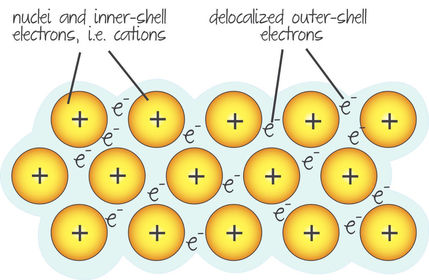
- 1Describe the ionization of a metalthe outer shell (valence) electrons from the atoms in the structure are no longer associated with each particular metal atom, but become free to move throughout the metal - these electrons are described as delocalized and are frequently referred to as a 'sea of electrons'. The metal atoms are effectively ionized.
- 2Explain the composition of metal crystalspositive ions (cations), surrounded by the 'sea' delocalized valence electrons.
- 3What is metallic bonding?the electrostatic attraction between the lattice of metal cations and the delocalized outer-shell electrons.
- 4Explain metallic bondingMetallic bonding is non-directional: all of the outer valence electrons are attracted to the nuclei of all the metal ions. The presence of delocalized electrons in the metal lattice provides an explanation for the physical properties of metals. This model of metallic bonding is often known as the 'electron-sea' model, where the delocalized valence electrons form the mobile ‘sea of electrons’ in which the metal ions are located.
- 5Metals show a distinctive range of common physical properties. What are they?-they are ductile and malleable,
-are excellent conductors of heat, and
-are excellent conductors electricity. - 6Explain the outcome if sufficient force was applied to a metalIn our model of metallic bonding, the outer electrons do not belong to any particular atom and the bonding is non-directional. Thus, if sufficient force is applied to the metal, one layer of metal atoms can slide over another without disrupting this bonding (Figure 3). The metallic bonding in a metal is strong and flexible, and so metals can be hammered into thin sheets (malleability), or drawn into long wires (ductility) without breaking or shattering.

- 7What happens when a voltage is passed through a metal? Continue your answer with an explanation of the delocalized electrons.When a potential difference (voltage) is applied across a metal, a direction is imposed on the movement of the mobile electrons. They are repelled from the negative electrode and directed to move towards the positive electrode. This orderly flow of delocalised electrons in a given direction constitutes the flow of an electric current.
The delocalized electrons can also move along the metal conducting heat by carrying kinetic energy (in the form of vibrations) from the hot part of the lattice to the colder parts of the metal. Thus the presence of delocalized electrons in the metallic lattice accounts for the high thermal and electrical conductivity of metals. - 8Explain the distinctive properties of metals.The physical properties of metals are quite distinct from those of ionic compounds, and indeed covalent elements (non-metals) and compounds. Many metals are strong and can be shaped and bent without shattering or breaking; the majority are malleable (they can be beaten into thin sheets) and ductile (they can be drawn into wires). They are excellent conductors of heat and electricity.
The mobility of electrons in the structure can also explain why metals have lustre and can be polished - they are shiny when cut or polished, and can participate in the photo-electric effect.
A theory of metallic bonding needs to account for all these physical properties, their general applicability, and indeed any trends observed in these properties for different metals. - 9Enter text here...Correct choice #1
sodium
Explanation
#1 is correct; the description is that of the metallic bond and only #1 is a metal. #2 a network covalent lattice, #3 is an ionic lattice and #4 is a simple molecular substance (made up of S8 molecules).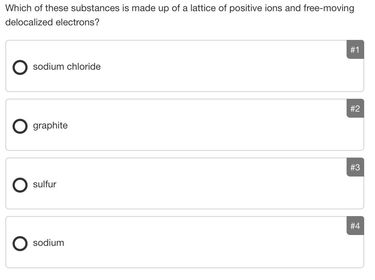
- 10How can metallic bonds be described?Metallic bonds are strong forces of attraction between delocalized electrons and positive ions. Metal lattices are often described as consisting of positive ions surrounded by a 'sea' of delocalized electrons.
- 11The stronger the bonding, the ____ the melting point.Higher
- 12What are the two factors controlling the strength of a metallic bond?De localized electrons
Size of metal ions - 13strength of metallic bond ∝ the number of valence electrons per atom and inversely proportional to the size of the atoms involved. strength of metallic bond ∝ 1 / metallic radiusstrength of metallic bond ∝ the number of valence electrons per atom
and inversely proportional to the size of the atoms involved.
strength of metallic bond ∝ 1 / metallic radius - 14the strength of metallic bonding therefore increases as we move across period ___.Three
- 15Why do the transition metals tend to have very strong metallic bonds?The transition elements tend to have very strong metallic bonds due to the large number of electrons that can become delocalized from both 3d and 4s sub-shells. We have seen earlier that these two sub-shells are very close energetically and all of these electrons are available to participate in the bonding in the metal.
- 16How are alloys produced/formed?By adding one or more metal elements to another metal in its molten state so that the different atoms can mix. The mixture solidifies and so the ions of the different metals are scattered throughout the lattice. Eventually ions bind with delocalized electrons so they form metallic bonds.
- 17The productions of alloys is possible because of two factors. What are they?-the non directional nature of the delocalized electrons in metallic bonding.
- the fact that the lattice can accommodate ions of different sizes. - 18In a pure metal, the layers of atoms can slide against each other if force is applied. This is not necessarily the same for alloys. Why?Because the atoms in alloys can be different sizes due to the mixture of metals so there is no longer a regular formation of layers and is disrupted by atoms of other sizes so can no longer slide across or against each other.
- 19Do transition metals have higher mp than metals in group 1,2 or 3? Why?Yes
Because they involve 4s as well as 3d electrons in the 'sea' of delocalized electrons. As more electrons are involved in the metallic bond, the structure will be stronger and thus will have a higher mp/bp.
Information
- Description
- International Baccalaureate (IB) Chemistry (4- Bonding ) Flashcards on Metallic Bonding, created by Lizzy Crockatt on 07/02/2017.
- Created by
- Lizzy Crockatt · Feb 2017
- Updated
- Feb 7, 2017
- Views
- 355
- Rating