
Flashcards
Chapter 1 Flashcards
Cards in this deck (13)
- 1Describe the term data and give an example of data [2]Data has no meaning, e.g. 12G6
- 2Show how data can become information [3]Data: 1250
Structure: Currency, two decimal places - 12.50
Context: UK pounds - £12.50
Meaning: Price of a family cinema ticket - 3Identify two different methods of representing information and give an advantage for each method [4]Text - clear to understand
Sound - good for visually impaired people - 4Describe three different costs of producing a leaflet in house? [6]Personnel - costs of employing someone to collect data/produce information
Hardware - cost of printers and computers
Software - cost of software - spreadsheet, database, DTP - 5Describe three advantages of encoding data [6]Less memory requirement - storing less information, therefore requiring smaller hard drive
Speed of input - codes take less time to enter therefore it is quicker to input large amount of data
Organisation of data - if data is in a standardised format then it can be compared and organised - 6Describe and give examples of three different methods of validation. Identify an appropriate field for each type of validation [9]Range check - upper and lower boundary for the data. The data entered must lie between these two values, e.g. DOB
Type check - make sure that the data entered is of the correct type, e.g. telephone number
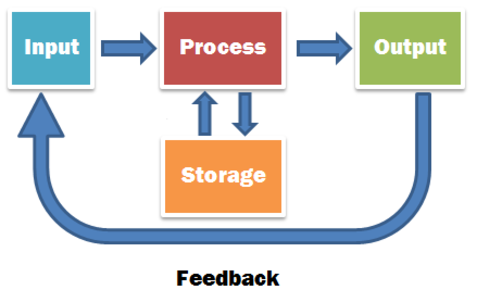
Presence check - some fields must have a value filled in, e.g. Surname - 7Data is input a system, processed, stored and outputted from the system. Draw a diagram to show how the terms: input, process, storage and output are related [4]
- 8Describe the advantages of text, graphics and sound representation methods, and give an example of their use [9]Text - clear to understand, lots of detail can be given, e.g. table of contents
Graphics - can match what you see - physical shapes, e.g. screenshot of features of application
Sound - can give feedback (good/bad), good for visually impaired people, e.g. text-to-speech - reading text - 9Describe the difference between information and knowledge [4]Information is based on certainties, knowledge is based on deductions.
Knowledge is based on information whereas information is based on data. - 10Describe what is meant by direct and indirect sources of data and give an example of each [6]Direct: Individual creating the source and collecting information themselves; no third party between individual and information, e.g. screenshots from individual using a software.
Indirect: Information could have been bought or passed on or used for a purpose other than that for which it was originally collected, e.g. screenshots of error messages and solutions provided by a company in manual. - 11Identify three factors that affect the quality of information and for each, use an example to describe how it could affect information [6]Accuracy - whether the information is correct or not - wrong screenshots of menu items given.
Relevance - is it about the topic - not about different software
Age - how up to date the information is - not too old to be of little value - not about previous versions of software - 12Describe the difference between static and dynamic data, and give an example for each [4]Static - does not change, e.g. text in a manual on how to complete a task.
Dynamic - can change/be updated, e.g. FAQs which can be updated. - 13Describe what feedback a company could receive on its manuals and how it could use the feedback to improve future manuals [4]Feedback from customers with suggestions on improvements which could be included in future versions.
Feedback from sales - influence on marketing and price.
Information
- Description
- ICT Flashcards on Chapter 1 Flashcards, created by Kiran Panesar :) on 23/04/2014.
- Created by
- Kiran Panesar :)
- Views
- 14
- Rating