
Flashcards
Umweltökonomik
Cards in this deck (50)
- 1What are the environment provided functions to the economy?1. Source of resource inputs
2. Source of amenity service
3.) Waste sink
4.) Provides life support services - 2Can flow resources be stored? Do they depend on the use of the past?NO there is no link between current and future use availability! Just stock resources, and only stock resources depend on the availability of yesterday!
- 3Was are the difference between fossil fuels (ff) and other minerals?- ff are intensively used in industrial economies
- minerals can be recycled, ff combustion is irreversibel
- for given use rate minerals date of exhaustion can be delayed
-burn ff damage caused by CO2 - 4What are the Amenity Services of the environment?The human has a deep binding with the nature.
Biodiversity is not only a beauty on earth it provides a lot of services for people.
It makes living on earth possible for us. - 5What are the two possibilties how recycling can substitute environmental services?1.) Demand to the sink function of the enviromental decreases
2.) With recycling materials the demand on extractions from enviroment decreases.
reproducible capital replaces natural capital - 6What are examples for: Open sys? closed sys? isolated sys?O. Sys. Engergy & material exchanges with environment => An Organism
C.Sys. only energy exchange wit e. => planet earth
I.Sys. no exchanges => the universe - 71.) Thermodynamic LAW 2.) Thermodynamic LAW1.) Energy can not be destroyed nor created, just converted!
2.) Lose of energy with conversion (chaos), that implies irreversibility! Entropy - 8Describe entrophy:Measures the unavailable energy, caused by conversions.
- 9What says the material balance principle?"The law of conservation of mass" says that material can neither be created nor destroyed.
Extracting matter form environment, but just transforming it, for more value. The material (eventually) returnes to environment, in a transformed state. - 10What are the differences of stability and resilience?AFTER A DISTURBANCE:
Stability means the population returns to an equilibrium.
Reslience means basic function and organicstructure stay the same. (like Monoculture decrease the resilience). - 11What are thresholds or tipping points?Crossing those "points" mean that the System will not be able to go back to it´s past equilibrium! (probably a new one)
- 12What are the dimensions of biodiversity?Amonunt of the biological organisms and their variability!
- 13Why is biodiversity so important?Diverse gene pools (no monoculture), insurance against ecological collapse. Makes nature and living organisms more robust against stress and form them in evolution.
- 14What kind of environmental impact activity you know?Extractions & Insertions
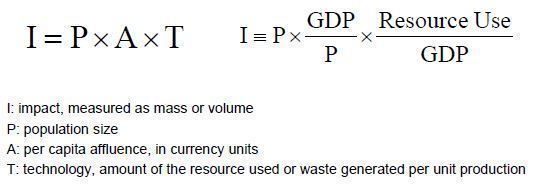
- 15How can the environmental impact activity be calculated?
- 16What does HEE mean?HUMAN ENERGY EQUIVALENT
- 17—Stage 1: Low income economy
Stage 2: Income rises -> better health and nutrition
Stage 3: increasing costs of child rearing decreases family size.
Stage 4: High income economy with equal rates -> constant pop. size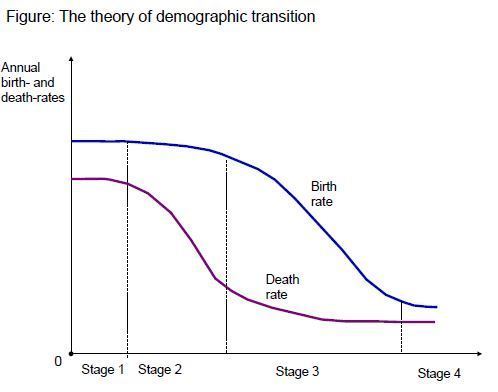
- 18What is the "Environmental Kuznets Curve"?Declining, cause industrie changes to information and service intensive economie coupled with environmental awareness! Both bring environmental friendly technology.
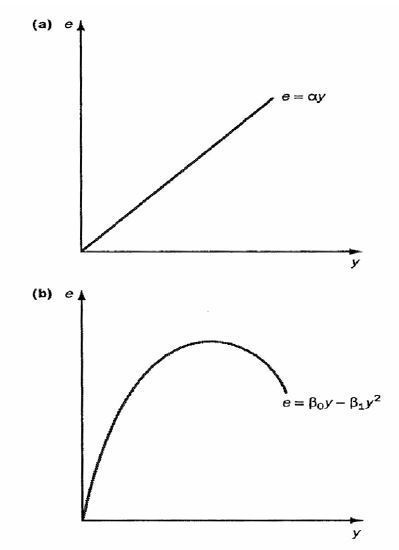
- 19What is the EKC hypothesis and does it hold in reality?The hypothesis say: With growing wealth (per capita income) the overall level of environmental degradation will fall!
Yes it hold empiracally, but not for all and not in the long run, (with expontial income increase). - 20Why is economic growth so important for today's society?It´s a way to solve the problem of poverty.
The better-off do not want redistribution from them to the poor.
Redistribution alone wont work, cause the poor are too many. - 21What were the Environmental limits in the "Word3 Model"?- Amount of land for agriculture
- amount of agricultural output
- non-renewable resources
- ability of environmental assimilation - 22Why was the "Word3 Model" criticism?The feedback loops were bad.
No pirce mechanism caused by scarcity.
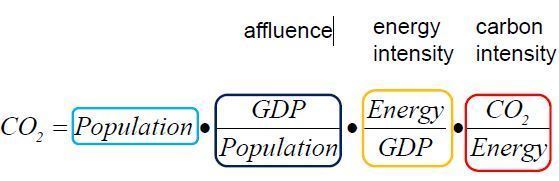
No correction of market failures - 23How we can formulate IPAT with dimensions?
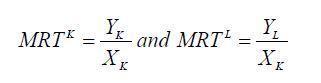
- 24What is the MRTL or MRTK?The marginal rate of transformation tells us, how much the output of one good increases by shifting an input factor away to the production process of the other coomodity.
- 25What means Economic Efficiency?It is not possible to make one person better off without making at least one worse off!
- 26What is the MRTK and what the MRTL equation?
- 27What is an "Pareto-improvement"?Making at least one person is better off without anyone else is getting worse off.
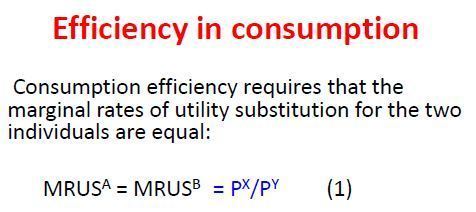
If there are not anymore improvements possible we call it PARETO OPTIMAL (or EFFICIENT) - 28What is the mathematical equation for efficiency in CONSUMPTION?
- 29What is the mathematical equation for efficiency in PRODUCTION?
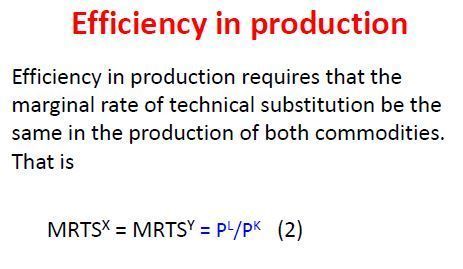
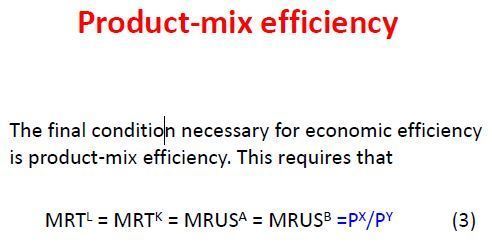
- 30What is the mathematical equation for efficiency in PRODUCT-MIX?
- 31The Product-mix efficiency graph is a "Edge worth box"! TRUE or FALSEFALSE
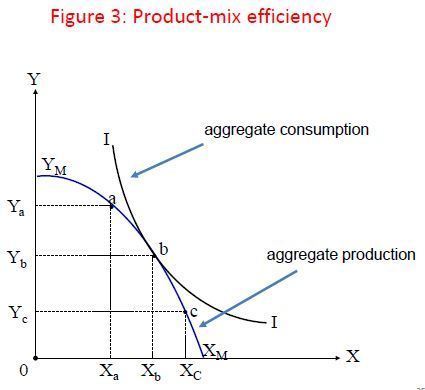
- 32There is always only one efficient allocation of resources! TRUE or FALSEFALSE
For an economy with given quantities of resources and given production & utility function, there will be many efficient allocations. - 33At the "Partial Equilibrium Framework" the demand function traces out all points where__________________?Marginal benefits are equal to the price!
MBx = P
MB > 0 MB´< - 34At the "Partial Equilibrium Framework" the supply function traces out all points where__________________?Marginal costs are equal to the price!
MCx = P
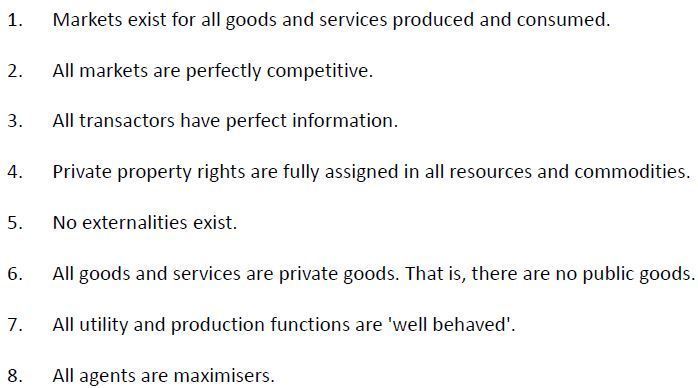
MC>0 MC´>0 - 35What are the conditions for a market to produce efficient allocations?
- 36(1) What is the efficient allocation for a 2 person markte with PRIVATE GOODS? (2) What is the efficient allocation for a 2 person markte with on commoditie is a PUBLIC GOOD?(1) MRUS of Person 1 =MRUS of P2 = MRT
(2) MRUS of P1 + MRUS of P2 = MRT - 37Why do we got an different efficient conditions?Not all consumer have the same value at the margin, only the sum of their marginal valuation has to be equal to the MC!
Market would not provide public goods in an efficient amount --> under provision caused by non-exludability! - 38Was is the "preference revelation problem"?People will understate their preferences / willingness to pay for a good, if they would have to pay for it.
And will overstate their preferences / willingness to pay for a good, if it is supplied for free. - 39What are externalities?Production or consumption decisions of one agent have impact on te utility/profi/... of another agent in an unintended way, and NO compensation is made by the generator.
- 40Externality classification: (just look at picture)
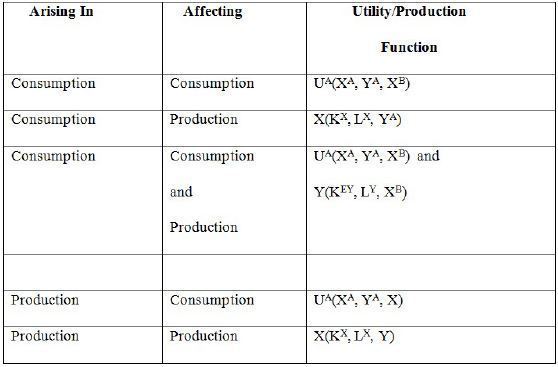
- 41Give some examples for positive (beneficial) effects in (1) Production (2) Consumption(1) The bees of a beekeeper will pollinate the flowers and trees in the neighborhood
(2) Vaccinations or a good smelling parfume - 42Give some examples for negative (adverse) effects in (1) Production (2) Consumption(1) Chemical factory discharging their contaminated water into a river.
(2) listen to loud music in a library - 43Which assumption got the "COASEM-THEOREM"?- No transaction costs
- No Income effects
- Small groups are involved in the externality problem
- Willingness to pay is not restricted by ability to pay - 44Do government intervention always realising efficiency gains?NO! Also losses possible, analysing a "market failure" does not mean that government intervention make a desirable or more efficient outcome possible!
- 45What are the 4 Points how "Public choice theory" explaining government failure?1.) To remove 1 failure does not lead to more efficient allocation if there are more than 1 fails.
2.) Goverment intervention can induce inefficiency itself.
3.) Chose the wrong instrument can, like quantity controls or direct regulation
4.) Government is not always motivated by efficiency (self-interests) - 46The pollution/emission target level depending on?- Size of modelling framework
- Geological or Politcal scope
- Partial or General equilibrium
- Systemsize - 47What are the differences of Flow and Stock-damage?FLOW-DAMAGE: is the result of "residuals" and the in inflow rate in the system.
STOCK-DAMAGE: means the pollution depends only on the stock of the pollutant (level from last periode) and the accumulation - 48Can pollution have also a benefits?YES, for example it could lower the production costs.
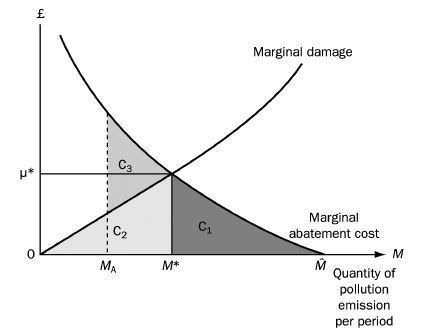
Efficient level of pollution is where "Marginal avoidance costs" are equal to the "Marginal damage of pollution"
--> Minimizes the sum of abatement costs and damage costs. MAC = MD - 49Describe the model with a Graph:
- 50—
Information
- Description
- Flashcards on Umweltökonomik, created by Gustav Glanz on 13/11/2018.
- Created by
- Gustav Glanz
- Views
- 17
- Rating