
Flowchart
Methodologies
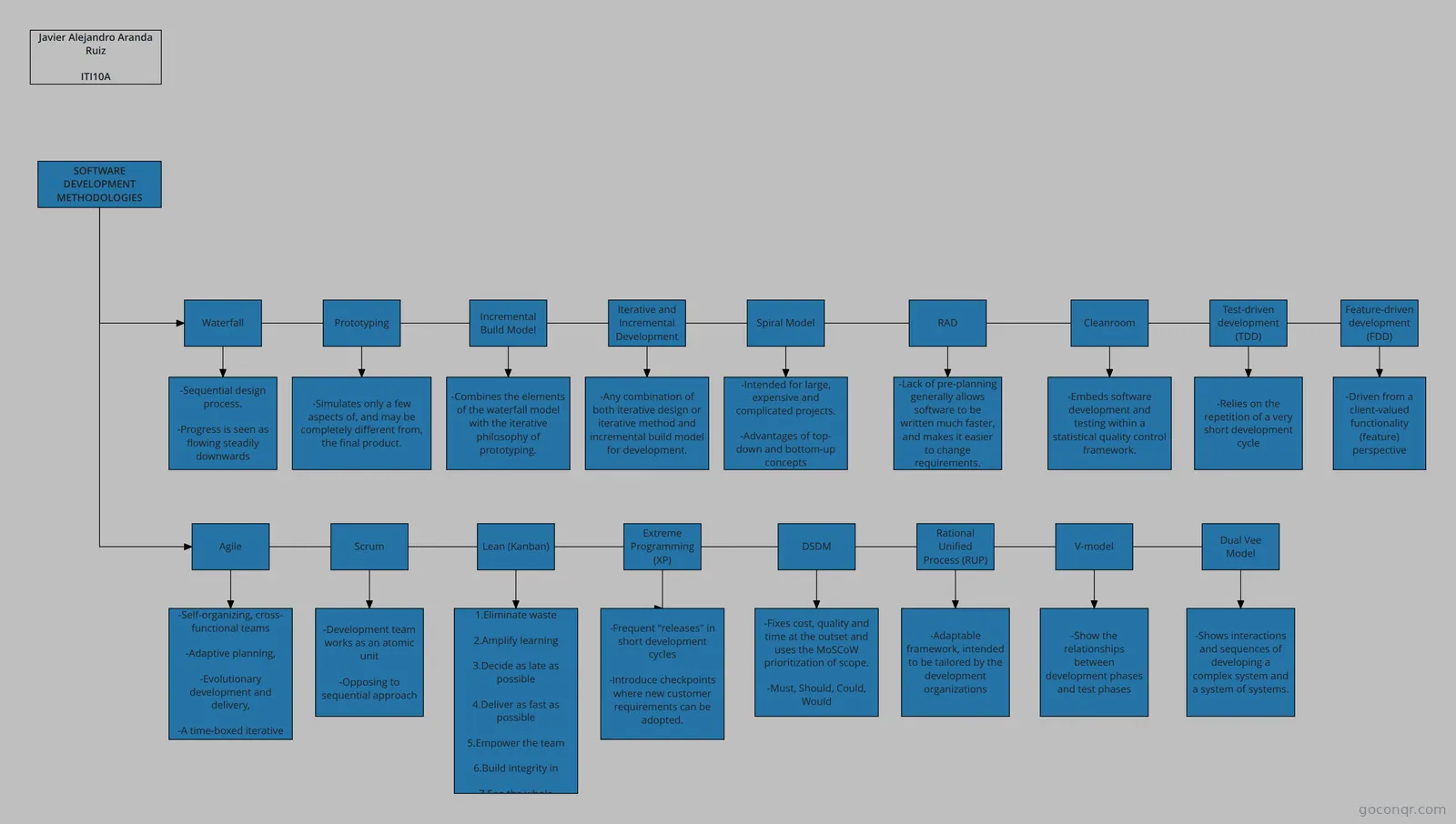
Flowchart: software development methodologies
Flowchart content
SOFTWARE
DEVELOPMENT
METHODOLOGIES
Waterfall
Prototyping
Incremental Build Model
Iterative and Incremental Development
Spiral Model
RAD
Cleanroom
-Sequential design
process.
-Progress is seen as
flowing steadily
downwards
-Simulates only a few aspects of, and may be completely different from, the final product.
-Combines the elements of the waterfall model with the iterative philosophy of prototyping.
-Any combination of both iterative design or iterative method and incremental build model for development.
-Intended for large, expensive and complicated projects.
-Advantages of top-down and bottom-up concepts
-Lack of pre-planning generally allows software to be written much faster, and makes it easier to change requirements.
-Embeds software development and testing within a statistical quality control framework.
Agile
Scrum
Lean (Kanban)
Extreme Programming (XP)
DSDM
-Self-organizing, cross-functional teams
-Adaptive planning,
-Evolutionary development and delivery,
-A time-boxed iterative approach,
•rapid and flexible response to change.
-Development team works as an atomic unit
-Opposing to sequential approach
1.Eliminate waste
2.Amplify learning
3.Decide as late as possible
4.Deliver as fast as possible
5.Empower the team
6.Build integrity in
7.See the whole
-Frequent "releases" in short development cycles
-Introduce checkpoints where new customer requirements can be adopted.
-Fixes cost, quality and time at the outset and uses the MoSCoW prioritization of scope.
-Must, Should, Could, Would
Test-driven development (TDD)
-Relies on the repetition of a very short development cycle
Rational Unified Process (RUP)
-Adaptable framework, intended to be tailored by the development organizations
V-model
-Show the relationships between development phases and test phases
Dual Vee Model
-Shows interactions and sequences of developing a complex system and a system of systems.
Feature-driven development (FDD)
-Driven from a client-valued functionality (feature) perspective
Javier Alejandro Aranda Ruiz
ITI10A
Information
- Description
- Flowchart on Methodologies, created by Javier Alejandro Aranda Ruiz on 19/03/2019.
- Created by
- Javier Alejandro Aranda Ruiz
- Views
- 0
- Rating