
Mind map
Chapter 3
Map content
Chapter 3
Chapter 4
- Logarithmic Functions
- log(base a) (x) = y
- log(base 5)625=4
- a^y=x
- 5^4=625
- Log graphs are the inverses of expoientail
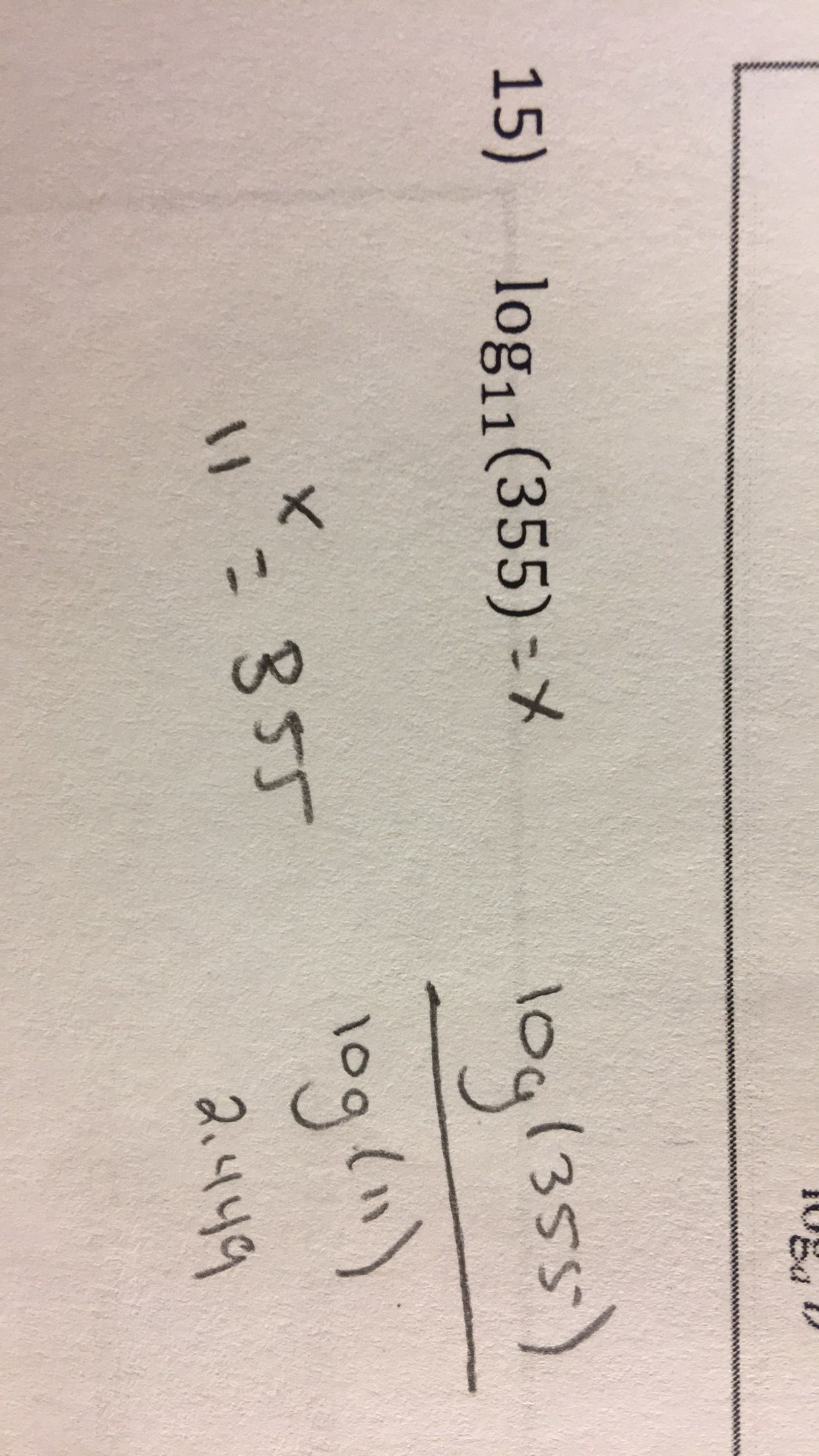
- Change of Base
- log(base)x=log(base)x/log(base)b
- Example below:
- log(base)x=log(base)x/log(base)b
- log(base a) (x) = y
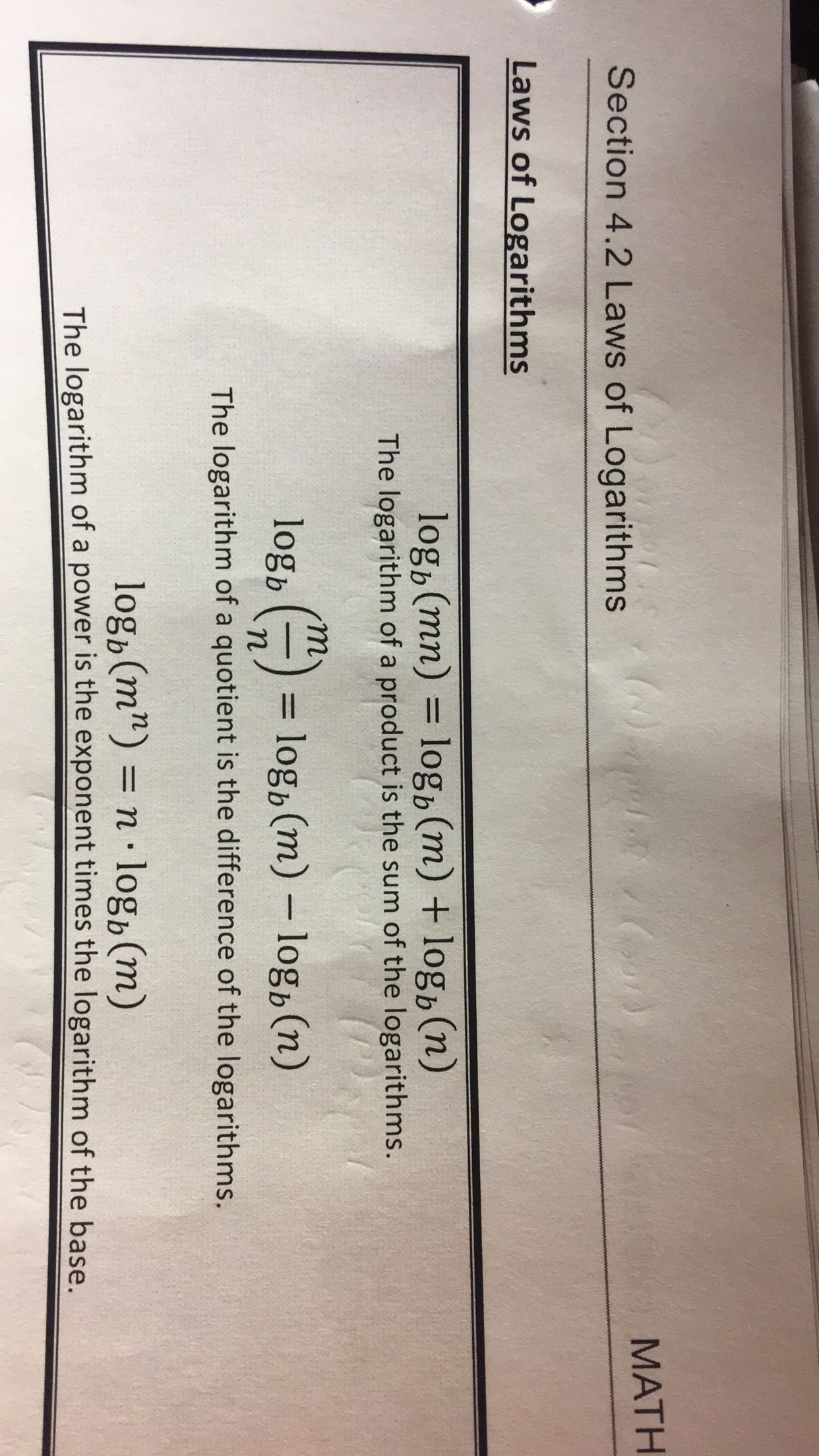
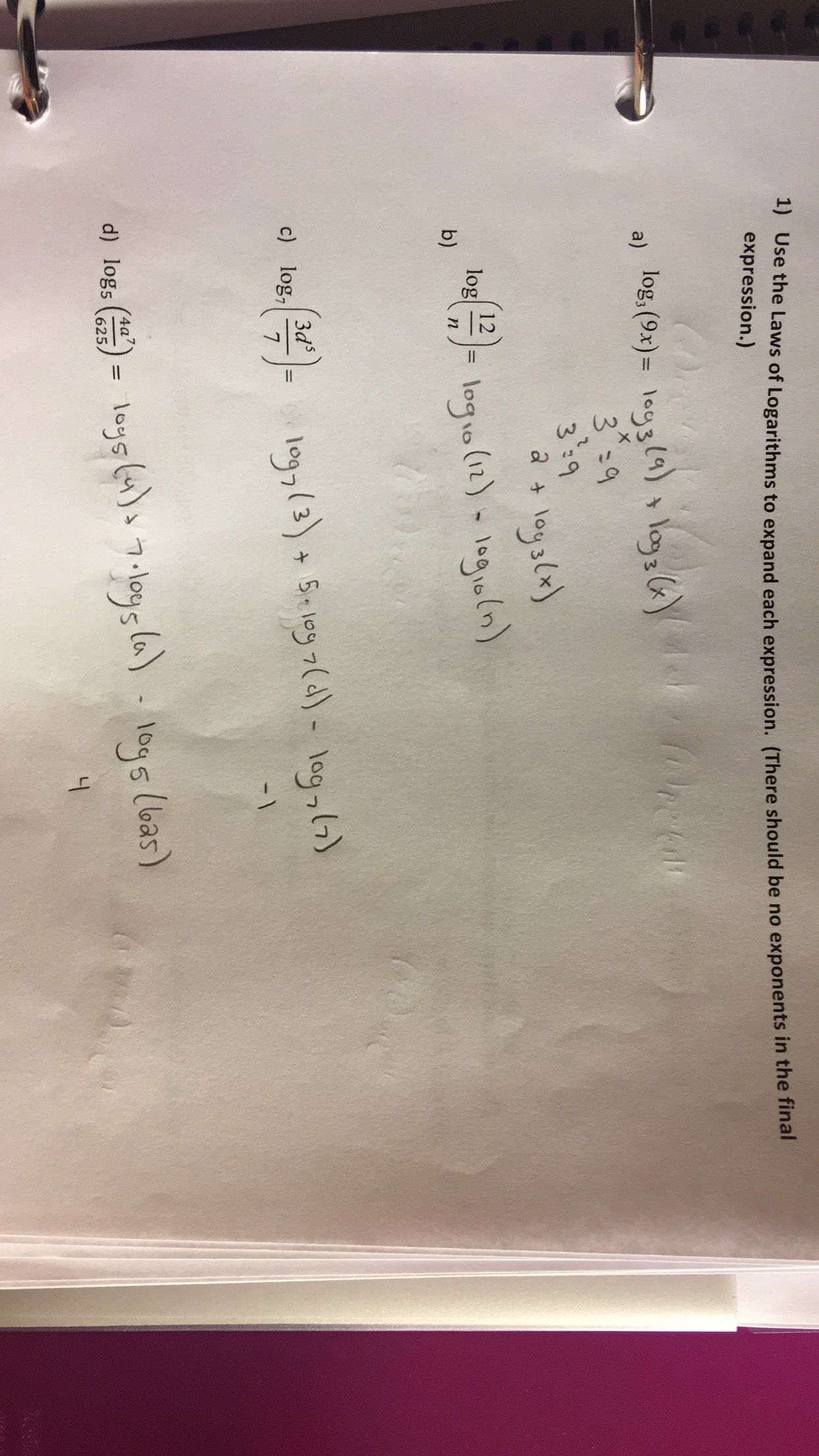
- Laws of Logarithims
- Chart of Laws below:
- Examples below:
- Chart of Laws below:
- Logarithmic Scales
- Ph Scale
- Scale ranges 0 to 14. Ph of 7 is neutral. Less than 7 is acidic, and more than 7 is basic.
- pH= -log(H^+)
- 10^-7
- pH= -log(10^-7)
- 10^-7
- Decibel Scale
- S=k times log(I/I base 0)
- I base 0 = 10^-12
- S=k times log(I/I base 0)
- Richter Scale
- M=log(I/S)
- I is the intensity of earthquake, S is the standard earthquake intensity
- M=log(I/S)
- Ph Scale
- Natural Exponential & Logarithm Functions
- Natural Exponential
- f(x)=e^x
- Natural Logarithm
- f(x)=In(x)=logbase e (x)
- Natural Exponential
- Logarithmic Functions
Exponential Growth
- x = # of time periods
- a = growth factor
- Where f)x) is multiplied when x increases by one time period
- C = initial value
- f(value when x=0
- Expoential Graphs always contain a curve in it
- Exponential Decay
- f(x)=Ca^x
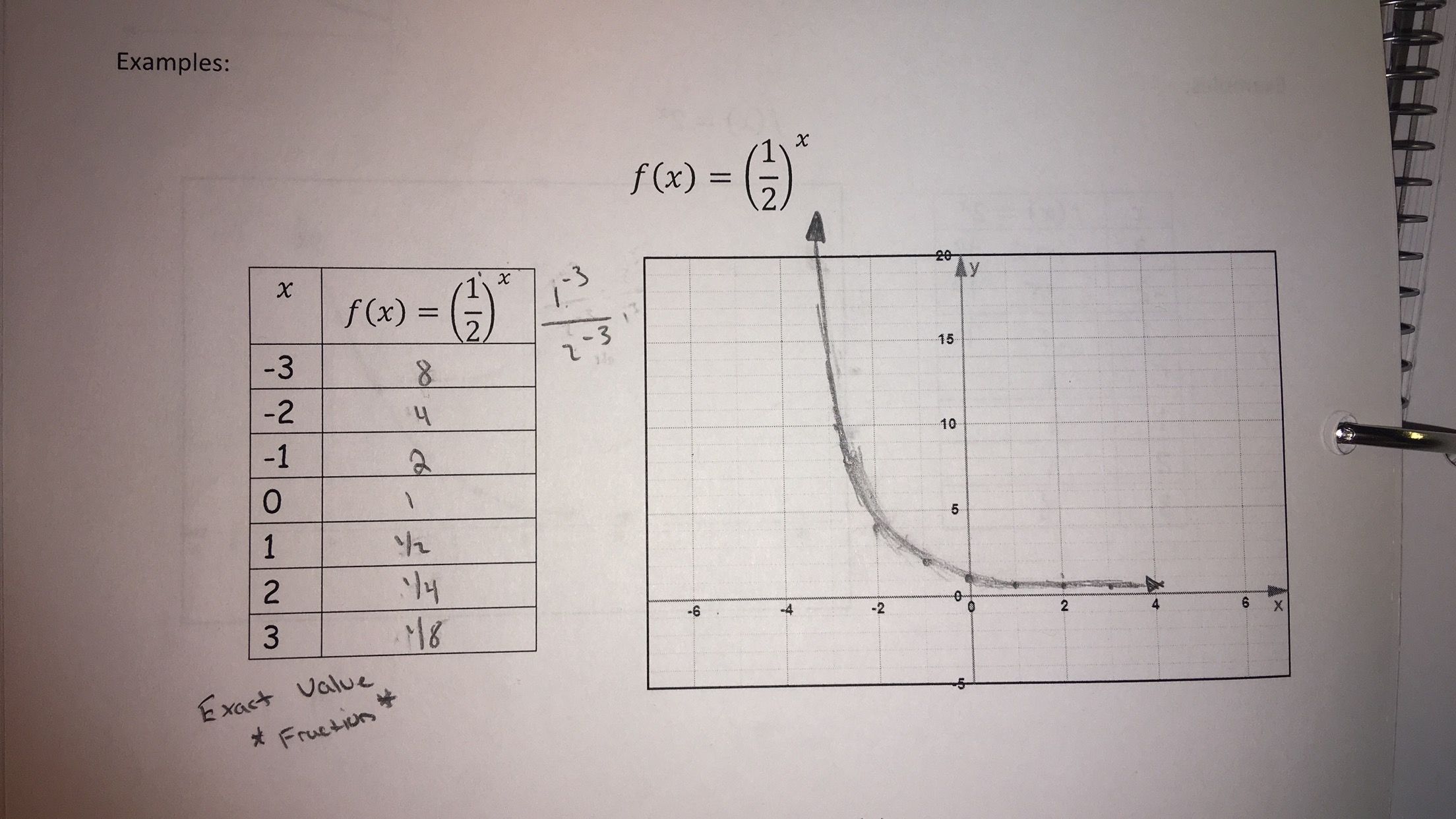
- f(x)=(1/2)^x
- Example of table and graph to the right
- The graph for an exponential growth would look the oppistie
- Example of table and graph to the right
- f(x)=(1/2)^x
- 0 < a < 1
- Decay rate is negative
- f(x)=Ca^x
- Exponential Decay
- Half Life
- Half life means 1/2 or .5
- The x value is always .5 or 1/2
- Half life means 1/2 or .5
Exponential Models: Comparing Rates
- Changing Time Periods
- If the time period is getting small the exponent will be a fraction. If its getting bigger the exponent is a hole number.
- Example:
- Jenny had 2 cats. Today 5 years later, she has 20.
- 20/2=10
- Y=2(10)^x
- 10^1/5 or 5 Square root
- Y=2(10)^x
- 20/2=10
- Jenny had 2 cats. Today 5 years later, she has 20.
- Compound Interest
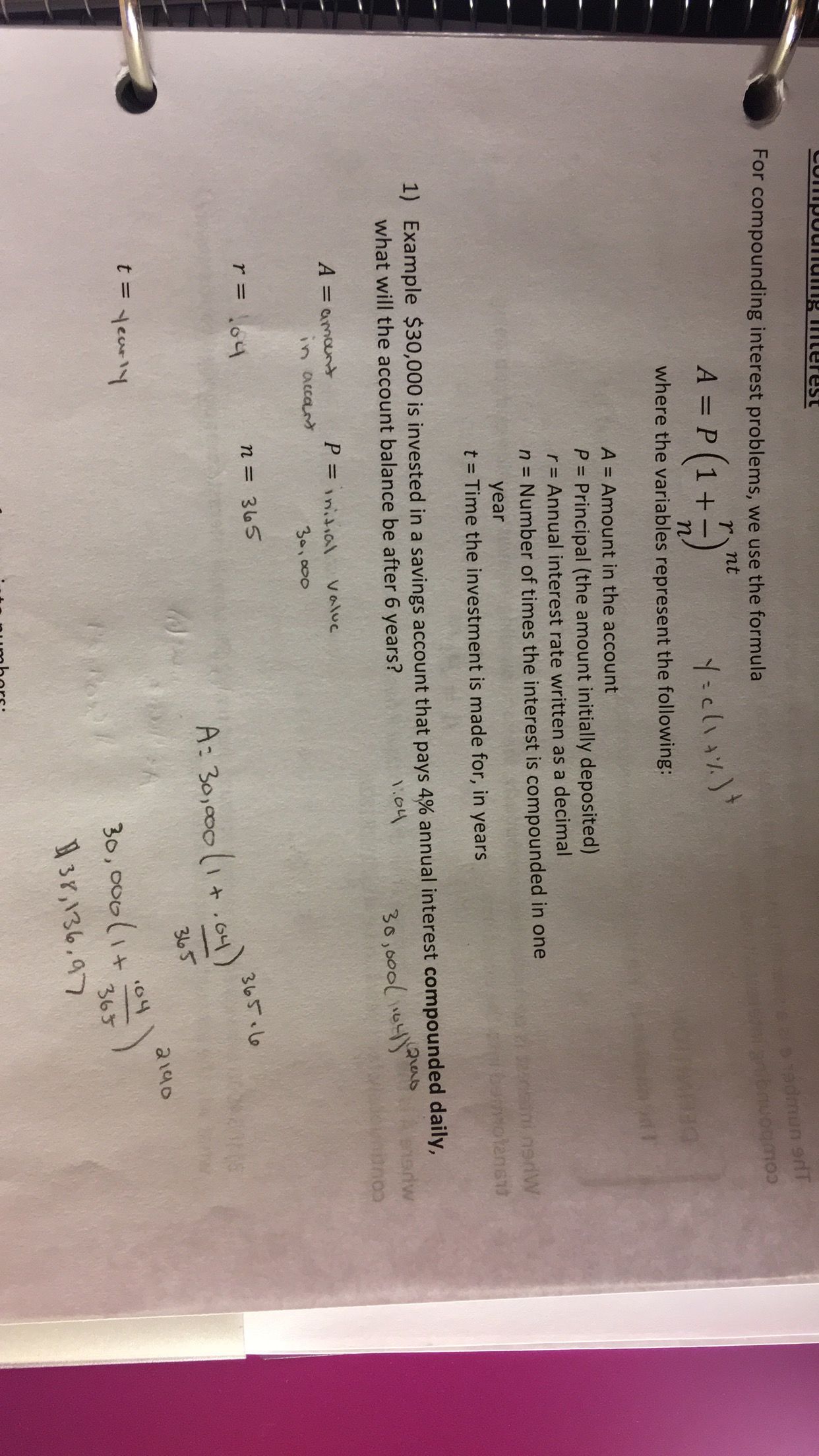
- A = P ( 1 + r/n ) ^nt
- A= Amount in the account, P= Principle, r= Annual interest rate as a decimal, n= Number of times the interest rate is compounded in one year, t= Time the investment is made for, in years.
- Example below:
- A= Amount in the account, P= Principle, r= Annual interest rate as a decimal, n= Number of times the interest rate is compounded in one year, t= Time the investment is made for, in years.
- A = P ( 1 + r/n ) ^nt
- Compounding Continuously
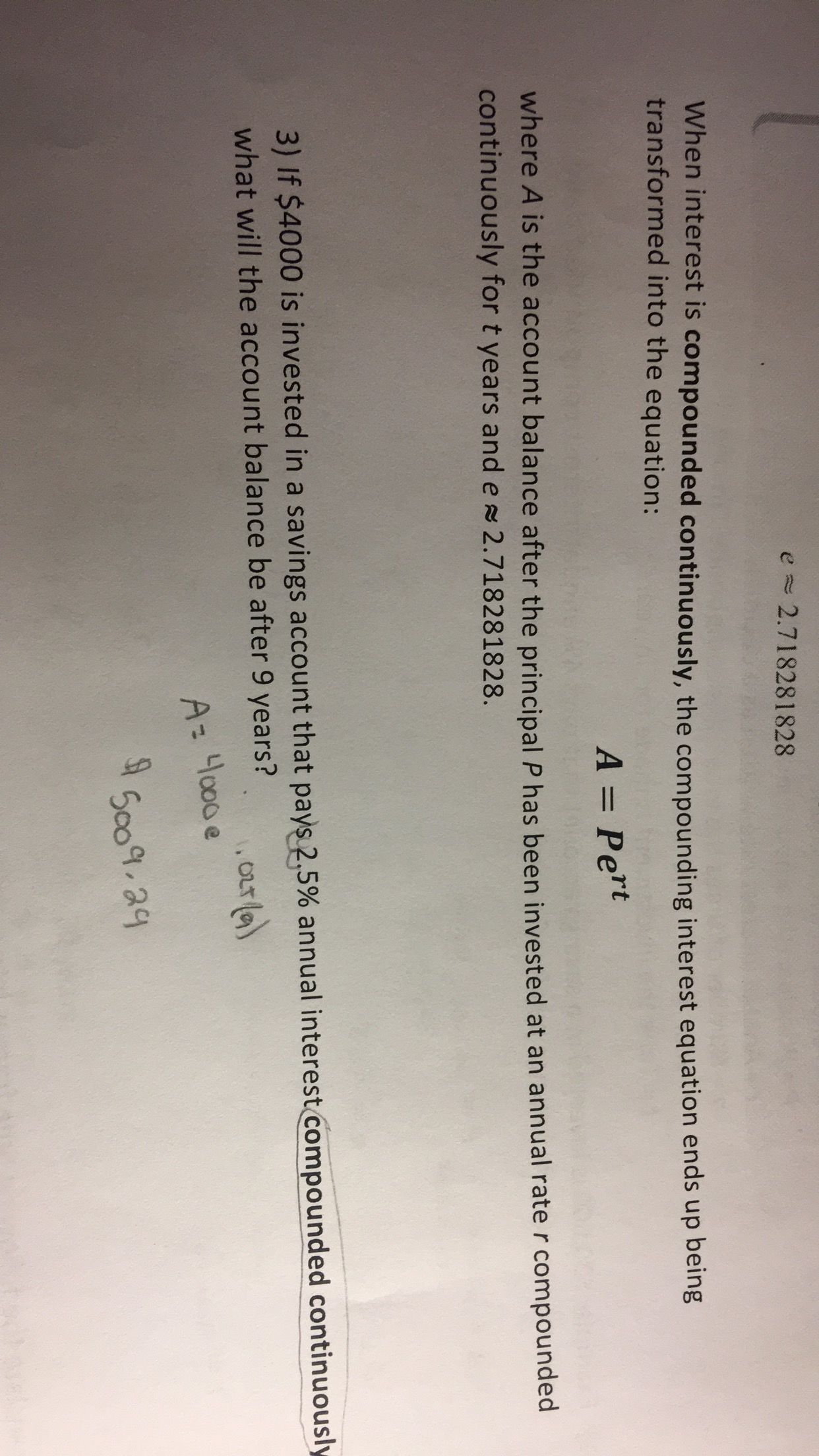
- A = Pe^rt
- An irrational number represented by the letter e.
- Example below:
- An irrational number represented by the letter e.
- A = Pe^rt
- Annual Percentage
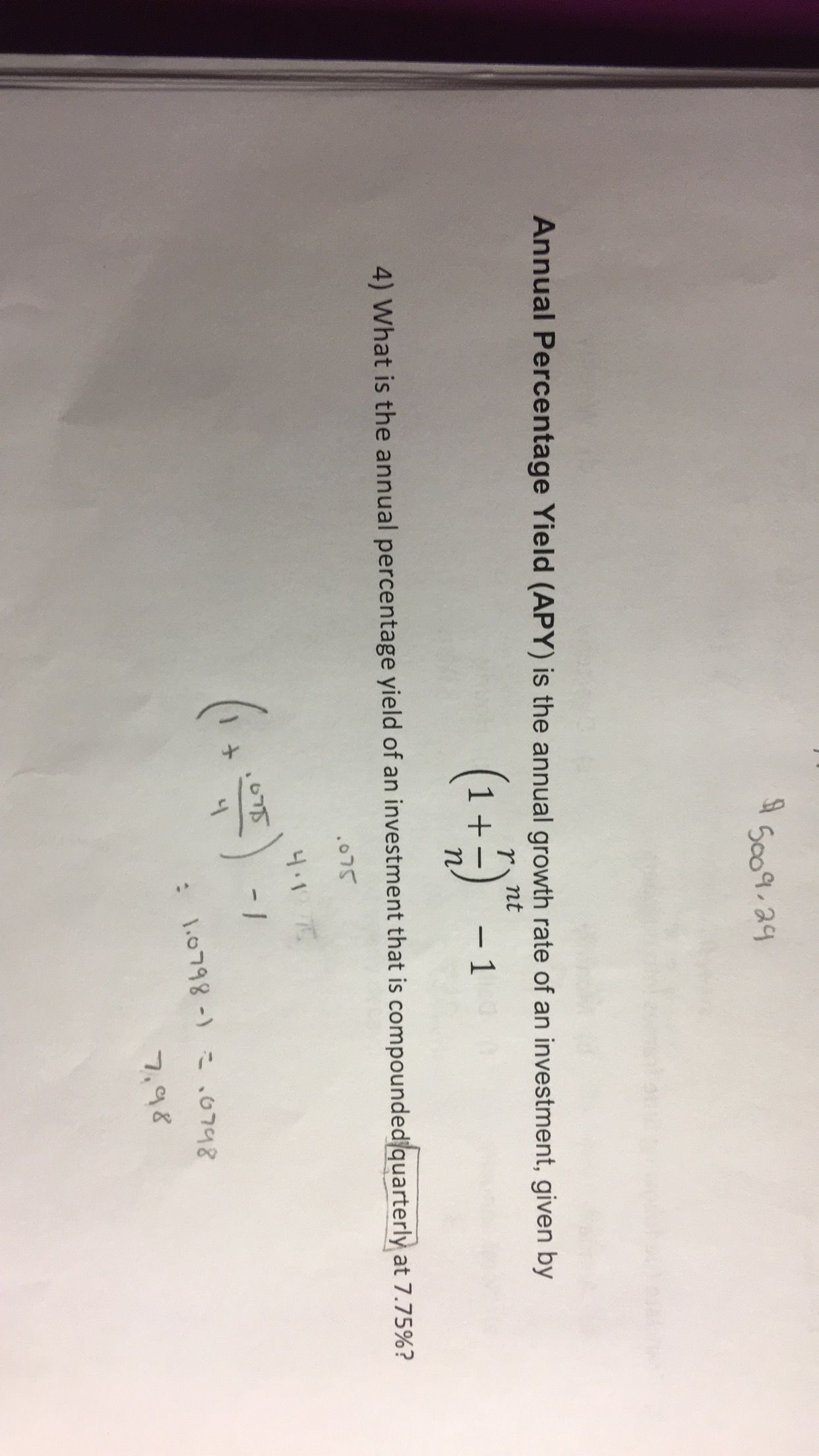
- ( 1 + r/n )^nt -1
- Compounded Quarterly
- Example Below:
- Compounded Quarterly
- ( 1 + r/n )^nt -1
- Changing Time Periods
Comparing Linear and Exponential Growth
- Rate of Change
- f(x+1)-f(x)
- % Rate of Change
- r=a-1
- Rate of Change
Images and files in the map
Information
- Description
- Mind Map on Chapter 3, created by Krystal Weise on 31/10/2017.
- Created by
- Krystal Weise
- Views
- 1
- Rating