
Mind map
Scientific activity
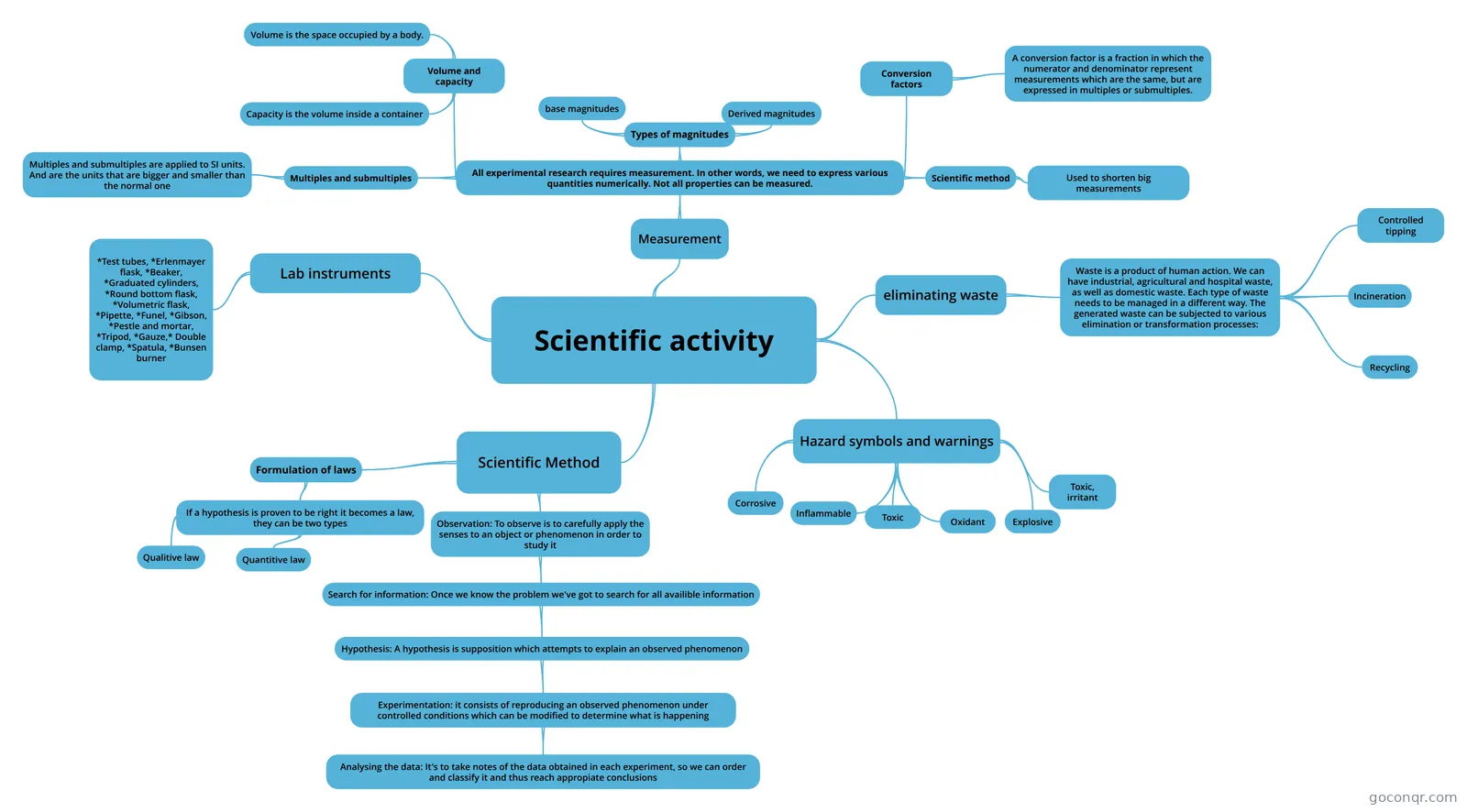
Mind map: Scientific activity
Map content
Scientific activity
Scientific Method
- Observation: To observe is to carefully apply the senses to an object or phenomenon in order to study it
- Search for information: Once we know the problem we've got to search for all availible information
- Hypothesis: A hypothesis is supposition which attempts to explain an observed phenomenon
- Experimentation: it consists of reproducing an observed phenomenon under controlled conditions which can be modified to determine what is happening
- Analysing the data: It's to take notes of the data obtained in each experiment, so we can order and classify it and thus reach appropiate conclusions
- Experimentation: it consists of reproducing an observed phenomenon under controlled conditions which can be modified to determine what is happening
- Hypothesis: A hypothesis is supposition which attempts to explain an observed phenomenon
- Search for information: Once we know the problem we've got to search for all availible information
- Formulation of laws
- If a hypothesis is proven to be right it becomes a law, they can be two types
- Qualitive law
- Quantitive law
- If a hypothesis is proven to be right it becomes a law, they can be two types
- Observation: To observe is to carefully apply the senses to an object or phenomenon in order to study it
Measurement
- All experimental research requires measurement. In other words, we need to express various quantities numerically. Not all properties can be measured.
- Types of magnitudes
- base magnitudes
- Derived magnitudes
- Scientific method
- Used to shorten big measurements
- Multiples and submultiples
- Multiples and submultiples are applied to SI units. And are the units that are bigger and smaller than the normal one
- Conversion factors
- A conversion factor is a fraction in which the numerator and denominator represent measurements which are the same, but are expressed in multiples or submultiples.
- Volume and capacity
- Volume is the space occupied by a body.
- Capacity is the volume inside a container
- Types of magnitudes
- All experimental research requires measurement. In other words, we need to express various quantities numerically. Not all properties can be measured.
Lab instruments
- *Test tubes, *Erlenmayer flask, *Beaker, *Graduated cylinders, *Round bottom flask, *Volumetric flask, *Pipette, *Funel, *Gibson, *Pestle and mortar, *Tripod, *Gauze,* Double clamp, *Spatula, *Bunsen burner
Hazard symbols and warnings
- Corrosive
- Inflammable
- Toxic
- Oxidant
- Explosive
- Toxic, irritant
eliminating waste
- Waste is a product of human action. We can have industrial, agricultural and hospital waste, as well as domestic waste. Each type of waste needs to be managed in a different way. The generated waste can be subjected to various elimination or transformation processes:
- Controlled tipping
- Incineration
- Recycling
- Waste is a product of human action. We can have industrial, agricultural and hospital waste, as well as domestic waste. Each type of waste needs to be managed in a different way. The generated waste can be subjected to various elimination or transformation processes:
Information
- Description
- Unit 1
- Created by
- Álvaro Cachón
- Views
- 1
- History
-
- Created by Álvaro Cachón · Nov 7, 2017
- Copied by Álvaro Cachón · Nov 7, 2017
- Rating