
Mind map
Period 3
Map content
Period 3
Sodium is more reactive than Magnesium
- They're the first two elements in period 3
- When they react they lose electrons as they're in groups 1 and 2
- Na loses one electron (Na+)
- Mg loses two electrons (Mg2+)
- It takes less energy to remove one electron than two electrons. So more heat is needed for magnesium to react
- Sodium will react vigorously with cold water
- 2Na(s)+2H(2)O(l)-> 2NaOH(aq)+H(2)(g)
- Strong alkaline solution produced
- Magnesium reacts slowly with cold water, but fast with steam
- Mg(s) + 2H(2)O(l) -> Mg(OH)(2)(aq) + H(2) (g)
- MORE ENERGY: Mg(s)+H(2)O (g) -> MgO +H(2)(g)
- Sodium will react vigorously with cold water
React readily with Oxygen
- Form oxides usually to their highest oxidation state
- Sulphur is an exception it produces SO(2) which has a +4 oxidation state. If a high temperature and a catyst is present then SO(3) can be produced ith an oxidation state of +6
- The equations are similar (element + oxygen=> Oxide)
- 2Na(s) + (1/2)O(2)(g)=> Na(2)O(s)
- Na, Mg, P, S REACT QUICKLY Na(2)O, MgO, P(4)O(10), SO(2)
- Al and Si REACT SLOWLY Al(2)O(3), SiO(2)
Bonding and structure affect meting points (Oxides)
- Na, Mg, Al all form giant ionic lattices and so have a high melting point
- Due to strong forces of attraction between each ion, requires a lot of heat to break the bonds
- Mg has a higher melting point than Na as it forms 2+ ions which bonds more strongly than Na's 1+ions
- Al as a lower melting point because the highly charged 3+ ions distort the oxygens electron cloud makig the bonds partially covalent.
- Si has the highest: giant macromolecular= lots of energy required to break the bonds
- P and S are the lowest: simple molecular structures: weak Van der Waals and dipole-dipole
- Na, Mg, Al all form giant ionic lattices and so have a high melting point
Ionic oxides
- Na and Mg both contain O(2-) ions
- When dissolved in water the O (2-) ions accept H+ ions to for hydroxide ions making it alkaline
- Na makes it more alkaline than Mg
- Na(2)O is more soluble in water
- When dissolved in water the O (2-) ions accept H+ ions to for hydroxide ions making it alkaline
- Na and Mg both contain O(2-) ions
Covalent oxides
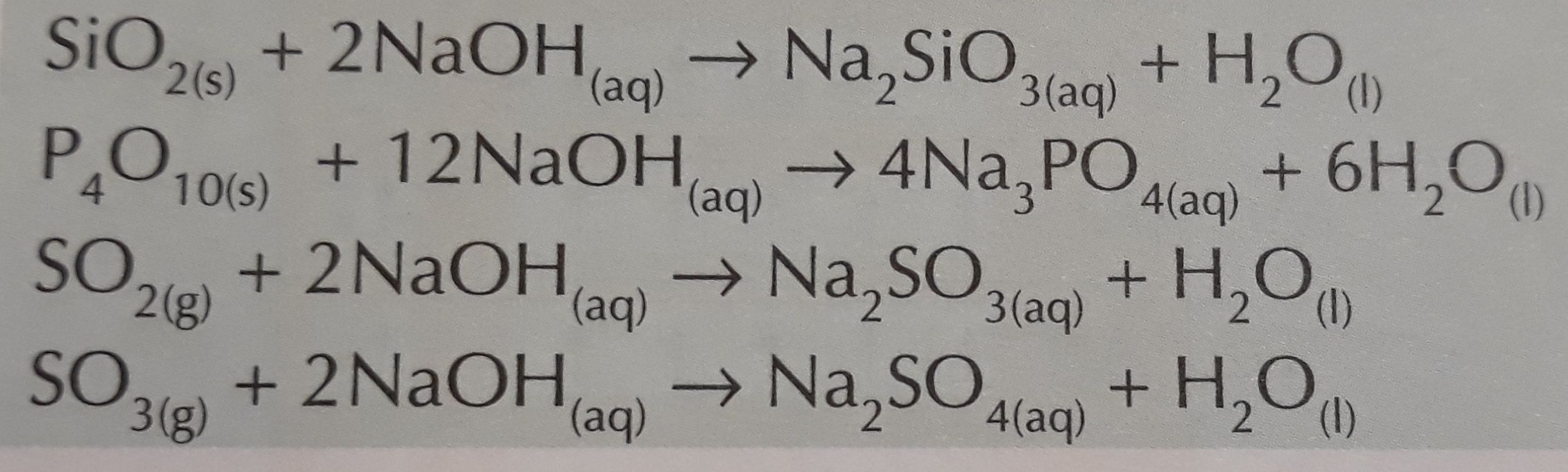
- P an S form acidic solutions ( PH 0-2) dissociate
- (split in to ions)
- E.g. P(4)O(10) s+ 6H(2)O=>4H(3)PO(4) H(3)PO(4)=> 3H+ (aq) + PO(4) 3-
- Silicon dioxide is insoluble in water because of its structure (macromolecular)
- However, it still can react with bases to form salts so it is acidic
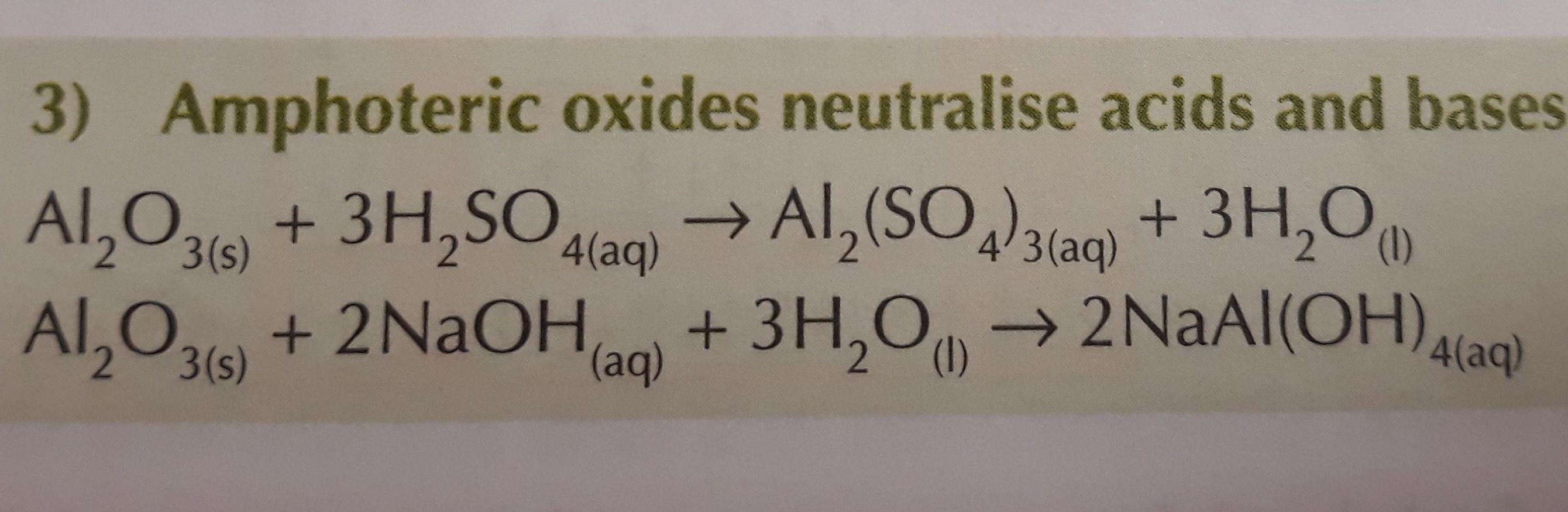
- Aluminium oxide is insoluble in water. It is partly ionic and covalent
- It can act as both an acid and a base so it is amphoteric
- P an S form acidic solutions ( PH 0-2) dissociate
Acid + base= salt +water
- Basic oxides neutralise acids
- Na(2)O (s) + 2HCl => NaCl (aq) +H(2)O (l)
- MgO(s) + H(2)SO(4) ((aq) => MgSO(4) (aq) + H(2)O
- Acidic oxides neutralise bases
- Amphoteric oxides neutralise acids and bases
- Basic oxides neutralise acids
Images and files in the map
Information
- Description
- A levels Chemistry (Year 2) Mind Map on Period 3, created by Jade Joseph on 19/11/2017.
- Created by
- Jade Joseph
- Views
- 120
- Tags
- Rating