
Mind map
Land Art
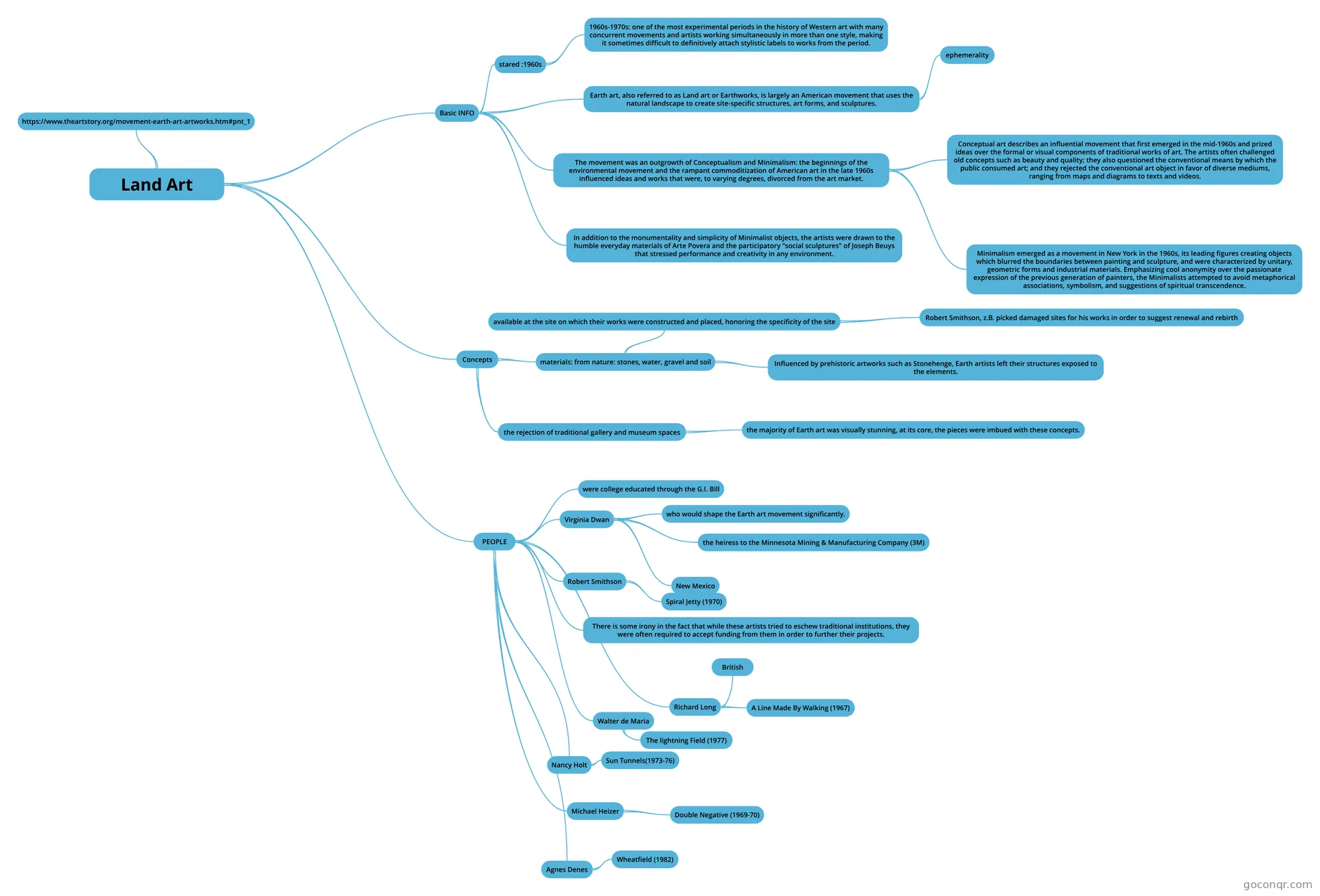
Mind map: Land Art
Map content
Land Art
Basic INFO
- stared :1960s
- 1960s-1970s: one of the most experimental periods in the history of Western art with many concurrent movements and artists working simultaneously in more than one style, making it sometimes difficult to definitively attach stylistic labels to works from the period.
- Earth art, also referred to as Land art or Earthworks, is largely an American movement that uses the natural landscape to create site-specific structures, art forms, and sculptures.
- ephemerality
- The movement was an outgrowth of Conceptualism and Minimalism: the beginnings of the environmental movement and the rampant commoditization of American art in the late 1960s influenced ideas and works that were, to varying degrees, divorced from the art market.
- Conceptual art describes an influential movement that first emerged in the mid-1960s and prized ideas over the formal or visual components of traditional works of art. The artists often challenged old concepts such as beauty and quality; they also questioned the conventional means by which the public consumed art; and they rejected the conventional art object in favor of diverse mediums, ranging from maps and diagrams to texts and videos.
- Minimalism emerged as a movement in New York in the 1960s, its leading figures creating objects which blurred the boundaries between painting and sculpture, and were characterized by unitary, geometric forms and industrial materials. Emphasizing cool anonymity over the passionate expression of the previous generation of painters, the Minimalists attempted to avoid metaphorical associations, symbolism, and suggestions of spiritual transcendence.
- In addition to the monumentality and simplicity of Minimalist objects, the artists were drawn to the humble everyday materials of Arte Povera and the participatory "social sculptures" of Joseph Beuys that stressed performance and creativity in any environment.
- stared :1960s
Concepts
- materials: from nature: stones, water, gravel and soil
- Influenced by prehistoric artworks such as Stonehenge, Earth artists left their structures exposed to the elements.
- available at the site on which their works were constructed and placed, honoring the specificity of the site
- Robert Smithson, z.B. picked damaged sites for his works in order to suggest renewal and rebirth
- the rejection of traditional gallery and museum spaces
- the majority of Earth art was visually stunning, at its core, the pieces were imbued with these concepts.
- materials: from nature: stones, water, gravel and soil
PEOPLE
- Virginia Dwan
- who would shape the Earth art movement significantly.
- New Mexico
- the heiress to the Minnesota Mining & Manufacturing Company (3M)
- were college educated through the G.I. Bill
- Robert Smithson
- Spiral Jetty (1970)
- There is some irony in the fact that while these artists tried to eschew traditional institutions, they were often required to accept funding from them in order to further their projects.
- Walter de Maria
- The lightning Field (1977)
- Richard Long
- A Line Made By Walking (1967)
- British
- Michael Heizer
- Double Negative (1969-70)
- Nancy Holt
- Sun Tunnels(1973-76)
- Agnes Denes
- Wheatfield (1982)
- Virginia Dwan
https://www.theartstory.org/movement-earth-art-artworks.htm#pnt_1
Information
- Description
- Architecture Mind Map on Land Art, created by Yanni Xu on 02/10/2018.
- Created by
- Yanni Xu
- Views
- 3
- Rating