
Mind map
2.2 Programming
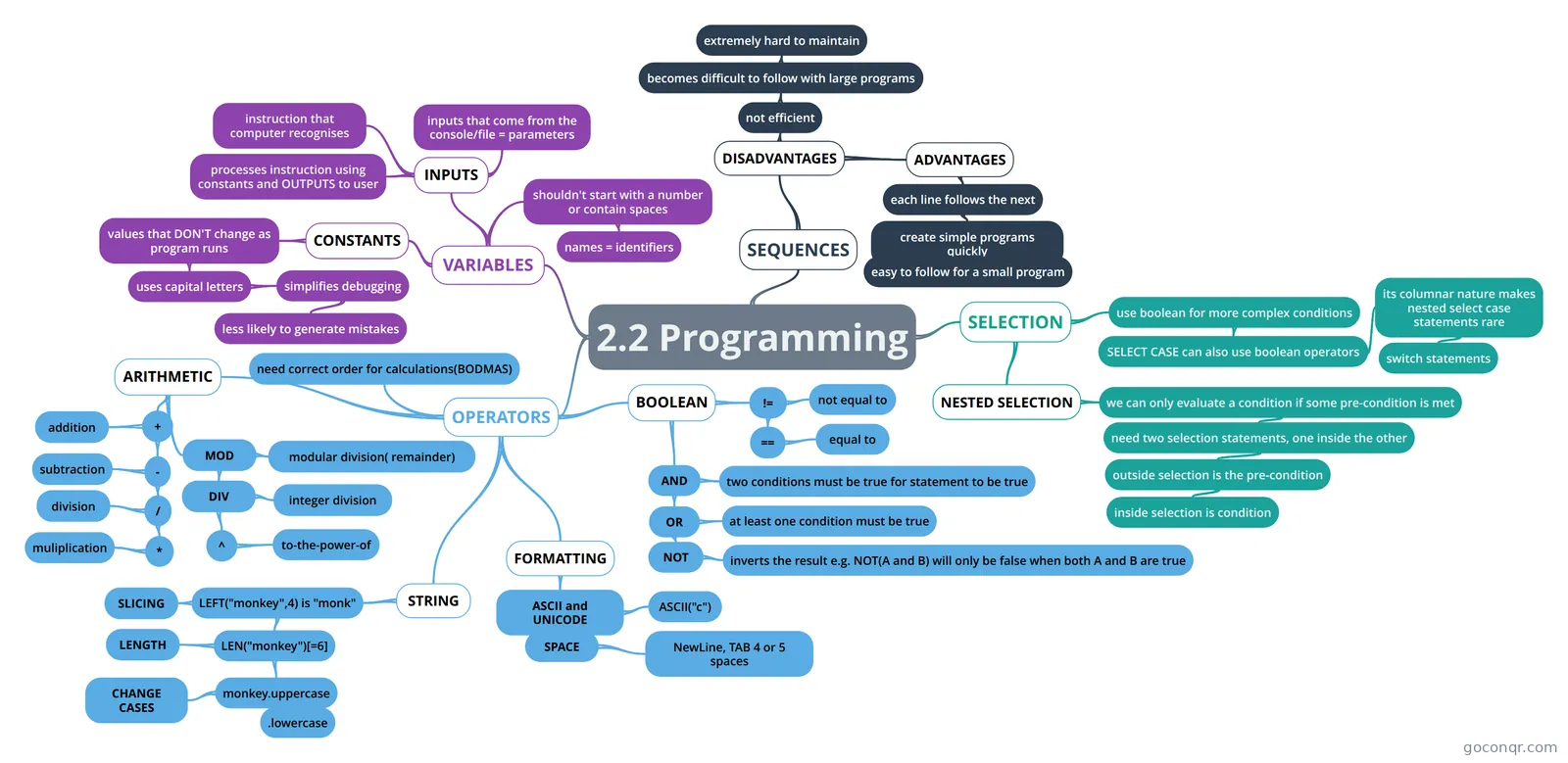
Mind map: programming
Map content
2.2 Programming
VARIABLES
- INPUTS
- instruction that computer recognises
- processes instruction using constants and OUTPUTS to user
- inputs that come from the console/file = parameters
- shouldn't start with a number or contain spaces
- names = identifiers
- CONSTANTS
- values that DON'T change as program runs
- uses capital letters
- simplifies debugging
- less likely to generate mistakes
- simplifies debugging
- uses capital letters
- values that DON'T change as program runs
- INPUTS
OPERATORS
- need correct order for calculations(BODMAS)
- ARITHMETIC
- +
- addition
- -
- subtraction
- /
- division
- *
- muliplication
- MOD
- modular division( remainder)
- DIV
- integer division
- ^
- to-the-power-of
- +
- BOOLEAN
- !=
- not equal to
- ==
- equal to
- AND
- two conditions must be true for statement to be true
- OR
- at least one condition must be true
- NOT
- inverts the result e.g. NOT(A and B) will only be false when both A and B are true
- !=
- STRING
- LEFT("monkey",4) is "monk"
- SLICING
- LEN("monkey")[=6]
- LENGTH
- monkey.uppercase
- CHANGE CASES
- .lowercase
- LEFT("monkey",4) is "monk"
- FORMATTING
- ASCII and UNICODE
- ASCII("c")
- SPACE
- NewLine, TAB 4 or 5 spaces
- ASCII and UNICODE
SEQUENCES
- DISADVANTAGES
- not efficient
- becomes difficult to follow with large programs
- extremely hard to maintain
- becomes difficult to follow with large programs
- ADVANTAGES
- each line follows the next
- create simple programs quickly
- easy to follow for a small program
- create simple programs quickly
- each line follows the next
- not efficient
- DISADVANTAGES
SELECTION
- use boolean for more complex conditions
- SELECT CASE can also use boolean operators
- its columnar nature makes nested select case statements rare
- switch statements
- its columnar nature makes nested select case statements rare
- SELECT CASE can also use boolean operators
- NESTED SELECTION
- we can only evaluate a condition if some pre-condition is met
- need two selection statements, one inside the other
- outside selection is the pre-condition
- inside selection is condition
- outside selection is the pre-condition
- need two selection statements, one inside the other
- we can only evaluate a condition if some pre-condition is met
- use boolean for more complex conditions
Information
- Description
- GCSE Computing Mind Map on 2.2 Programming, created by kimi rod on 06/02/2019.
- Created by
- kimi rod
- Views
- 7
- Rating