
Mind map
Cell Division
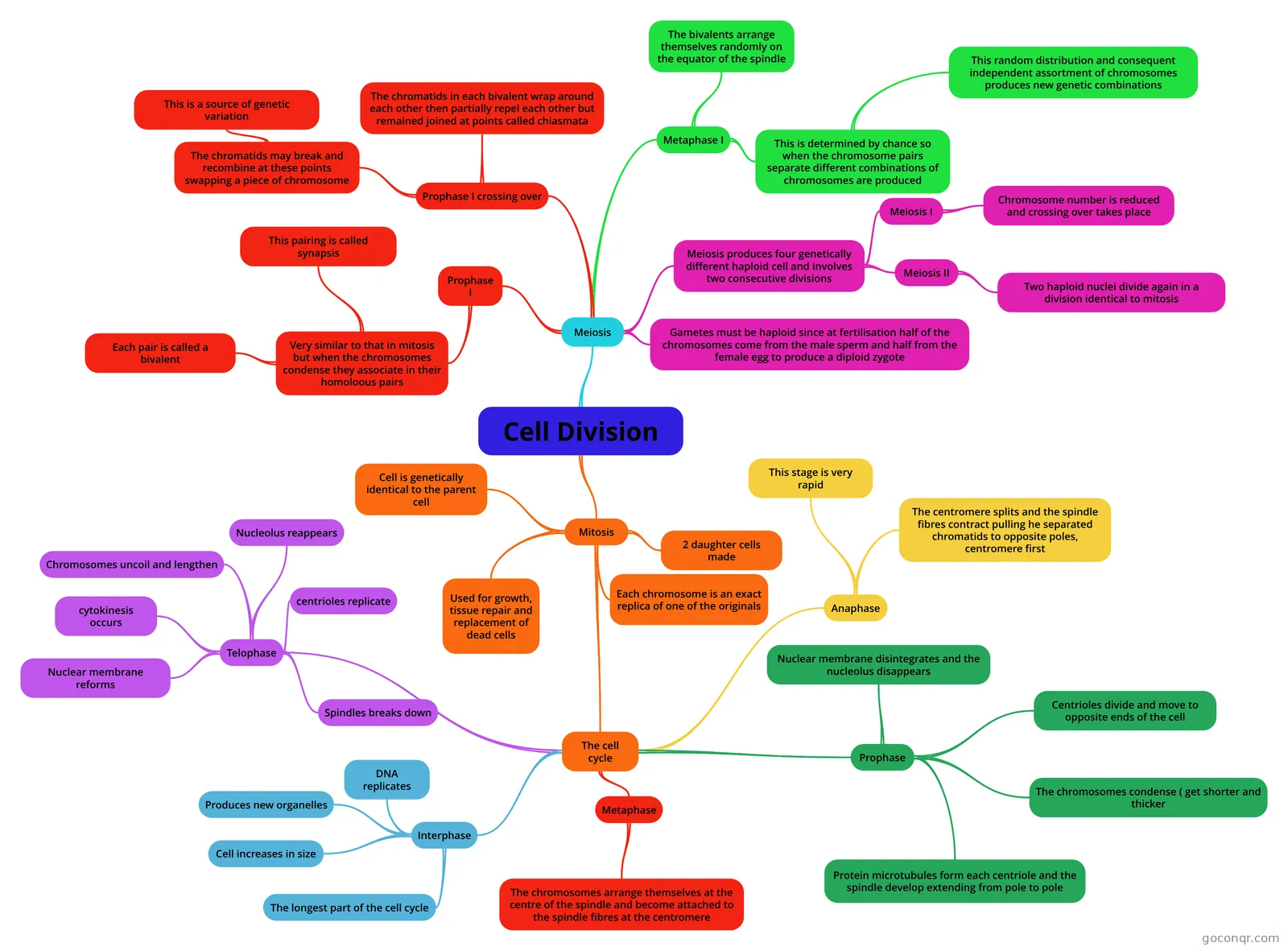
Mind map: Cell Division
Map content
Cell Division
Mitosis
- The cell cycle
- Interphase
- The longest part of the cell cycle
- Cell increases in size
- Produces new organelles
- DNA replicates
- Prophase
- The chromosomes condense ( get shorter and thicker
- Centrioles divide and move to opposite ends of the cell
- Protein microtubules form each centriole and the spindle develop extending from pole to pole
- Nuclear membrane disintegrates and the nucleolus disappears
- Metaphase
- The chromosomes arrange themselves at the centre of the spindle and become attached to the spindle fibres at the centromere
- Anaphase
- The centromere splits and the spindle fibres contract pulling he separated chromatids to opposite poles, centromere first
- This stage is very rapid
- Telophase
- Chromosomes uncoil and lengthen
- Spindles breaks down
- cytokinesis occurs
- centrioles replicate
- Nucleolus reappears
- Nuclear membrane reforms
- Interphase
- 2 daughter cells made
- Cell is genetically identical to the parent cell
- Used for growth, tissue repair and replacement of dead cells
- Each chromosome is an exact replica of one of the originals
- The cell cycle
Meiosis
- Gametes must be haploid since at fertilisation half of the chromosomes come from the male sperm and half from the female egg to produce a diploid zygote
- Meiosis produces four genetically different haploid cell and involves two consecutive divisions
- Meiosis I
- Chromosome number is reduced and crossing over takes place
- Meiosis II
- Two haploid nuclei divide again in a division identical to mitosis
- Meiosis I
- Prophase I
- Very similar to that in mitosis but when the chromosomes condense they associate in their homoloous pairs
- This pairing is called synapsis
- Each pair is called a bivalent
- Very similar to that in mitosis but when the chromosomes condense they associate in their homoloous pairs
- Prophase I crossing over
- The chromatids in each bivalent wrap around each other then partially repel each other but remained joined at points called chiasmata
- The chromatids may break and recombine at these points swapping a piece of chromosome
- This is a source of genetic variation
- Metaphase I
- The bivalents arrange themselves randomly on the equator of the spindle
- This is determined by chance so when the chromosome pairs separate different combinations of chromosomes are produced
- This random distribution and consequent independent assortment of chromosomes produces new genetic combinations
Information
- Description
- As Biology and chemistry Mind Map on Cell Division, created by sonnyh_2k6 on 01/01/2015.
- Created by
- sonnyh_2k6
- Views
- 0
- Rating