
Mind map
Hardware
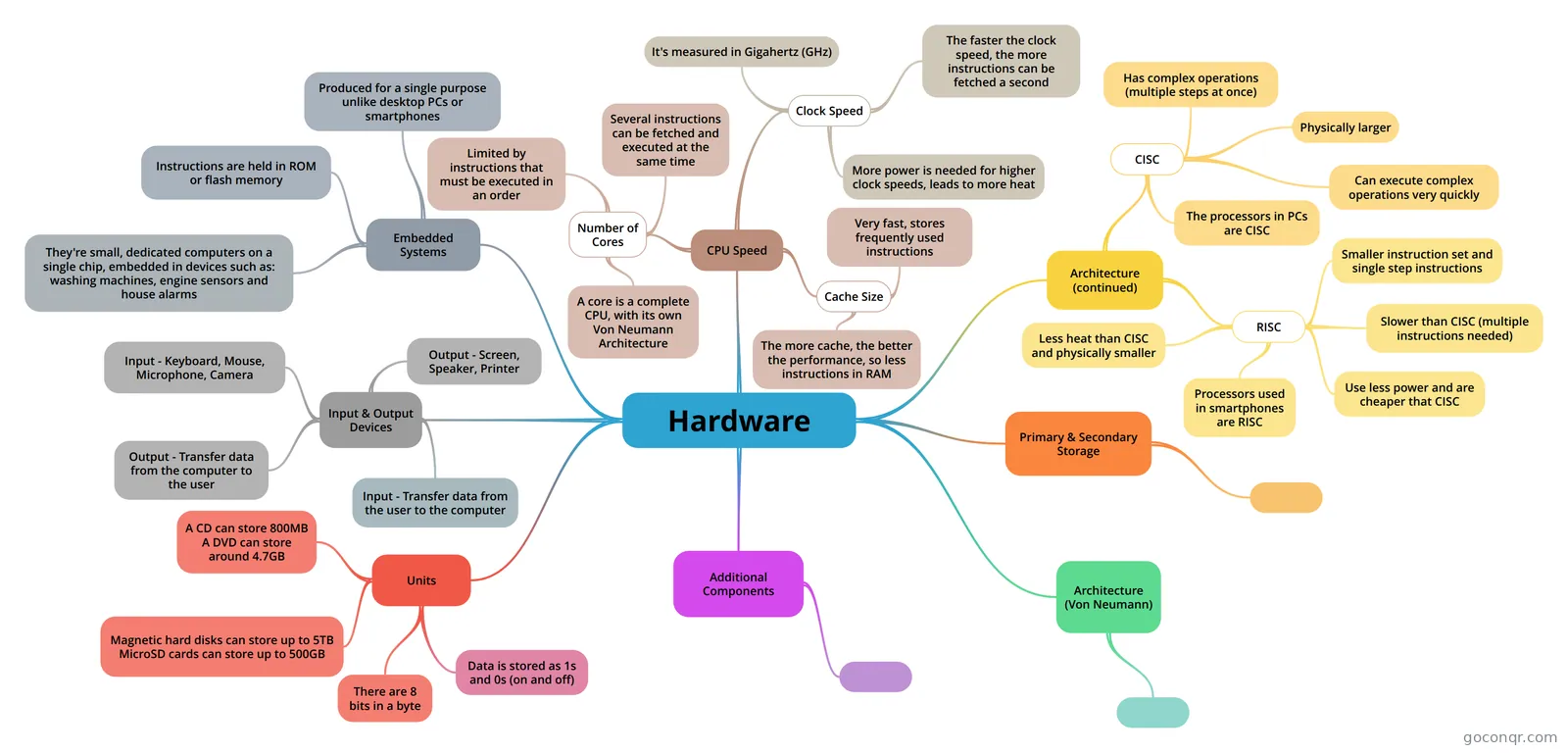
Mind map: Hardware: Architecture, Components, and Storage
Map content
Hardware
Architecture (Von Neumann)
Architecture (continued)
- CISC
- Has complex operations (multiple steps at once)
- Physically larger
- Can execute complex operations very quickly
- The processors in PCs are CISC
- RISC
- Smaller instruction set and single step instructions
- Slower than CISC (multiple instructions needed)
- Use less power and are cheaper that CISC
- Less heat than CISC and physically smaller
- Processors used in smartphones are RISC
- CISC
CPU Speed
- Clock Speed
- The faster the clock speed, the more instructions can be fetched a second
- More power is needed for higher clock speeds, leads to more heat
- It's measured in Gigahertz (GHz)
- Number of Cores
- A core is a complete CPU, with its own Von Neumann Architecture
- Several instructions can be fetched and executed at the same time
- Limited by instructions that must be executed in an order
- Cache Size
- Very fast, stores frequently used instructions
- The more cache, the better the performance, so less instructions in RAM
- Clock Speed
Additional Components
Embedded Systems
- They're small, dedicated computers on a single chip, embedded in devices such as: washing machines, engine sensors and house alarms
- Instructions are held in ROM or flash memory
- Produced for a single purpose unlike desktop PCs or smartphones
Units
- Data is stored as 1s and 0s (on and off)
- There are 8 bits in a byte
- A CD can store 800MB A DVD can store around 4.7GB
- Magnetic hard disks can store up to 5TB MicroSD cards can store up to 500GB
Input & Output Devices
- Input - Transfer data from the user to the computer
- Output - Transfer data from the computer to the user
- Input - Keyboard, Mouse, Microphone, Camera
- Output - Screen, Speaker, Printer
Primary & Secondary Storage