
Mind map
COASTS
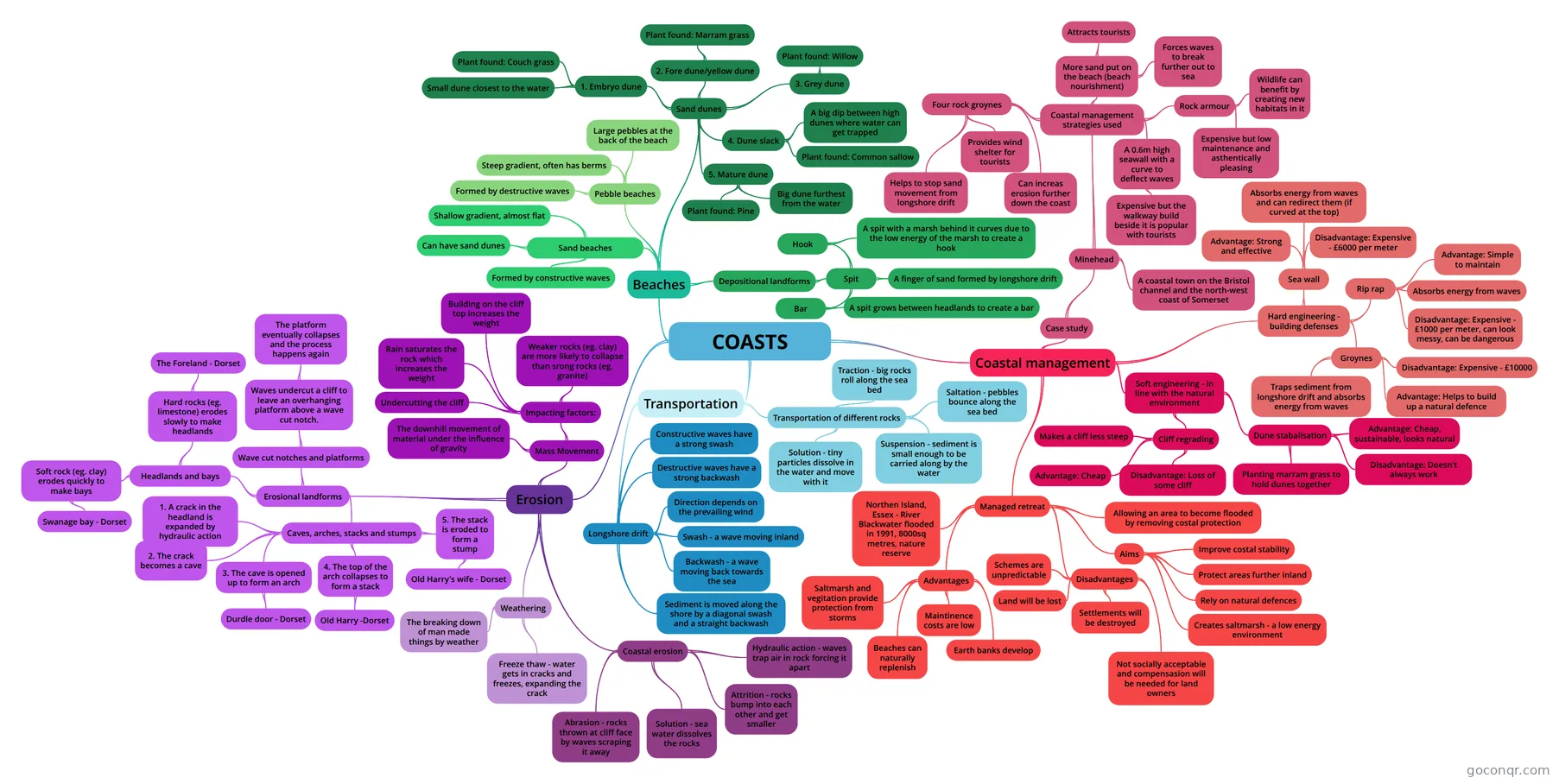
Mind map: coasts geography
Map content
COASTS
Erosion
- Weathering
- Freeze thaw - water gets in cracks and freezes, expanding the crack
- The breaking down of man made things by weather
- Mass Movement
- The downhill movement of material under the influence of gravity
- Impacting factors:
- Undercutting the cliff
- Building on the cliff top increases the weight
- Rain saturates the rock which increases the weight
- Weaker rocks (eg. clay) are more likely to collapse than srong rocks (eg. granite)
- Coastal erosion
- Hydraulic action - waves trap air in rock forcing it apart
- Abrasion - rocks thrown at cliff face by waves scraping it away
- Attrition - rocks bump into each other and get smaller
- Solution - sea water dissolves the rocks
- Erosional landforms
- Headlands and bays
- Soft rock (eg. clay) erodes quickly to make bays
- Swanage bay - Dorset
- Hard rocks (eg. limestone) erodes slowly to make headlands
- The Foreland - Dorset
- Soft rock (eg. clay) erodes quickly to make bays
- Caves, arches, stacks and stumps
- 1. A crack in the headland is expanded by hydraulic action
- 2. The crack becomes a cave
- 3. The cave is opened up to form an arch
- Durdle door - Dorset
- 4. The top of the arch collapses to form a stack
- Old Harry -Dorset
- 5. The stack is eroded to form a stump
- Old Harry's wife - Dorset
- Wave cut notches and platforms
- Waves undercut a cliff to leave an overhanging platform above a wave cut notch.
- The platform eventually collapses and the process happens again
- Waves undercut a cliff to leave an overhanging platform above a wave cut notch.
- Headlands and bays
- Weathering
Transportation
- Transportation of different rocks
- Traction - big rocks roll along the sea bed
- Saltation - pebbles bounce along the sea bed
- Suspension - sediment is small enough to be carried along by the water
- Solution - tiny particles dissolve in the water and move with it
- Longshore drift
- Direction depends on the prevailing wind
- Constructive waves have a strong swash
- Destructive waves have a strong backwash
- Sediment is moved along the shore by a diagonal swash and a straight backwash
- Swash - a wave moving inland
- Backwash - a wave moving back towards the sea
- Transportation of different rocks
Beaches
- Sand beaches
- Formed by constructive waves
- Can have sand dunes
- Shallow gradient, almost flat
- Pebble beaches
- Formed by destructive waves
- Steep gradient, often has berms
- Large pebbles at the back of the beach
- Depositional landforms
- Spit
- A finger of sand formed by longshore drift
- Hook
- A spit with a marsh behind it curves due to the low energy of the marsh to create a hook
- Bar
- A spit grows between headlands to create a bar
- Spit
- Sand dunes
- 1. Embryo dune
- Small dune closest to the water
- Plant found: Couch grass
- 2. Fore dune/yellow dune
- Plant found: Marram grass
- 3. Grey dune
- Plant found: Willow
- 4. Dune slack
- A big dip between high dunes where water can get trapped
- Plant found: Common sallow
- 5. Mature dune
- Big dune furthest from the water
- Plant found: Pine
- 1. Embryo dune
- Sand beaches
Coastal management
- Hard engineering - building defenses
- Sea wall
- Absorbs energy from waves and can redirect them (if curved at the top)
- Advantage: Strong and effective
- Disadvantage: Expensive - £6000 per meter
- Rip rap
- Absorbs energy from waves
- Advantage: Simple to maintain
- Disadvantage: Expensive - £1000 per meter, can look messy, can be dangerous
- Groynes
- Traps sediment from longshore drift and absorbs energy from waves
- Advantage: Helps to build up a natural defence
- Disadvantage: Expensive - £10000
- Sea wall
- Soft engineering - in line with the natural environment
- Cliff regrading
- Makes a cliff less steep
- Advantage: Cheap
- Disadvantage: Loss of some cliff
- Dune stabalisation
- Planting marram grass to hold dunes together
- Advantage: Cheap, sustainable, looks natural
- Disadvantage: Doesn't always work
- Cliff regrading
- Managed retreat
- Allowing an area to become flooded by removing costal protection
- Aims
- Improve costal stability
- Protect areas further inland
- Rely on natural defences
- Creates saltmarsh - a low energy environment
- Northen Island, Essex - River Blackwater flooded in 1991, 8000sq metres, nature reserve
- Advantages
- Earth banks develop
- Maintinence costs are low
- Saltmarsh and vegitation provide protection from storms
- Beaches can naturally replenish
- Disadvantages
- Land will be lost
- Settlements will be destroyed
- Not socially acceptable and compensasion will be needed for land owners
- Schemes are unpredictable
- Case study
- Minehead
- A coastal town on the Bristol channel and the north-west coast of Somerset
- Coastal management strategies used
- A 0.6m high seawall with a curve to deflect waves
- Expensive but the walkway build beside it is popular with tourists
- Rock armour
- Expensive but low maintenance and asthentically pleasing
- Wildlife can benefit by creating new habitats in it
- More sand put on the beach (beach nourishment)
- Forces waves to break further out to sea
- Attracts tourists
- Four rock groynes
- Helps to stop sand movement from longshore drift
- Provides wind shelter for tourists
- Can increas erosion further down the coast
- A 0.6m high seawall with a curve to deflect waves
- Minehead
- Hard engineering - building defenses
Information
- Description
- Year 10 Geography Mind Map on COASTS, created by Amy Taylor on 22/02/2020.
- Created by
- Amy Taylor
- Views
- 15
- Rating