
Mind map
*2 Close Relationships
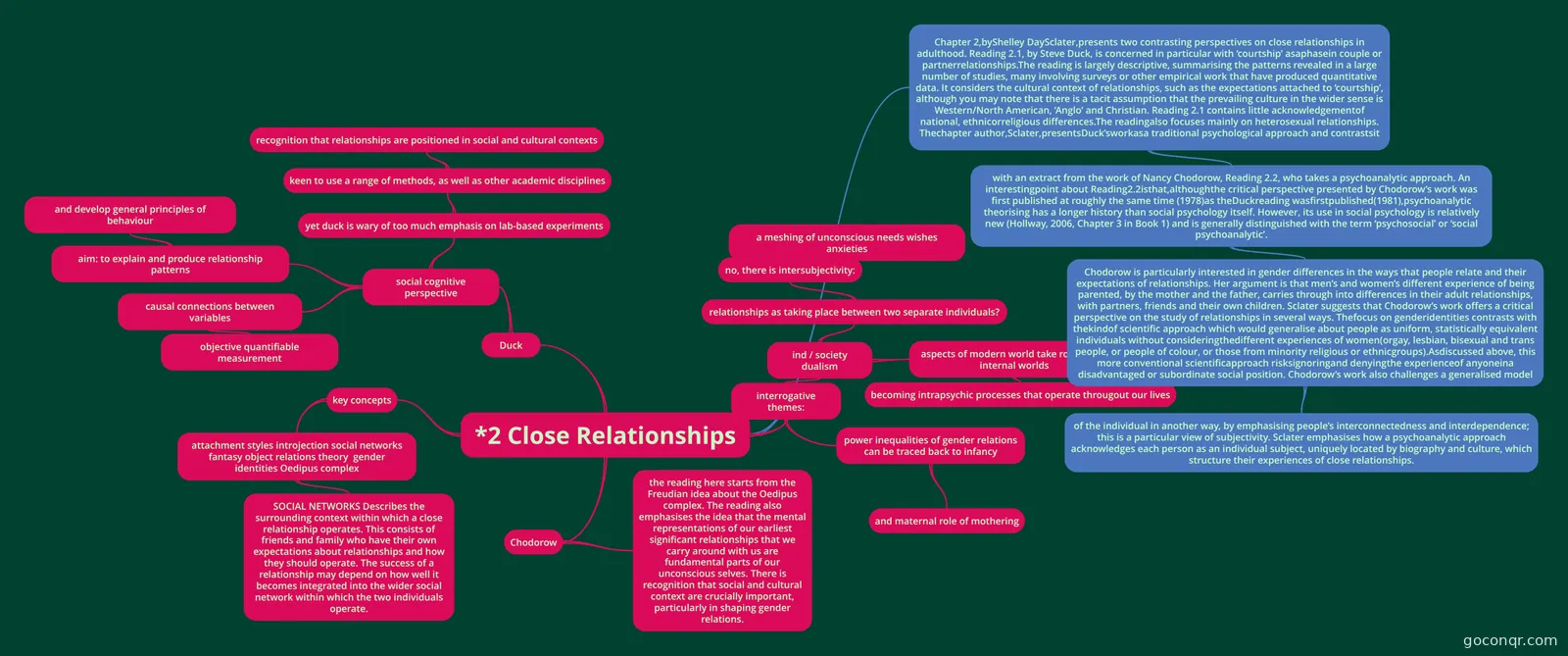
Mind map: close relationships in adulthood
Map content
*2 Close Relationships
Duck
- social cognitive perspective
- causal connections between variables
- objective quantifiable measurement
- aim: to explain and produce relationship patterns
- and develop general principles of behaviour
- yet duck is wary of too much emphasis on lab-based experiments
- keen to use a range of methods, as well as other academic disciplines
- recognition that relationships are positioned in social and cultural contexts
- keen to use a range of methods, as well as other academic disciplines
- causal connections between variables
- social cognitive perspective
Chodorow
- the reading here starts from the Freudian idea about the Oedipus complex. The reading also emphasises the idea that the mental representations of our earliest significant relationships that we carry around with us are fundamental parts of our unconscious selves. There is recognition that social and cultural context are crucially important, particularly in shaping gender relations.
interrogative themes:
- power inequalities of gender relations can be traced back to infancy
- and maternal role of mothering
- ind / society dualism
- aspects of modern world take root in our internal worlds
- becoming intrapsychic processes that operate througout our lives
- relationships as taking place between two separate individuals?
- no, there is intersubjectivity:
- a meshing of unconscious needs wishes anxieties
- no, there is intersubjectivity:
- aspects of modern world take root in our internal worlds
- power inequalities of gender relations can be traced back to infancy
key concepts
- attachment styles introjection social networks fantasy object relations theory gender identities Oedipus complex
- SOCIAL NETWORKS Describes the surrounding context within which a close relationship operates. This consists of friends and family who have their own expectations about relationships and how they should operate. The success of a relationship may depend on how well it becomes integrated into the wider social network within which the two individuals operate.
- attachment styles introjection social networks fantasy object relations theory gender identities Oedipus complex
Chapter 2,byShelley DaySclater,presents two contrasting perspectives on close relationships in adulthood. Reading 2.1, by Steve Duck, is concerned in particular with ‘courtship’ asaphasein couple or partnerrelationships.The reading is largely descriptive, summarising the patterns revealed in a large number of studies, many involving surveys or other empirical work that have produced quantitative data. It considers the cultural context of relationships, such as the expectations attached to ‘courtship’, although you may note that there is a tacit assumption that the prevailing culture in the wider sense is Western/North American, ‘Anglo’ and Christian. Reading 2.1 contains little acknowledgementof national, ethnicorreligious differences.The readingalso focuses mainly on heterosexual relationships. Thechapter author,Sclater,presentsDuck’sworkasa traditional psychological approach and contrastsit
- with an extract from the work of Nancy Chodorow, Reading 2.2, who takes a psychoanalytic approach. An interestingpoint about Reading2.2isthat,althoughthe critical perspective presented by Chodorow’s work was first published at roughly the same time (1978)as theDuckreading wasfirstpublished(1981),psychoanalytic theorising has a longer history than social psychology itself. However, its use in social psychology is relatively new (Hollway, 2006, Chapter 3 in Book 1) and is generally distinguished with the term ‘psychosocial’ or ‘social psychoanalytic’.
- Chodorow is particularly interested in gender differences in the ways that people relate and their expectations of relationships. Her argument is that men’s and women’s different experience of being parented, by the mother and the father, carries through into differences in their adult relationships, with partners, friends and their own children. Sclater suggests that Chodorow’s work offers a critical perspective on the study of relationships in several ways. Thefocus on genderidentities contrasts with thekindof scientific approach which would generalise about people as uniform, statistically equivalent individuals without consideringthedifferent experiences of women(orgay, lesbian, bisexual and trans people, or people of colour, or those from minority religious or ethnicgroups).Asdiscussed above, this more conventional scientificapproach risksignoringand denyingthe experienceof anyoneina disadvantaged or subordinate social position. Chodorow’s work also challenges a generalised model
- of the individual in another way, by emphasising people’s interconnectedness and interdependence; this is a particular view of subjectivity. Sclater emphasises how a psychoanalytic approach acknowledges each person as an individual subject, uniquely located by biography and culture, which structure their experiences of close relationships.
- Chodorow is particularly interested in gender differences in the ways that people relate and their expectations of relationships. Her argument is that men’s and women’s different experience of being parented, by the mother and the father, carries through into differences in their adult relationships, with partners, friends and their own children. Sclater suggests that Chodorow’s work offers a critical perspective on the study of relationships in several ways. Thefocus on genderidentities contrasts with thekindof scientific approach which would generalise about people as uniform, statistically equivalent individuals without consideringthedifferent experiences of women(orgay, lesbian, bisexual and trans people, or people of colour, or those from minority religious or ethnicgroups).Asdiscussed above, this more conventional scientificapproach risksignoringand denyingthe experienceof anyoneina disadvantaged or subordinate social position. Chodorow’s work also challenges a generalised model
- with an extract from the work of Nancy Chodorow, Reading 2.2, who takes a psychoanalytic approach. An interestingpoint about Reading2.2isthat,althoughthe critical perspective presented by Chodorow’s work was first published at roughly the same time (1978)as theDuckreading wasfirstpublished(1981),psychoanalytic theorising has a longer history than social psychology itself. However, its use in social psychology is relatively new (Hollway, 2006, Chapter 3 in Book 1) and is generally distinguished with the term ‘psychosocial’ or ‘social psychoanalytic’.
Information
- Description
- level 5 Social Psychology Mind Map on *2 Close Relationships, created by Eli Y on 26/05/2015.
- Created by
- Eli Y
- Views
- 0
- Rating