
Mind map
English Language - Word Classes
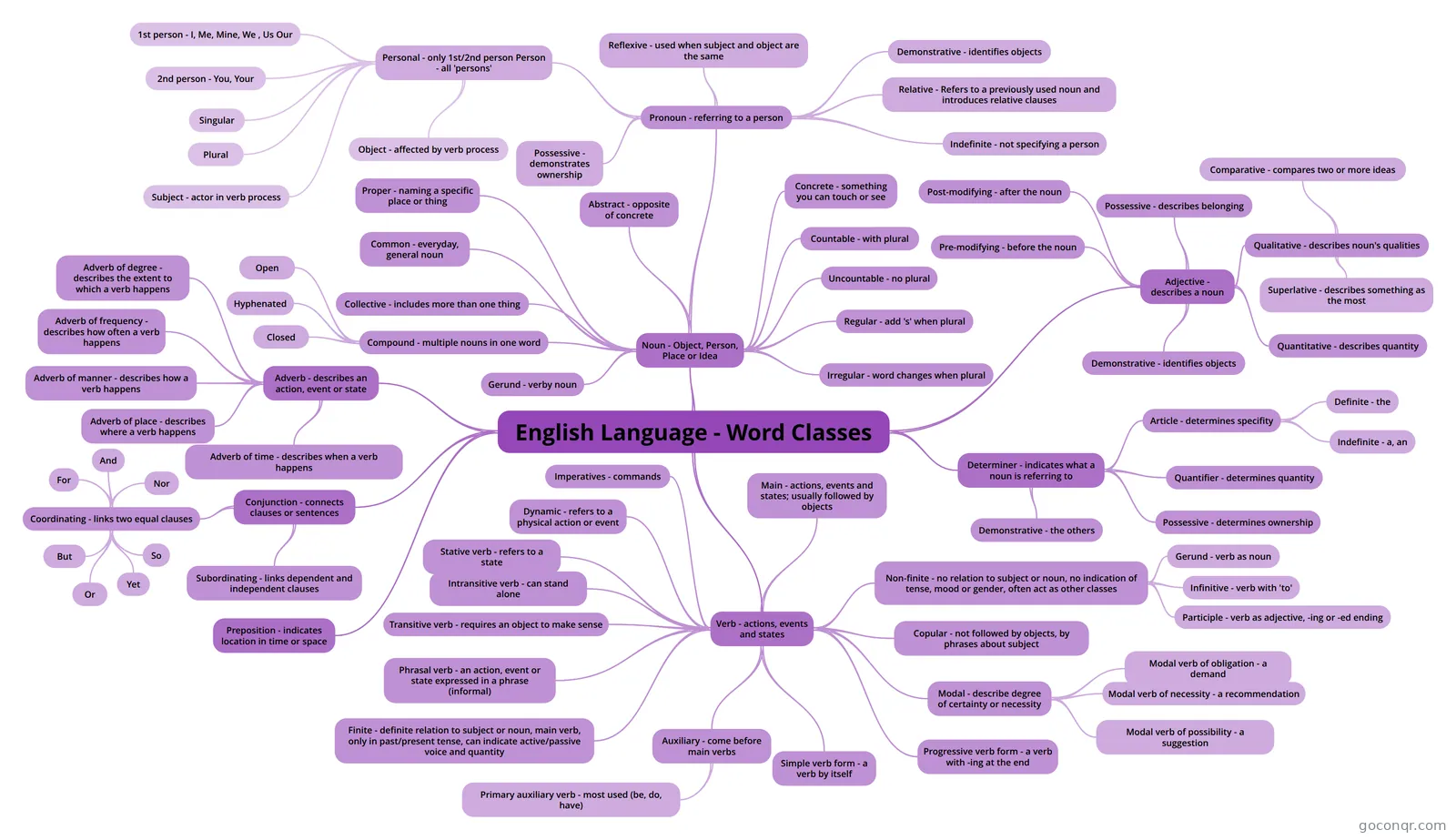
Mind map: English word classes
Map content
English Language - Word Classes
Verb - actions, events and states
- Main - actions, events and states; usually followed by objects
- Copular - not followed by objects, by phrases about subject
- Auxiliary - come before main verbs
- Primary auxiliary verb - most used (be, do, have)
- Modal - describe degree of certainty or necessity
- Modal verb of necessity - a recommendation
- Modal verb of obligation - a demand
- Modal verb of possibility - a suggestion
- Imperatives - commands
- Finite - definite relation to subject or noun, main verb, only in past/present tense, can indicate active/passive voice and quantity
- Non-finite - no relation to subject or noun, no indication of tense, mood or gender, often act as other classes
- Gerund - verb as noun
- Infinitive - verb with 'to'
- Participle - verb as adjective, -ing or -ed ending
- Dynamic - refers to a physical action or event
- Intransitive verb - can stand alone
- Phrasal verb - an action, event or state expressed in a phrase (informal)
- Progressive verb form - a verb with -ing at the end
- Transitive verb - requires an object to make sense
- Simple verb form - a verb by itself
- Stative verb - refers to a state
Noun - Object, Person, Place or Idea
- Common - everyday, general noun
- Proper - naming a specific place or thing
- Concrete - something you can touch or see
- Abstract - opposite of concrete
- Countable - with plural
- Uncountable - no plural
- Regular - add 's' when plural
- Irregular - word changes when plural
- Collective - includes more than one thing
- Compound - multiple nouns in one word
- Open
- Hyphenated
- Closed
- Pronoun - referring to a person
- Personal - only 1st/2nd person Person - all 'persons'
- 1st person - I, Me, Mine, We , Us Our
- 2nd person - You, Your
- Singular
- Subject - actor in verb process
- Object - affected by verb process
- Plural
- Possessive - demonstrates ownership
- Reflexive - used when subject and object are the same
- Demonstrative - identifies objects
- Relative - Refers to a previously used noun and introduces relative clauses
- Indefinite - not specifying a person
- Personal - only 1st/2nd person Person - all 'persons'
- Gerund - verby noun
Adjective - describes a noun
- Pre-modifying - before the noun
- Post-modifying - after the noun
- Possessive - describes belonging
- Qualitative - describes noun's qualities
- Comparative - compares two or more ideas
- Superlative - describes something as the most
- Demonstrative - identifies objects
- Quantitative - describes quantity
Adverb - describes an action, event or state
- Adverb of degree - describes the extent to which a verb happens
- Adverb of frequency - describes how often a verb happens
- Adverb of manner - describes how a verb happens
- Adverb of place - describes where a verb happens
- Adverb of time - describes when a verb happens
Conjunction - connects clauses or sentences
- Coordinating - links two equal clauses
- For
- And
- Nor
- But
- Or
- Yet
- So
- Subordinating - links dependent and independent clauses
- Coordinating - links two equal clauses
Determiner - indicates what a noun is referring to
- Article - determines specifity
- Definite - the
- Indefinite - a, an
- Quantifier - determines quantity
- Possessive - determines ownership
- Demonstrative - the others
- Article - determines specifity
Preposition - indicates location in time or space
Information
- Description
- This is a mind map of the different word classifications in the English language.
- Created by
- stellapips
- Views
- 366
- Tags
- Rating