
Mind map
C3 A-C
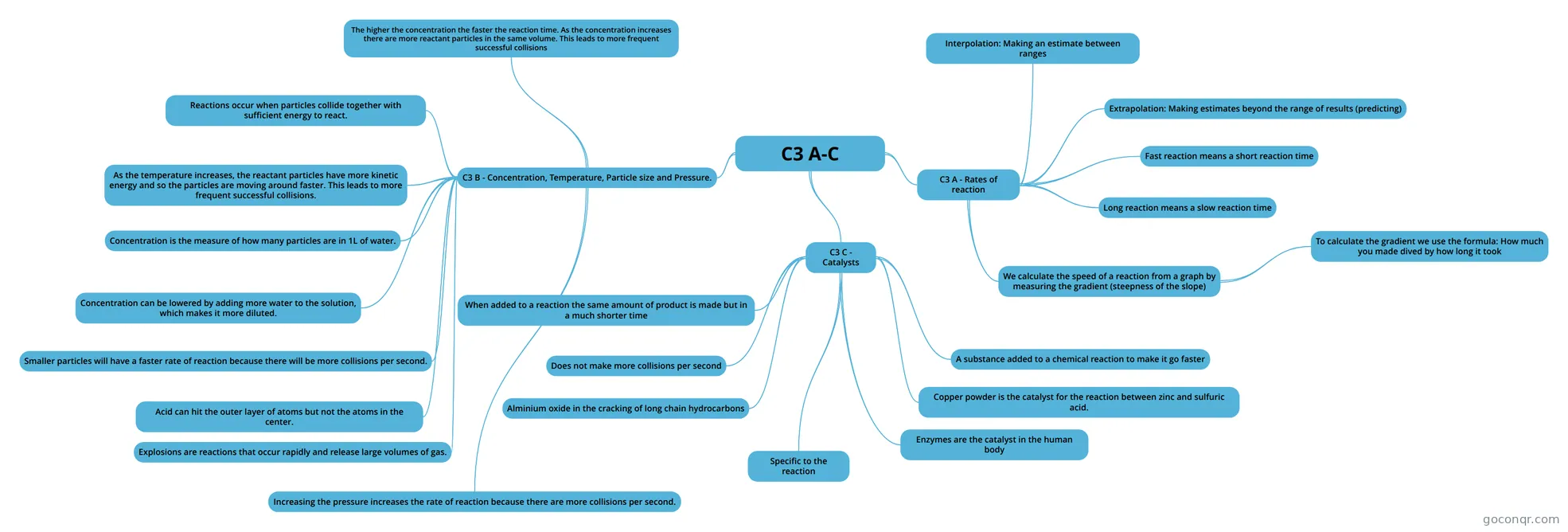
Mind map: C3 rates of reaction
Map content
C3 A-C
C3 A - Rates of reaction
- Interpolation: Making an estimate between ranges
- Extrapolation: Making estimates beyond the range of results (predicting)
- Fast reaction means a short reaction time
- Long reaction means a slow reaction time
- We calculate the speed of a reaction from a graph by measuring the gradient (steepness of the slope)
- To calculate the gradient we use the formula: How much you made dived by how long it took
C3 B - Concentration, Temperature, Particle size and Pressure.
- As the temperature increases, the reactant particles have more kinetic energy and so the particles are moving around faster. This leads to more frequent successful collisions.
- Reactions occur when particles collide together with sufficient energy to react.
- Concentration is the measure of how many particles are in 1L of water.
- Concentration can be lowered by adding more water to the solution, which makes it more diluted.
- The higher the concentration the faster the reaction time. As the concentration increases there are more reactant particles in the same volume. This leads to more frequent successful collisions
- Smaller particles will have a faster rate of reaction because there will be more collisions per second.
- Acid can hit the outer layer of atoms but not the atoms in the center.
- Explosions are reactions that occur rapidly and release large volumes of gas.
- Increasing the pressure increases the rate of reaction because there are more collisions per second.
C3 C - Catalysts
- A substance added to a chemical reaction to make it go faster
- Copper powder is the catalyst for the reaction between zinc and sulfuric acid.
- Alminium oxide in the cracking of long chain hydrocarbons
- Does not make more collisions per second
- When added to a reaction the same amount of product is made but in a much shorter time
- Specific to the reaction
- Enzymes are the catalyst in the human body