
Mind map
How to Understand Problems
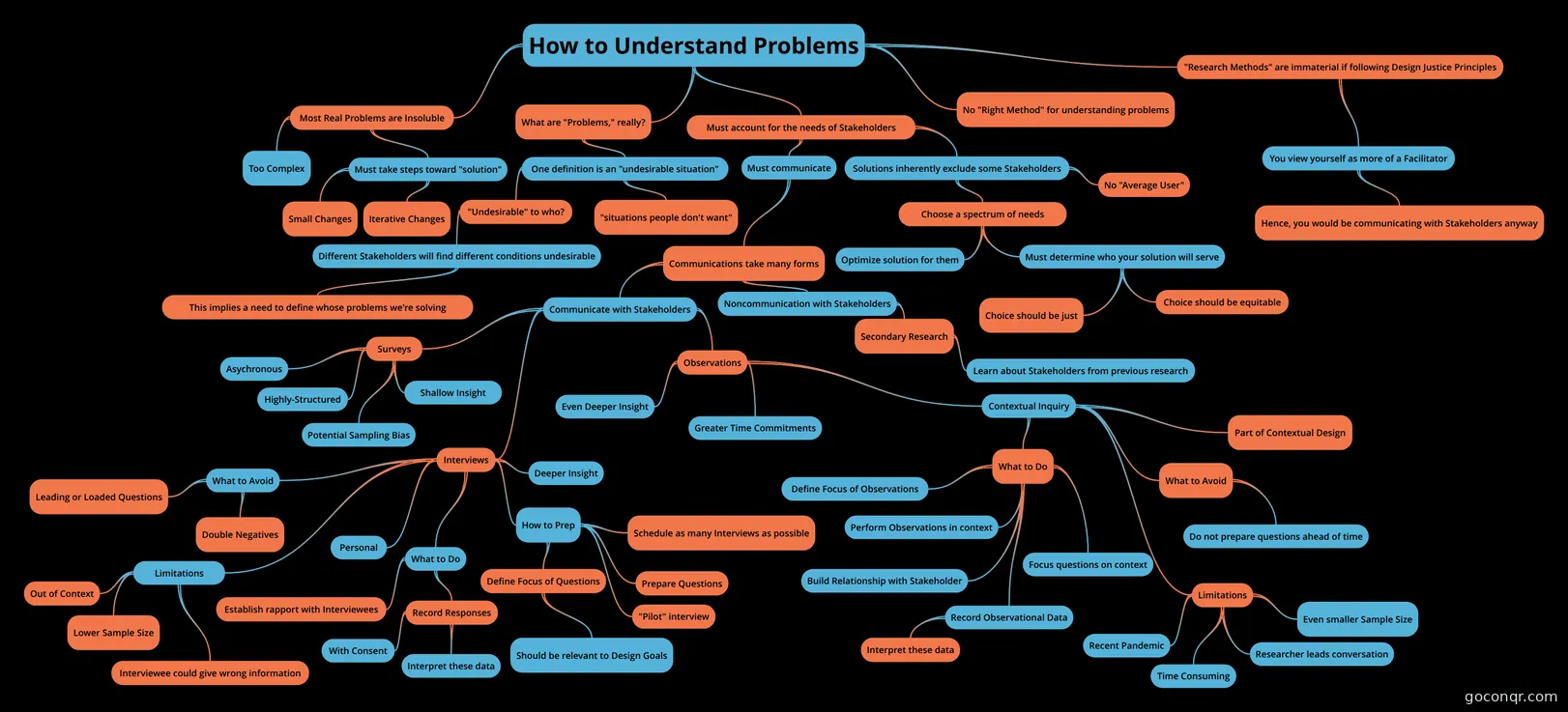
Mind map: How to understand problems
Map content
How to Understand Problems
Most Real Problems are Insoluble
- Too Complex
- Must take steps toward "solution"
- Small Changes
- Iterative Changes
What are "Problems," really?
- One definition is an "undesirable situation"
- "Undesirable" to who?
- Different Stakeholders will find different conditions undesirable
- This implies a need to define whose problems we're solving
- Different Stakeholders will find different conditions undesirable
- "situations people don't want"
- "Undesirable" to who?
- One definition is an "undesirable situation"
Must account for the needs of Stakeholders
- Must communicate
- Communications take many forms
- Communicate with Stakeholders
- Surveys
- Asychronous
- Highly-Structured
- Shallow Insight
- Potential Sampling Bias
- Interviews
- Personal
- Deeper Insight
- Limitations
- Lower Sample Size
- Out of Context
- Interviewee could give wrong information
- What to Avoid
- Leading or Loaded Questions
- Double Negatives
- How to Prep
- Define Focus of Questions
- Should be relevant to Design Goals
- Prepare Questions
- Schedule as many Interviews as possible
- "Pilot" interview
- Define Focus of Questions
- What to Do
- Establish rapport with Interviewees
- Record Responses
- With Consent
- Interpret these data
- Observations
- Even Deeper Insight
- Greater Time Commitments
- Contextual Inquiry
- Part of Contextual Design
- What to Do
- Define Focus of Observations
- Perform Observations in context
- Build Relationship with Stakeholder
- Focus questions on context
- Record Observational Data
- Interpret these data
- What to Avoid
- Do not prepare questions ahead of time
- Limitations
- Recent Pandemic
- Researcher leads conversation
- Time Consuming
- Even smaller Sample Size
- Surveys
- Noncommunication with Stakeholders
- Secondary Research
- Learn about Stakeholders from previous research
- Secondary Research
- Communicate with Stakeholders
- Communications take many forms
- Solutions inherently exclude some Stakeholders
- Choose a spectrum of needs
- Optimize solution for them
- Must determine who your solution will serve
- Choice should be just
- Choice should be equitable
- No "Average User"
- Choose a spectrum of needs
- Must communicate
No "Right Method" for understanding problems
"Research Methods" are immaterial if following Design Justice Principles
- You view yourself as more of a Facilitator
- Hence, you would be communicating with Stakeholders anyway
- You view yourself as more of a Facilitator
Information
- Description
- Mind Map on How to Understand Problems, created by Christopher Driggers-Ellis on 13/09/2022.
- Created by
- Christopher Driggers-Ellis
- Views
- 4
- Rating