
Mind map
Animal Diversity
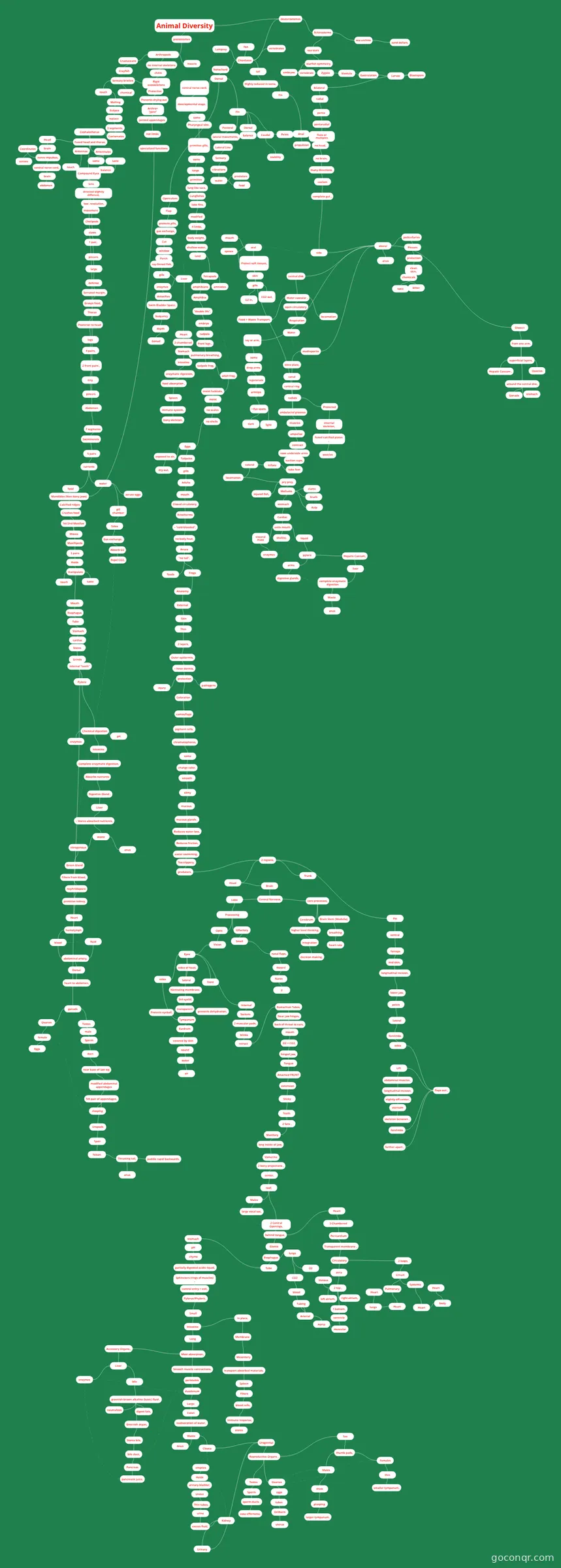
Mind map: Animal diversity
Map content
Animal Diversity
protostomes
- Arthropods
- no internal skeletons
- chitin
- Rigid exoskeletons
- Arthro= “joint”
- jointed appendages
- not limbs
- jointed appendages
- Protective
- Prevents drying out
- Sensory bristles
- chemical
- touch
- Molting
- Ecdysis
- replace
- 3 segments,
- Coelomates
- Cephalothorax
- Fused head and thorax,
- Antennae
- touch
- Antennules
- taste
- balance
- some
- taste
- Head
- brain
- Coordinates
- senses
- nerve impulses,
- ventral nerve cord,
- brain
- abdomen
- brain
- ventral nerve cord,
- Coordinates
- brain
- Antennae
- Compound Eyes
- Thorax
- Posterior to head
- legs
- 4 pairs,
- 2 front pairs ,
- tiny
- pincers
- tiny
- 2 front pairs ,
- 4 pairs,
- legs
- Abdomen
- 7 segments
- Swimmerets
- 5 pairs
- currents
- water
- aerate eggs
- gill chamber
- Sides
- Gas exchange,
- Absorb O2
- Expel CO2,
- Absorb O2
- Gas exchange,
- Sides
- food
- Mandibles (Non-bony jaws)
- specialized functions
- Calcified ridges
- Crushes food
- 1st/2nd Maxillae
- Maxillipeds
- 3 pairs
- Holds
- manipulate
- Mouth
- Esophagus
- Tube
- Stomach
- cardiac
- Stores
- Grinds
- Pyloric
- Chemical digestion
- pH
- enzymes
- Intestine
- Complete enzymatic digestion,
- Absorbs nutrients
- Digestive Gland ,
- Liver
- – Stores absorbed nutrients,
- waste
- anus
- nitrogenous
- Green Gland
- Filters from blood,
- nephridiopore
- primitive kidney,
- Heart
- hemolymph
- blood
- abdominal artery,
- Dorsal
- heart to abdomen,
- fluid
- Dorsal
- abdominal artery,
- blood
- hemolymph
- Heart
- primitive kidney,
- nephridiopore
- Filters from blood,
- Green Gland
- waste
- – Stores absorbed nutrients,
- Liver
- Digestive Gland ,
- Absorbs nutrients
- Complete enzymatic digestion,
- Chemical digestion
- internal “teeth”
- gonads
- Ovaries
- female
- Eggs
- female
- Testes
- male
- Sperm
- duct
- near base of last leg
- modified abdominal appendages
- 5th pair of appendages,
- Uropods
- 1pair
- Telson
- Thrusting tail,
- paddle rapid backwards,
- anus
- Thrusting tail,
- Telson
- 1pair
- clasping
- Uropods
- 5th pair of appendages,
- modified abdominal appendages
- near base of last leg
- duct
- Sperm
- male
- Ovaries
- gonads
- Pyloric
- Grinds
- Stores
- cardiac
- Stomach
- Tube
- Esophagus
- touch
- taste
- Mouth
- manipulate
- Holds
- 3 pairs
- Moves
- Maxillipeds
- 1st/2nd Maxillae
- Crushes food
- Mandibles (Non-bony jaws)
- water
- currents
- 5 pairs
- Swimmerets
- 7 segments
- Posterior to head
- Chelipeds
- claws
- 1 pair,
- pincers
- large
- defense
- Serrated margin,
- Grasps food,
- Serrated margin,
- defense
- large
- pincers
- 1 pair,
- claws
- lens
- directed slightly different,
- low- resolution,
- movement
- low- resolution,
- directed slightly different,
- Thorax
- Fused head and thorax,
- Cephalothorax
- Coelomates
- 3 segments,
- replace
- Ecdysis
- Molting
- Arthro= “joint”
- Rigid exoskeletons
- chitin
- Crustaceans
- Crayfish
- Insects
- no internal skeletons
- Arthropods
deuterostomes
- Echinoderms
- sea urchins
- sand dollars,
- sea stars
- starfish symmetry,
- embryos
- vertebrate
- Zygote
- blastula
- Gastrulation
- Larvae
- Blastopore
- bilateral
- radial
- penta
- pentaradial
- fives or multiples
- no head,
- no brain,
- many directions,
- coelom
- complete gut ,
- side
- aboral
- anus
- madreporite
- sieve plate,
- canal
- central ring
- radials
- Protected
- internal skeleton,
- fused calcified plates ,
- ossicles
- fused calcified plates ,
- internal skeleton,
- ambulacral grooves
- oral
- mouth
- spines
- Protect soft tissues,
- skin
- gills
- O2 in,
- CO2 out,
- gills
- skin
- Protect soft tissues,
- muscles
- ampullae
- contract
- rows underside arms
- suction cups,
- tube feet
- Inflate
- extend
- locomotion
- pry prey,
- Mollusks
- clams
- Snails
- Kelp
- stomach
- Cardiac
- exits mouth
- shell(s),
- visceral mass
- enzymes
- liquid
- pyloric
- Hepatic Caecum,
- liver
- complete enzymatic digestion
- Waste
- anus
- Waste
- complete enzymatic digestion
- liver
- arms
- digestive glands,
- Hepatic Caecum,
- pyloric
- exits mouth
- Cardiac
- injured fish,
- Mollusks
- pry prey,
- locomotion
- extend
- Inflate
- tube feet
- suction cups,
- rows underside arms
- contract
- ampullae
- oral
- Protected
- radials
- central ring
- canal
- sieve plate,
- Dissect
- from one arm,
- superficial layers,
- Hepatic Caecum ,
- Ossicles
- around the central disc,
- Gonads
- stomach
- superficial layers,
- from one arm,
- ray or arm,
- some
- drop arms
- regenerate
- armtips
- • Eye spots,
- light
- dark
- • Eye spots,
- armtips
- regenerate
- drop arms
- some
- pedicellaries
- Pincers
- protection
- clean skin,
- chemicals
- toxic
- bitter
- chemicals
- clean skin,
- protection
- Pincers
- central disk
- Water vascular ,
- locomotion
- Food + Waste Transport,
- open circulatory
- Respiration
- Water
- Respiration
- Water vascular ,
- aboral
- side
- complete gut ,
- coelom
- many directions,
- no brain,
- no head,
- fives or multiples
- pentaradial
- penta
- radial
- bilateral
- Blastopore
- Larvae
- Gastrulation
- blastula
- Zygote
- vertebrate
- embryos
- starfish symmetry,
- sea urchins
- Chordates
- Notochord
- Dorsal
- central nerve cord,
- developmental stage,
- some
- Pharyngeal slits ,
- primitive gills,
- some
- lungs
- primitive
- lung-like sacs,
- Lungfishes
- lobe fins,
- modified
- 4 limbs,
- body weight,
- shallow water,
- land
- Tetrapods
- amphibians
- Amphibia
- “double life”,
- embryo
- tadpole
- front legs ,
- pulmonary breathing,
- tadpole frog,
- adult frog,
- moist habitats,
- moist
- no scales
- no shells
- Eggs
- exposed to air,
- dry out,
- Tadpoles
- gills
- Adults
- mouth
- Closed circulatory,
- Ectotherms
- – “cold-blooded”,
- no body heat,
- Anura
- “no tail”,
- Toads
- Frogs
- Anatomy
- External
- Skin
- Thin
- 2 layers,
- Outer epidermis,
- – Inner dermis,
- protection
- injury
- pathogens
- Coloration
- camouflage
- pigment cells,
- chromatophores,
- some
- change color,
- smooth
- slimy
- mucous
- mucous glands ,
- Reduces water loss,
- Reduces friction,
- easier swimming,
- Too slippery,
- predators,
- 2 regions,
- Head
- Brain
- Central Nervous,
- Lobe
- Processing
- Olfactory
- Smell
- nasal flaps,
- Nostril
- Nares
- 2
- Nares
- Nostril
- nasal flaps,
- Smell
- Optic
- Vision
- Eyes
- sides of head,
- lateral
- sides
- Tympanum
- Eardrum
- covered by skin
- sound
- water
- air
- water
- sound
- covered by skin
- Eardrum
- Tympanum
- front
- Nictitating membrane,
- 3rd eyelid,
- transparent
- Protects eyeball,
- prevents dehydration,
- transparent
- 3rd eyelid,
- Internal
- Sockets
- 2 muscular pads,
- blinks
- retract
- Eustachian Tubes,
- Near jaw hinges,
- back of throat to ears,
- mouth
- O2 + CO2,
- hinged jaw,
- Tongue
- Attached FRONT
- extension
- Sticky
- Teeth
- 2 Sets ,
- Maxillary
- long inside of jaw,
- Vomerine
- 2 bony projections ,
- center,
- roof,
- 2 Central Openings,
- behind tongue,
- Glottis
- Heart
- 3-Chambered
- Pericardium
- Transparent membrane ,
- Circulatory
- atria
- 2 top ,
- left atrium,
- right atrium,
- 1 bottom,
- ventricle
- muscular
- Aorta
- Arterial
- blood
- CO2
- lungs
- Esophagus
- Tube
- stomach
- pH
- chyme
- partially digested acidic liquid,
- Sphincters (rings of muscles) ,
- Sphincters (rings of muscles) ,
- partially digested acidic liquid,
- chyme
- pH
- stomach
- Tube
- Esophagus
- lungs
- CO2
- blood
- Arterial
- Aorta
- muscular
- ventricle
- 2 top ,
- atria
- Circulatory
- Transparent membrane ,
- Pericardium
- 3-Chambered
- behind tongue,
- 2 Central Openings,
- roof,
- center,
- 2 bony projections ,
- Vomerine
- long inside of jaw,
- Maxillary
- 2 Sets ,
- Teeth
- Sticky
- extension
- Attached FRONT
- Tongue
- hinged jaw,
- O2 + CO2,
- mouth
- back of throat to ears,
- Near jaw hinges,
- Eustachian Tubes,
- retract
- blinks
- 2 muscular pads,
- Sockets
- sides of head,
- Eyes
- Vision
- Olfactory
- Processing
- Lobe
- Central Nervous,
- Brain
- Head
- 2 regions,
- predators,
- Too slippery,
- easier swimming,
- Reduces friction,
- Reduces water loss,
- mucous glands ,
- mucous
- slimy
- smooth
- change color,
- some
- chromatophores,
- pigment cells,
- camouflage
- protection
- – Inner dermis,
- Outer epidermis,
- 2 layers,
- Thin
- Skin
- External
- Anatomy
- “no tail”,
- Anura
- no body heat,
- – “cold-blooded”,
- Ectotherms
- Closed circulatory,
- mouth
- Adults
- gills
- exposed to air,
- Eggs
- no shells
- no scales
- moist
- moist habitats,
- adult frog,
- tadpole frog,
- pulmonary breathing,
- front legs ,
- tadpole
- embryo
- “double life”,
- Amphibia
- amphibians
- Tetrapods
- land
- shallow water,
- body weight,
- 4 limbs,
- modified
- lobe fins,
- Lungfishes
- lung-like sacs,
- primitive
- lungs
- some
- primitive gills,
- Pharyngeal slits ,
- some
- developmental stage,
- central nerve cord,
- Dorsal
- Notochord
- Echinoderms