
Mind map
Vision and Lighting
Map content
Vision and Lighting
Designing a Petrol Pump
- Visual display
- Style of display
- Day/Night use
- Supplementary lighting needed for the display?
- Characteristics of the lighting (sodium)
- Could the lighting affect the identification of the colour of the pump, signage or display?
- Supplementary lighting needed for the display?
- Glass/plastic covering, reflections from the artificial lighting sun or car headlamps?
- Height of display for users (standing/sitting)
- Visual display
How do we see
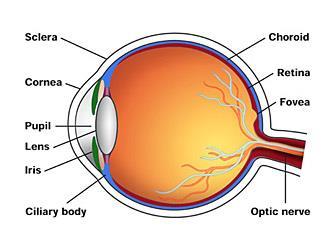
- Light rays from an object pass through the pupil apeture, lens and inside of eyeball, converge on the retina. Specific sensors (rods and cones) are stimulated.
- Brain
- Controls pupil size
- Lens curvature
- Eyeball movement
- Integrates signals from the eye into a picture (we see)
- Pupil
- Controls the amount of light entering the eye
- Cornea and Lens
- Refracts the rays of light and focuses them on the retina
Basic Human Vision Capabilities
- Visual Acuity
- The ability of the eye to discriminate fine detail
- Vernier acuity
- Snellen chart
- Occurs in the fovea (cones)
- Requires accomodation - changes in the curvature of the lens by contractions of the ciliary muscle
- Problems
- Myopia
- Near sightedness (converge infront of retina)
- Hyperopia
- Far sightedness - converge behind the retina
- Lens can stiffen with age - problems
- Myopia
- Increases with better lighting
- The ability of the eye to discriminate fine detail
- Contrast sensitivity
- The ability of the eye to perceive differences in illuminaton
- Critical for seeing shapes and hazards
- The ability of the eye to perceive differences in illuminaton
- Adaption
- The changes in our sensitivity to light. Adapting to different light levels, bright sunshine - x10000000000 brighter than a dark night- can still see from adaption
- Light to dark
- Very quick to start - could take up to 1 hour for full
- Dark to light
- Quicker- Full takes a few minutes
- Vehicles - illuminated instruments (red/yellow light and night-easier to adjust to) - maintains dark adaption of rods - can see black, grey, white on roads.
- Light to dark
- The changes in our sensitivity to light. Adapting to different light levels, bright sunshine - x10000000000 brighter than a dark night- can still see from adaption
- Colour Discrimination
- Contrast can vary for different colour combinations
- 7-9% males colour deficient (RED-GREEN)
- Contrast can vary for different colour combinations
- Rods and Cones
- Rods
- Located through periphery- more common closer to the lens
- More sensitive to light levels than cones - used for night vision
- Cones
- In fovea
- Need lots of illumination to operate
- Provide visual acuity and colour sensitivity
- Rods
- Eye/Neck/Head movement
- Tracking movements
- Visual Acuity
Parameters of Light
- Illuminance/Illumination
- The amount of light falling onto a surface (lux)
- Luminance
- The amount of light emitted from a surface (candela per m^2)
- Reflectance
- % = (Luminance / Illuminance) x pi x 100
- Illuminance/Illumination
Images and files in the map
Information
- Description
- Uni Ergonomics Mind Map on Vision and Lighting, created by Ellen Rita on 24/12/2015.
- Created by
- Ellen Rita
- Views
- 8
- Rating