
Mind map
LAW Alternative Dispute Resolution
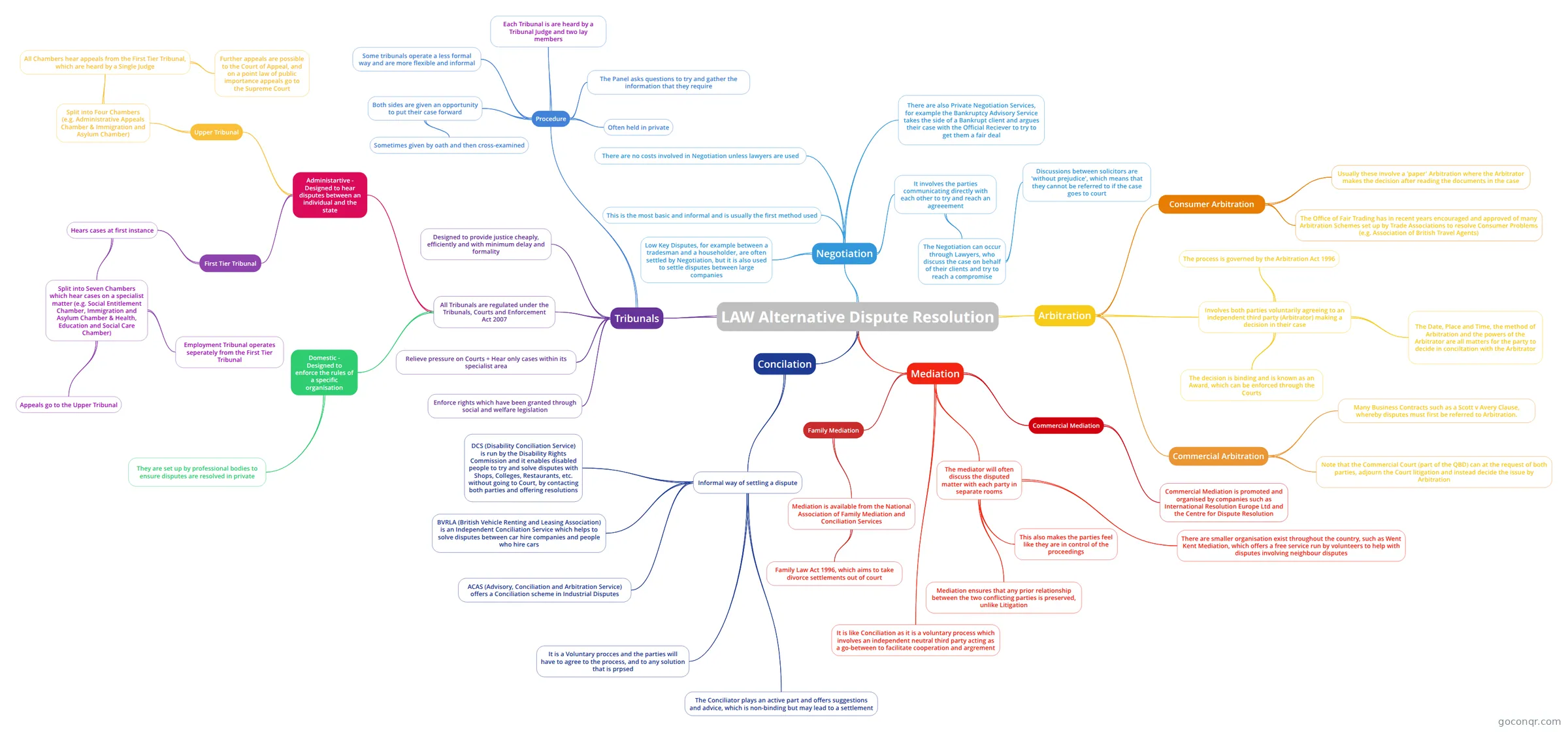
Mind map: Alternative Dispute Resolution
Map content
LAW Alternative Dispute Resolution
Arbitration
- Involves both parties voluntarily agreeing to an independent third party (Arbitrator) making a decision in their case
- The decision is binding and is known as an Award, which can be enforced through the Courts
- The process is governed by the Arbitration Act 1996
- The Date, Place and Time, the method of Arbitration and the powers of the Arbitrator are all matters for the party to decide in conciltation with the Arbitrator
- Consumer Arbitration
- The Office of Fair Trading has in recent years encouraged and approved of many Arbitration Schemes set up by Trade Associations to resolve Consumer Problems (e.g. Association of British Travel Agents)
- Usually these involve a 'paper' Arbitration where the Arbitrator makes the decision after reading the documents in the case
- Commercial Arbitration
- Many Business Contracts such as a Scott v Avery Clause, whereby disputes must first be referred to Arbitration.
- Note that the Commercial Court (part of the QBD) can at the request of both parties, adjourn the Court litigation and instead decide the issue by Arbitration
- Involves both parties voluntarily agreeing to an independent third party (Arbitrator) making a decision in their case
Concilation
- Informal way of settling a dispute
- It is a Voluntary procces and the parties will have to agree to the process, and to any solution that is prpsed
- The Conciliator plays an active part and offers suggestions and advice, which is non-binding but may lead to a settlement
- ACAS (Advisory, Conciliation and Arbitration Service) offers a Conciliation scheme in Industrial Disputes
- DCS (Disability Conciliation Service) is run by the Disability Rights Commission and it enables disabled people to try and solve disputes with Shops, Colleges, Restaurants, etc. without going to Court, by contacting both parties and offering resolutions
- BVRLA (British Vehicle Renting and Leasing Association) is an Independent Conciliation Service which helps to solve disputes between car hire companies and people who hire cars
- Informal way of settling a dispute
Negotiation
- This is the most basic and informal and is usually the first method used
- It involves the parties communicating directly with each other to try and reach an agreeement
- The Negotiation can occur through Lawyers, who discuss the case on behalf of their clients and try to reach a compromise
- Discussions between solicitors are 'without prejudice', which means that they cannot be referred to if the case goes to court
- The Negotiation can occur through Lawyers, who discuss the case on behalf of their clients and try to reach a compromise
- Low Key Disputes, for example between a tradesman and a householder, are often settled by Negotiation, but it is also used to settle disputes between large companies
- There are no costs involved in Negotiation unless lawyers are used
- There are also Private Negotiation Services, for example the Bankruptcy Advisory Service takes the side of a Bankrupt client and argues their case with the Official Reciever to try to get them a fair deal
Tribunals
- All Tribunals are regulated under the Tribunals, Courts and Enforcement Act 2007
- Domestic - Designed to enforce the rules of a specific organisation
- They are set up by professional bodies to ensure disputes are resolved in private
- Administartive - Designed to hear disputes between an individual and the state
- First Tier Tribunal
- Hears cases at first instance
- Split into Seven Chambers which hear cases on a specialist matter (e.g. Social Entitlement Chamber, Immigration and Asylum Chamber & Health, Education and Social Care Chamber)
- Appeals go to the Upper Tribunal
- Employment Tribunal operates seperately from the First Tier Tribunal
- Split into Seven Chambers which hear cases on a specialist matter (e.g. Social Entitlement Chamber, Immigration and Asylum Chamber & Health, Education and Social Care Chamber)
- Hears cases at first instance
- Upper Tribunal
- Split into Four Chambers (e.g. Administrative Appeals Chamber & Immigration and Asylum Chamber)
- All Chambers hear appeals from the First Tier Tribunal, which are heard by a Single Judge
- Further appeals are possible to the Court of Appeal, and on a point law of public importance appeals go to the Supreme Court
- All Chambers hear appeals from the First Tier Tribunal, which are heard by a Single Judge
- Split into Four Chambers (e.g. Administrative Appeals Chamber & Immigration and Asylum Chamber)
- First Tier Tribunal
- Domestic - Designed to enforce the rules of a specific organisation
- Enforce rights which have been granted through social and welfare legislation
- Relieve pressure on Courts + Hear only cases within its specialist area
- Designed to provide justice cheaply, efficiently and with minimum delay and formality
- Procedure
- Each Tribunal is are heard by a Tribunal Judge and two lay members
- Both sides are given an opportunity to put their case forward
- Sometimes given by oath and then cross-examined
- Some tribunals operate a less formal way and are more flexible and informal
- The Panel asks questions to try and gather the information that they require
- Often held in private
- All Tribunals are regulated under the Tribunals, Courts and Enforcement Act 2007
Mediation
- It is like Conciliation as it is a voluntary process which involves an independent neutral third party acting as a go-between to facilitate cooperation and argrement
- The mediator will often discuss the disputed matter with each party in separate rooms
- Mediation ensures that any prior relationship between the two conflicting parties is preserved, unlike Litigation
- This also makes the parties feel like they are in control of the proceedings
- There are smaller organisation exist throughout the country, such as Went Kent Mediation, which offers a free service run by volunteers to help with disputes involving neighbour disputes
- Commercial Mediation
- Commercial Mediation is promoted and organised by companies such as International Resolution Europe Ltd and the Centre for Dispute Resolution
- Family Mediation
- Mediation is available from the National Association of Family Mediation and Conciliation Services
- Family Law Act 1996, which aims to take divorce settlements out of court
- Mediation is available from the National Association of Family Mediation and Conciliation Services
Information
- Description
- AS - Level Law Mind Map on LAW Alternative Dispute Resolution, created by Joe D on 11/03/2016.
- Created by
- Joe D
- Views
- 12
- Rating