
Mind map
Class differences in education
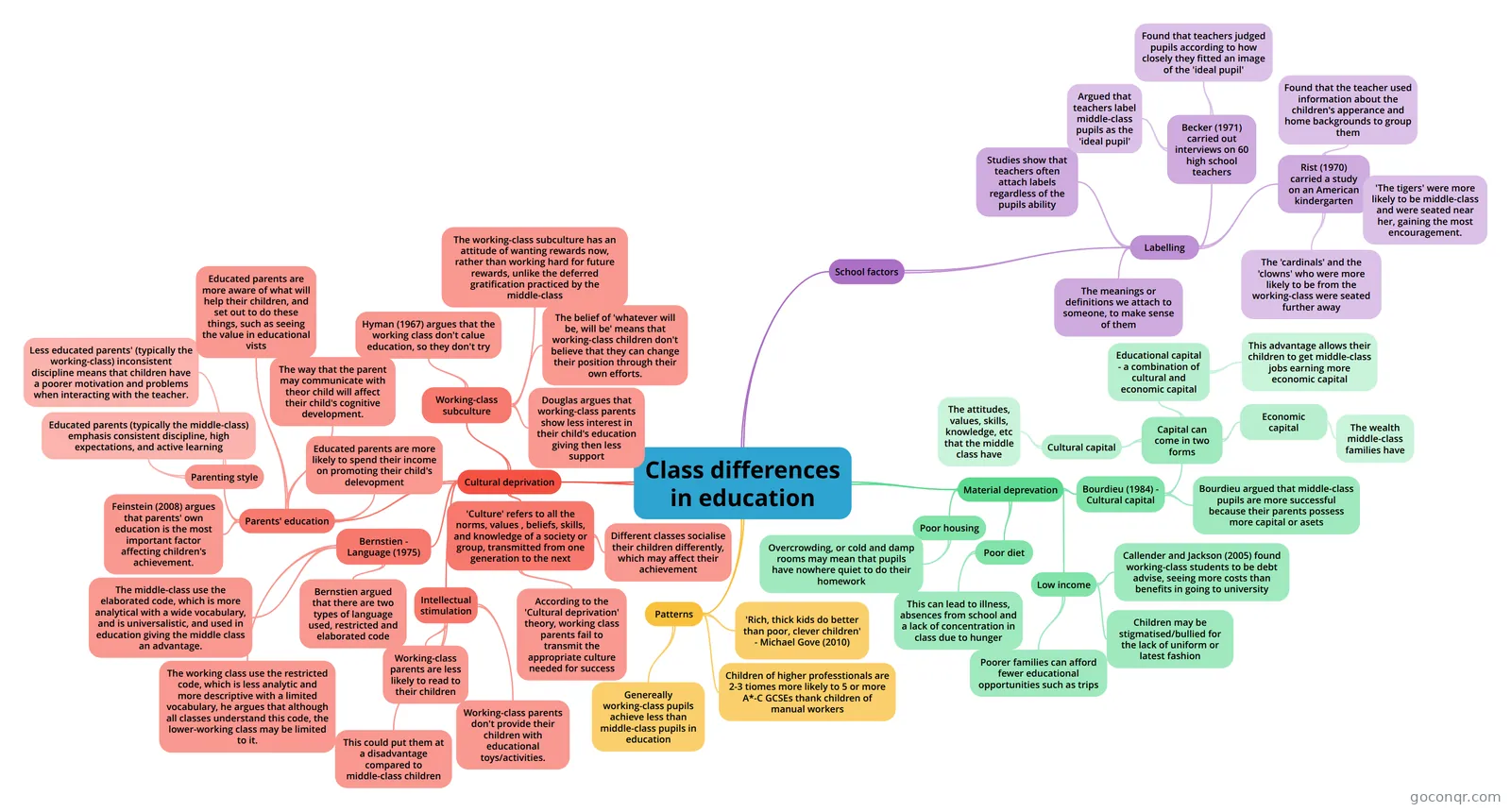
Mind map: Class differences in education
Map content
Class differences in education
Patterns
- Genereally working-class pupils achieve less than middle-class pupils in education
- Children of higher professtionals are 2-3 tiomes more likely to 5 or more A*-C GCSEs thank children of manual workers
- 'Rich, thick kids do better than poor, clever children' - Michael Gove (2010)
Cultural deprivation
- 'Culture' refers to all the norms, values , beliefs, skills, and knowledge of a society or group, transmitted from one generation to the next
- Different classes socialise their children differently, which may affect their achievement
- According to the 'Cultural deprivation' theory, working class parents fail to transmit the appropriate culture needed for success
- Intellectual stimulation
- Working-class parents don't provide their children with educational toys/activities.
- This could put them at a disadvantage compared to middle-class children
- Working-class parents are less likely to read to their children
- Bernstien - Language (1975)
- Bernstien argued that there are two types of language used, restricted and elaborated code
- The working class use the restricted code, which is less analytic and more descriptive with a limited vocabulary, he argues that although all classes understand this code, the lower-working class may be limited to it.
- The middle-class use the elaborated code, which is more analytical with a wide vocabulary, and is universalistic, and used in education giving the middle class an advantage.
- Parents' education
- Feinstein (2008) argues that parents' own education is the most important factor affecting children's achievement.
- Parenting style
- Educated parents (typically the middle-class) emphasis consistent discipline, high expectations, and active learning
- Less educated parents' (typically the working-class) inconsistent discipline means that children have a poorer motivation and problems when interacting with the teacher.
- Educated parents are more aware of what will help their children, and set out to do these things, such as seeing the value in educational vists
- Educated parents are more likely to spend their income on promoting their child's delevopment
- The way that the parent may communicate with theor child will affect their child's cognitive development.
- Working-class subculture
- The working-class subculture has an attitude of wanting rewards now, rather than working hard for future rewards, unlike the deferred gratification practiced by the middle-class
- The belief of 'whatever will be, will be' means that working-class children don't believe that they can change their position through their own efforts.
- Hyman (1967) argues that the working class don't calue education, so they don't try
- Douglas argues that working-class parents show less interest in their child's education giving then less support
- 'Culture' refers to all the norms, values , beliefs, skills, and knowledge of a society or group, transmitted from one generation to the next
Material deprevation
- Poor housing
- Overcrowding, or cold and damp rooms may mean that pupils have nowhere quiet to do their homework
- Poor diet
- This can lead to illness, absences from school and a lack of concentration in class due to hunger
- Low income
- Poorer families can afford fewer educational opportunities such as trips
- Children may be stigmatised/bullied for the lack of uniform or latest fashion
- Callender and Jackson (2005) found working-class students to be debt advise, seeing more costs than benefits in going to university
- Bourdieu (1984) - Cultural capital
- Bourdieu argued that middle-class pupils are more successful because their parents possess more capital or asets
- Capital can come in two forms
- Economic capital
- The wealth middle-class families have
- Cultural capital
- The attitudes, values, skills, knowledge, etc that the middle class have
- Educational capital - a combination of cultural and economic capital
- This advantage allows their children to get middle-class jobs earning more economic capital
- Economic capital
- Poor housing
School factors
- Labelling
- The meanings or definitions we attach to someone, to make sense of them
- Studies show that teachers often attach labels regardless of the pupils ability
- Becker (1971) carried out interviews on 60 high school teachers
- Found that teachers judged pupils according to how closely they fitted an image of the 'ideal pupil'
- Argued that teachers label middle-class pupils as the 'ideal pupil'
- Rist (1970) carried a study on an American kindergarten
- Found that the teacher used information about the children's apperance and home backgrounds to group them
- 'The tigers' were more likely to be middle-class and were seated near her, gaining the most encouragement.
- The 'cardinals' and the 'clowns' who were more likely to be from the working-class were seated further away
- Labelling
Information
- Description
- A Level Sociology (Education) Mind Map on Class differences in education, created by Phoebe Fletcher on 11/05/2016.
- Created by
- Phoebe Fletcher
- Views
- 105
- Tags
- Rating