
Mind map
CPU, F-D-E, Clock speeds, Cores, Processors
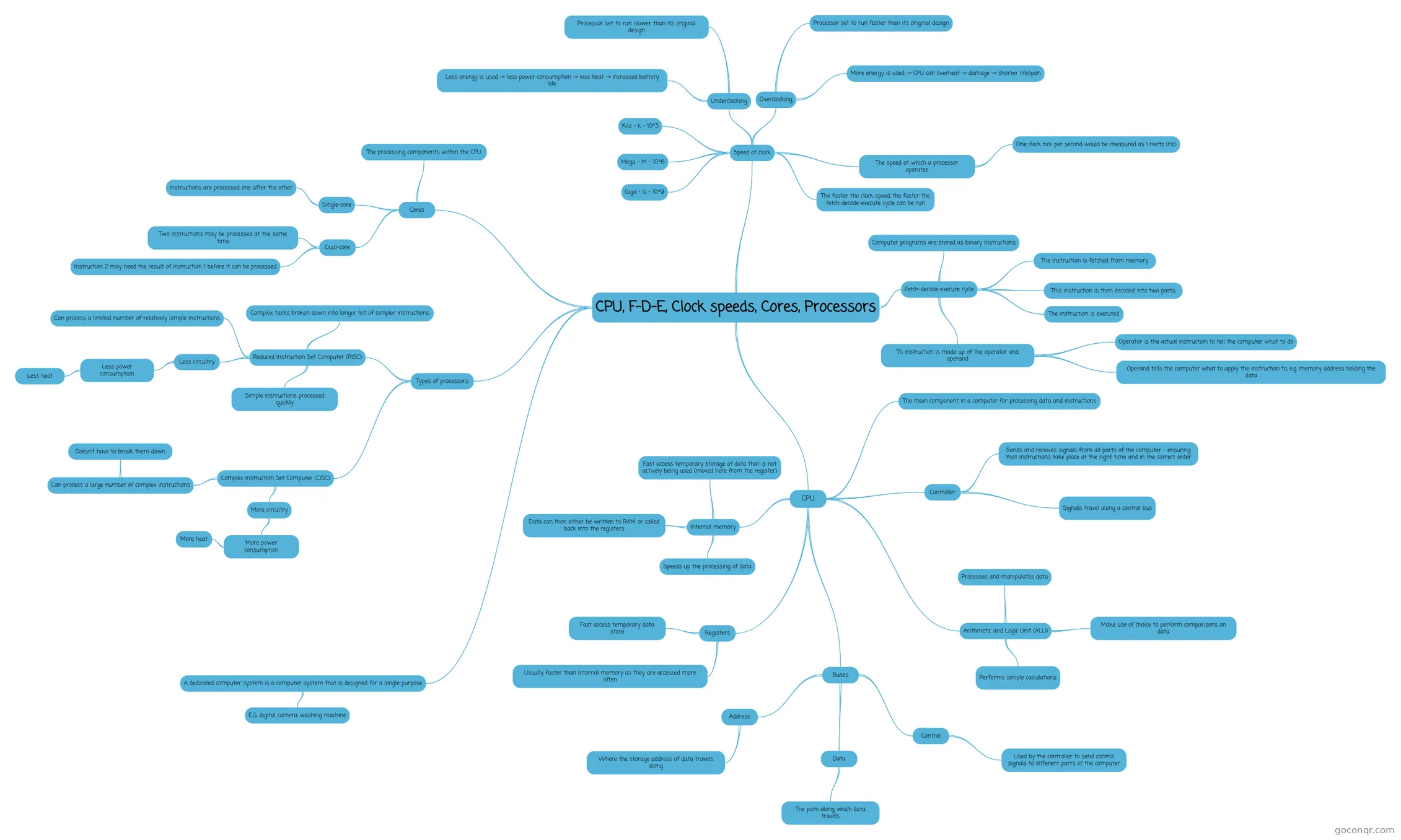
Mind map: CPU, F-D-E cycle, clock speeds, cores and processors
Map content
CPU, F-D-E, Clock speeds, Cores, Processors
CPU
- The main component in a computer for processing data and instructions
- Controller
- Sends and receives signals from all parts of the computer - ensuring that instructions take place at the right time and in the correct order
- Signals travel along a control bus
- Arithmetic and Logic Unit (ALU)
- Processes and manipulates data
- Performs simple calculations
- Make use of choice to perform comparisons on data
- Registers
- Fast access temporary data store
- Usually faster than internal memory as they are accessed more often
- Internal memory
- Fast access temporary storage of data that is not actively being used (moved here from the register)
- Data can then either be written to RAM or called back into the registers
- Speeds up the processing of data
- Buses
- Address
- Where the storage address of data travels along
- Data
- The path along which data travels
- Control
- Used by the controller to send control signals to different parts of the computer
- Address
Fetch-decode-execute cycle
- The instruction is fetched from memory
- This instruction is then decoded into two parts
- The instruction is executed
- Computer programs are stored as binary instructions
- Th instruction is made up of the operator and operand
- Operator is the actual instruction to tell the computer what to do
- Operand tells the computer what to apply the instruction to, e.g. memory address holding the data
Speed of clock
- The speed at which a processor operates
- One clock tick per second would be measured as 1 Hertz (Hz)
- The faster the clock speed, the faster the fetch-decode-execute cycle can be run
- Kilo - k - 10^3
- Mega - M - 10^6
- Giga - G - 10^9
- Overclocking
- Processor set to run faster than its original design
- More energy is used -> CPU can overheat -> damage -> shorter lifespan
- Underclocking
- Processor set to run slower than its original design
- Less energy is used -> less power consumption -> less heat -> increased battery life
- The speed at which a processor operates
Cores
- The processing components within the CPU
- Single-core
- Instructions are processed one after the other
- Dual-core
- Two instructions may be processed at the same time
- Instruction 2 may need the result of Instruction 1 before it can be processed
Types of processors
- Reduced Instruction Set Computer (RISC)
- Can process a limited number of relatively simple instructions
- Complex tasks broken down into longer list of simpler instructions
- Simple instructions processed quickly
- Less circuitry
- Less power consumption
- Less heat
- Less power consumption
- Complex Instruction Set Computer (CISC)
- Can process a large number of complex instructions
- Doesn't have to break them down
- More circuitry
- More power consumption
- More heat
- More power consumption
- Can process a large number of complex instructions
- Reduced Instruction Set Computer (RISC)
A dedicated computer system is a computer system that is designed for a single purpose
- E.G: digital camera, washing machine
Information
- Description
- GCSE Computer Science (1. Computer Systems) Mind Map on CPU, F-D-E, Clock speeds, Cores, Processors, created by Zoe CB on 31/05/2016.
- Created by
- Zoe CB
- Views
- 3
- Rating
More on Fetch-decode-execute cycle