
Mind map
JEWS
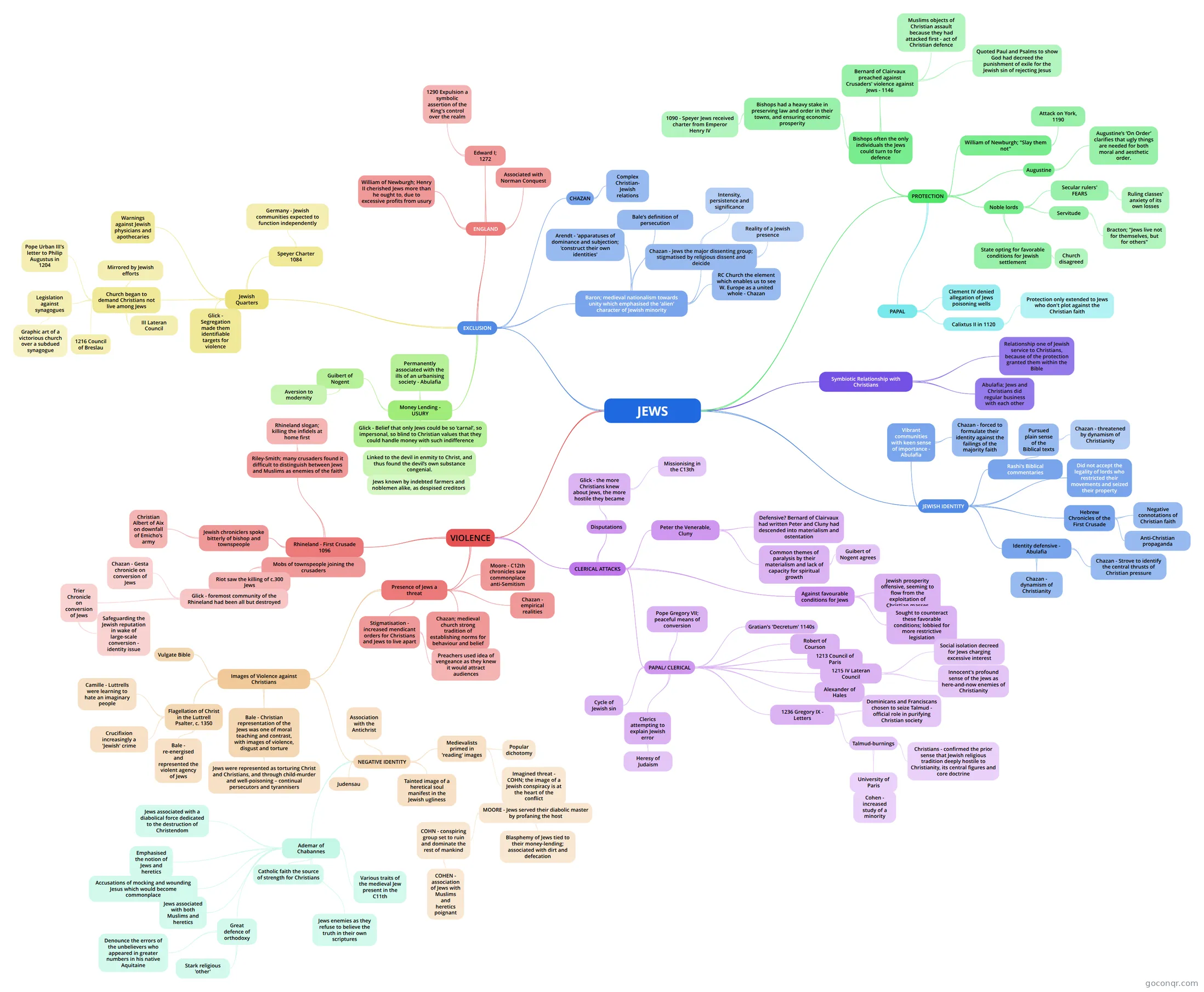
Mind map: Jews in medieval Europe
Map content
JEWS
EXCLUSION
- Baron; medieval nationalism towards unity which emphasised the 'alien' character of Jewish minority
- Chazan - Jews the major dissenting group; stigmatised by religious dissent and deicide
- Reality of a Jewish presence
- The theological quarrel between the two faiths and popular imagery served to keep Christian Europe conscious of Jews.
- Intensity, persistence and significance
- Jewish-Christian works are in large measure a function of the peculiar combination of intimacy and divergence that marks the relationship between the two faiths
- Reality of a Jewish presence
- Bale's definition of persecution
- From Aristotle’s definition of fear as a ‘painful or troubled feeling caused by the impression of an imminent evil that causes destruction or pain’
- Arendt - 'apparatuses of dominance and subjection; 'construct their own identities'
- RC Church the element which enables us to see W. Europe as a united whole - Chazan
- Chazan - Jews the major dissenting group; stigmatised by religious dissent and deicide
- Jewish Quarters
- Church began to demand Christians not live among Jews
- III Lateran Council
- Resolved throughout Christendom, Christians who 'presume to live among Jews will be excommunicated'
- 1216 Council of Breslau
- Believed it had to protect the newly Christianised population against Jewish religious influences; the Christian people might more easily be infected by the superstitions and the depraved mores of the Jews living with them. "In order that the Christian faith be more easily and quickly implanted in the heart of the faithful in these regions, we strictly prescribe that the Jews inhabiting this province of Gniezno should not indiscriminately dwell among the Christians, but should possess contiguous or adjoining houses in a segregated location of each village or town"
- Mirrored by Jewish efforts
- Rabbinic and sectarian - Talmud warned against Jews sojourning with Gentiles on the Sabbath
- That Jews wanted to live alone was evident - Glick
- Legislation against synagogues
- Tried to outlaw the building of new synagogues, and endeavoured to prevent their height exceeding that of the churches'.
- Pious laymen felt the sound of the Jewish liturgy from the synagogue intermingling of prayers was a disgrace to the faith - pollution of the Christian service
- Graphic art of a victorious church over a subdued synagogue
- Pope Urban III's letter to Philip Augustus in 1204
- Complained of the favouritism extended to the Jews by the French princes; preferred the sons of crucifiers, against whom His blood still cries out to the ears of the Father, to the heirs of Christ crucified are extremely offensive to the sight of the Divine Majesty
- III Lateran Council
- Warnings against Jewish physicians and apothecaries
- Discriminatory and segregationist tone - Church circulated rumours that Jewish doctors discriminated against Christian patients and wilfully undermined their patients' health
- Speyer Charter 1084
- Jews enclosed by a wall, but expected to defend it; perhaps against fellow Christian residents
- Bishop consigned church-owned land to the Jews; going out of his way to be receptive
- Germany - Jewish communities expected to function independently
- To establish themselves as a semi-enclosed community within a town, to attend to their own legal and admin needs, a society within society.
- Glick - Segregation made them identifiable targets for violence
- Church began to demand Christians not live among Jews
- Money Lending - USURY
- Glick - 'the Jewish occupation' - high rates of interest symbolised the supposed wickedness of Jews
- Glick - Belief that only Jews could be so ‘carnal’, so impersonal, so blind to Christian values that they could handle money with such indifference
- Linked to the devil in enmity to Christ, and thus found the devil’s own substance congenial.
- Jews known by indebted farmers and noblemen alike, as despised creditors
- Linked to the devil in enmity to Christ, and thus found the devil’s own substance congenial.
- Guibert of Nogent
- Taking interest tantamount to stealing - Jews (as usurers) are thieves as well - taking interest off of the necks of the needy
- Aversion to modernity
- Attached to the established social order, contributing to his enmity of the Jews - by their very nature are obsessed with the love of money and the lure of material gain
- Permanently associated with the ills of an urbanising society - Abulafia
- ENGLAND
- William of Newburgh; Henry II cherished Jews more than he ought to, due to excessive profits from usury
- Allowed the Jews to act insolently against Christians and impose hardship
- Edward I; 1272
- Learnt the English were no longer willing to bear the brunt of indirect burdens caused by heavy tallages upon the Jews
- Statute of the Jewry in 1275 acknowledged that English kings had profited from Jewish usury at the expense of their Christian debtors.
- 1290 Expulsion a symbolic assertion of the King's control over the realm
- Associated with Norman Conquest
- English Jews associated with the new Norman monarchy and thus a part of the conquering class that had imposed itself on the English people. Jews very much belonging to the King
- The newcomer status, the moneylending and the alliance with the monarchy were all more pronounced, and thus anti-Jewish hostility more intense.
- William of Newburgh; Henry II cherished Jews more than he ought to, due to excessive profits from usury
- CHAZAN
- Complex Christian- Jewish relations
- Communities so polarised as medieval Christians and Jews inevitably looked upon dramatic incidents from strikingly different perspectives
- Each side focussing on their own concerns and providing own opinion on the events witnessed (Crusaders' violence eg)
- Complex Christian- Jewish relations
- Baron; medieval nationalism towards unity which emphasised the 'alien' character of Jewish minority
PROTECTION
- Bishops often the only individuals the Jews could turn to for defence
- Bishops had a heavy stake in preserving law and order in their towns, and ensuring economic prosperity
- 1090 - Speyer Jews received charter from Emperor Henry IV
- Extended commercial pursuits, and the freedom to travel and trade. Even exempted them from taxes and certain tolls
- BUT explicitly warned against forced baptisms, and abduction and conversion of Christian slaves
- 1090 - Speyer Jews received charter from Emperor Henry IV
- Bernard of Clairvaux preached against Crusaders' violence against Jews - 1146
- Against the monk Ralph; "people restrained by Bernard's saintliness"
- Quoted Paul and Psalms to show God had decreed the punishment of exile for the Jewish sin of rejecting Jesus
- Human revenge as inappropriate
- Muslims objects of Christian assault because they had attacked first - act of Christian defence
- As Jews live docilely under Christian rule, they aren't legitimate targets of Christian violence
- Jews are a people “from whom we have a law and a promise and whose flesh was shared by Jesus”
- Bishops had a heavy stake in preserving law and order in their towns, and ensuring economic prosperity
- Noble lords
- Servitude
- Became, from the C12th onwards, the personal property of those whom they served, with no other rights than those they 'earned' by supplying money on demand - Glick
- Bracton; "Jews live not for themselves, but for others"
- Contemporary account justifying servitude of Jews, and that debts owed to Jews were owed to the king
- Secular rulers' FEARS
- All disturbances were dangerous, and what began as anti-Jewish rioting might well end as a broad anti-establishment movement.
- Ruling classes' anxiety of its own losses
- The Jews were an important source of governmental revenues, and assaults on the Jews meant direct and tangible loss to their rulers. This mostly won them protection from their overlords. Chazan
- State opting for favorable conditions for Jewish settlement
- Stimulating Jewish settlement, profits and taxes.
- State involved itself in Jewish affairs and afforded specific aids to the Jews, particularly in the vexing area of collection of outstanding obligations.
- Church disagreed
- Servitude
- PAPAL
- Calixtus II in 1120
- Sicut Judaeis; just as Jews mustn’t overstep their bounds, so Christians mustn’t arbitrarily mistreat them. Christian charity demands that they be granted papal protection.
- Protection only extended to Jews who don't plot against the Christian faith
- Clement IV denied allegation of Jews poisoning wells
- Calixtus II in 1120
- William of Newburgh; "Slay them not"
- Jews were the crucifiers of Christ and were allowed to live among Christians for the express purpose of reminding them of Christ’s passion
- Attack on York, 1190
- Irrational attack by rational people (the Christians)
- Augustine
- Base Church position to safeguard Jewish life, as witnesses of Scripture, and recognised the right to practice Judaism within Christendom
- Augustine’s ‘On Order’ clarifies that ugly things are needed for both moral and aesthetic order.
- Bishops often the only individuals the Jews could turn to for defence
VIOLENCE
- Rhineland - First Crusade 1096
- Mobs of townspeople joining the crusaders
- Riot saw the killing of c.300 Jews
- Attack on bishop's compound saw the massacre of another c.500 Jews. Some Jews killed themselves in fear. Glick - most victims offered little resistance
- Glick - foremost community of the Rhineland had been all but destroyed
- Chazan - Gesta chronicle on conversion of Jews
- Noble Christian achievement, and sensible, laudable action on the part of the Jews
- Reversion as DESPICABLE and indicated moral and intellectual shortcoming
- Trier Chronicle on conversion of Jews
- Conversion as reprehensible, yet forced conversions understandable
- Reversion is praiseworthy, and reflects the insincerity of the original act
- Safeguarding the Jewish reputation in wake of large-scale conversion - identity issue
- Chazan - Gesta chronicle on conversion of Jews
- Riot saw the killing of c.300 Jews
- Jewish chroniclers spoke bitterly of bishop and townspeople
- Christian Albert of Aix on downfall of Emicho's army
- The hand of the Lord is believed to have been against the pilgrims, and who slaughtered the exiled Jews through greed of money rather than for the sake of God’s justice
- Christian Albert of Aix on downfall of Emicho's army
- Riley-Smith; many crusaders found it difficult to distinguish between Jews and Muslims as enemies of the faith
- Desire for revenge for the Crucifixion, which one contemporary understood as a reason for the crusade
- Rhineland slogan; killing the infidels at home first
- Mobs of townspeople joining the crusaders
- Presence of Jews a threat
- Glick - Jewish antagonists arose as real people, more formidable than the nameless villains of the gospels
- Chazan; medieval church strong tradition of establishing norms for behaviour and belief
- Considerable effort to define the status of Jewry and Judaism in practical and theoretical terms
- Images of Violence against Christians
- Flagellation of Christ in the Luttrell Psalter, c. 1350
- Demonstrates Christ’s humanity and his degradation at the hands of the Jews; but now expelled from England, so an imagined threat
- Bale - re-energised and represented the violent agency of Jews
- Camille - Luttrells were learning to hate an imaginary people
- Jews in the Psalter, read in the retrained eyes of the High Middle Ages, stand for wickedness, temporary power, agency, activity, and teach the reader to discern the correct, spiritual message of the Psalm itself.
- Crucifixion increasingly a 'Jewish' crime
- Vulgate Bible
- Only the Jews 'gave him blows', 'they began to spit on him and cover his face, and to buffet him'
- Bale - Christian representation of the Jews was one of moral teaching and contrast, with images of violence, disgust and torture
- Jews were represented as torturing Christ and Christians, and through child-murder and well-poisoning – continual persecutors and tyrannisers
- Rhetoric of Christian-Jewish conflict; Jews labelled as 'dogs' by Christians whereas Jews argued it was Christians who 'bark'
- Jews were represented as torturing Christ and Christians, and through child-murder and well-poisoning – continual persecutors and tyrannisers
- NEGATIVE IDENTITY
- Judensau
- Bestial corruption of Jews, and the corrupt basis of their faith - the sinful errors and the allegation of sexual corruption
- Tainted image of a heretical soul manifest in the Jewish ugliness
- Giotto’s image of Judas used the ‘slanting’ nose to reveal a ‘crooked soul’.
- Medievalists primed in 'reading' images
- Types of gesture, expression and pose as expressions of inner character and interpersonal engagement.
- Popular dichotomy
- Medieval culture had well-established and well-defined registers of beauty and ugliness, grace and immorality, used to construct a sense of order
- Imagined threat - COHN; the image of a Jewish conspiracy is at the heart of the conflict
- Synagogue of Satan in Psalms 2:9 and 3:9.
- MOORE - Jews served their diabolic master by profaning the host
- Blasphemy of Jews tied to their money-lending; associated with dirt and defecation
- King Louis VII of France warned by Peter the Venerable that Jews would subject sacred vessels which came into their hands to disgusting indignities
- COHN - conspiring group set to ruin and dominate the rest of mankind
- COHEN - association of Jews with Muslims and heretics poignant
- Process would deprive the Jew of “that singularity which distinguished him and underlay his worth" - complete loss of a separate identity
- COHEN - association of Jews with Muslims and heretics poignant
- Blasphemy of Jews tied to their money-lending; associated with dirt and defecation
- Association with the Antichrist
- Flock to the Antichrist as they did not accept Jesus as Christ
- Ademar of Chabannes
- Jews associated with a diabolical force dedicated to the destruction of Christendom
- Emphasised the notion of Jews and heretics
- Accusations of mocking and wounding Jesus which would become commonplace
- Evidence that the Jews were the enemy to Christian society
- Jews associated with both Muslims and heretics
- Muslims=greatest external threat to Christendom Heretics=greatest internal threat to Christendom
- Great defence of orthodoxy
- Prepared to demonstrate his own adherence to the Christian faith of his day.
- Denounce the errors of the unbelievers who appeared in greater numbers in his native Aquitaine
- Stark religious 'other'
- Catholic faith the source of strength for Christians
- The cause of the destruction of ‘Jews and Saracens and pagans and heretics and antichrists and devils'
- Various traits of the medieval Jew present in the C11th
- Image of the Jew as an enemy of the faith emerging - as a heretic or Antichrist or ally of the Saracens.
- Jews enemies as they refuse to believe the truth in their own scriptures
- Judensau
- Flagellation of Christ in the Luttrell Psalter, c. 1350
- Stigmatisation - increased mendicant orders for Christians and Jews to live apart
- Preachers used idea of vengeance as they knew it would attract audiences
- Abstract injuries of 'shame' and 'honour' to which any past action could contribute to - dealt with the current injury of Jerusalem at the hands of Christan enemies, and the custom of vendetta
- Preachers used idea of vengeance as they knew it would attract audiences
- Moore - C12th chronicles saw commonplace anti-Semitism
- Chazan - empirical realities
- Jews were confronted with the sharp contrast between Christian ascendancy and Jewish decline
- CLERICAL ATTACKS
- Disputations
- Jews forced into disputations - often presenting a brief challenge, followed with a lengthy defence and counterattack from Christian theologians - Christians always won
- Glick - the more Christians knew about Jews, the more hostile they became
- Missionising in the C13th
- Forced preaching; gathered against their will Jews were subjected to sermons debasing Judaism and extolling Christianity, often delivered by new converts.
- Missionising in the C13th
- Peter the Venerable, Cluny
- “How much longer, you miserable creatures, will you go on rejecting the truth? How long will you stand against God? How long before your hearts of iron are softened?
- Common themes of paralysis by their materialism and lack of capacity for spiritual growth
- Guibert of Nogent agrees
- Jews are only interested in material things because the literal translation of the Law of Moses, to which they stubbornly adhere, offers them no other rewards than material ones.
- Hearts are impure and filled with material things; cannot see God as their filfthy customs shut them off from spiritual matters
- Guibert of Nogent agrees
- Defensive? Bernard of Clairvaux had written Peter and Cluny had descended into materialism and ostentation
- Peter the Venerable trying to associate the Jews with money and greed, and thus distance attention from his own monastery's wealth and power - Glick
- PAPAL/ CLERICAL
- 1215 IV Lateran Council
- Increased litigation against Jewish moneylending
- Universal demand that Jews and Muslims be required to wear clothing which would distinguish them from Christians in order to avoid illicit sexual encounters between them.
- Therefore, lest these people under the cover of error find an excuse for the GRAVE SIN of such intercourse, we decree that these people [Jews and Saracens] of either sex and in all Christian lands and at all times shall be distinguishable from other people by the quality of their clothing.”
- Identifiable clothing linked the Jews with the Heretics - a subservient group
- Social isolation decreed for Jews charging excessive interest
- Innocent's profound sense of the Jews as here-and-now enemies of Christianity
- By their own guilt [Jews] are consigned to perpetual servitude, because they crucified the Lord; letter to Archbishop of Sens
- Jewish crimes; blasphemy against Jesus, blasphemy against the host and oppression of Christians through usury
- Robert of Courson
- Preached passionately about how the practice of usury was eating away at the heart of Christian society
- 1213 Council of Paris
- Condemned usurers as being even worse than heretics and all usurers were assimilated in ecclesiastical vocabulary with Jewish moneylenders
- Gratian's 'Decretum' 1140s
- Circumcised place of Jews within society; Whilst Jews were allowed to observe their religion, they must not be permitted to spread their faith by influencing others.
- Pope Gregory VII; peaceful means of conversion
- Those who sincerely wish to lead people who stand outside the Christian religion into the proper faith should strive to do so by gentle means rather than harsh means, lest adversity alienate the mind of those whom a reasonable argument would have been able to attract
- Alexander of Hales
- Summa Theologica; Asks whether Judaism should be tolerated in culture
- NOT to be tolerated; blaspheme against Virgin Mary and injure the sacraments - in the OT, blasphemers are to be put to death
- FOR toleration - Psalms; "Kill them not, lest my people forget", and the Catholic faith takes testimony from the OT - witnesses of the faith's authenticity
- Cycle of Jewish sin
- Jews are evil because they will not rise above a literal understanding of the Bible; it is precisely because they engage in evil activities that they are stuck in the rut of carnality.
- Clerics attempting to explain Jewish error
- Errors of Jewish tradition, role of Jewish teaches leading their followers astray, Jewish blindness and divine intention - an example of God's punishment on men
- Heresy of Judaism
- Identification of ‘heresy’ and the effort to destroy it were major ecclesiastical concerns from the twelfth century onwards.
- 1236 Gregory IX - Letters
- Talmud represents Jewish dismissal of the divinely revealed Bible in favour of a human work
- Talmud contains material “so abusive and so unspeakable that it arouses shame in those who speak of it and horror in those who hear it”
- Talmud is the chief factor in the obstinacy of the Jews - major impediment to their acceptance of the Christian faith.
- Dominicans and Franciscans chosen to seize Talmud - official role in purifying Christian society
- Talmud-burnings
- For Jews; loss of the books constituted a direct attack on their identity and heritage
- Christians - confirmed the prior sense that Jewish religious tradition deeply hostile to Christianity, its central figures and core doctrine
- University of Paris
- Talmud 'books full of errors...inclined to fables and lies'
- Cohen - increased study of a minority
- Led to a greater bifurcation between the circumscribed value of an outlook and its despised protagonists
- 1215 IV Lateran Council
- Against favourable conditions for Jews
- Jewish prosperity offensive, seeming to flow from the exploitation of Christian masses
- Anxiety over Jewish flaunting Christian prohibitions - moneylending and material greed; Chazan
- Sought to counteract these favorable conditions; lobbied for more restrictive legislation
- Jewish prosperity offensive, seeming to flow from the exploitation of Christian masses
- Disputations
- Rhineland - First Crusade 1096
Symbiotic Relationship with Christians
- Abulafia; Jews and Christians did regular business with each other
- Relationship one of Jewish service to Christians, because of the protection granted them within the Bible
JEWISH IDENTITY
- Vibrant communities with keen sense of importance - Abulafia
- Chazan - forced to formulate their identity against the failings of the majority faith
- Rashi's Biblical commentaries
- Hebrew condemnation of the Christian errors of reading the Bible - Augustine's depiction of the Jews as witnesses to Christian truth a role the Jews did not accept
- Pursued plain sense of the Biblical texts
- convinced that their analysis far exceeded that of their Christian contemporaries in depth and accuracy
- Chazan - threatened by dynamism of Christianity
- Felt the need to trumpet the superiority of the Jewish religious vision and its attendant cultural and spiritual creativity.
- Did not accept the legality of lords who restricted their movements and seized their property
- Hebrew Chronicles of the First Crusade
- Passionate account of the defiant response of hundreds of Jews facing attack by the crusaders. They decided that group martyrdom would be the most appropriate response to this Christian onslaught on their Jewish identity. Abulafia
- Negative connotations of Christian faith
- Holy Sepulchre is denoted as the ‘grave of other idolatry’ and churches described as ‘houses of idolatry’. Baptism is called ‘stinking water’ which corrupts rather than purifies, and Christianity seen as an error. The cross worn by crusaders called an ‘evil sign’.
- Anti-Christian propaganda
- Jewish Rhineland poems repeatedly express the hope that the blood of the martyrs would hasten God’s revenge on the enemies of Israel.
- Medieval Jews were letting off their pent-up frustrations against the pressures of their lives under Christian hegemony by anti-Christian language and rituals.
- Identity defensive - Abulafia
- Jewish anti-Christianity was in part fuelled by the continuing need for Jews to keep themselves from being absorbed into an increasingly Christianising environment.
- Chazan - Strove to identify the central thrusts of Christian pressure
- Offer their followers rebuttals to resist Christian forces.
- Chazan - dynamism of Christianity
- Vibrant communities with keen sense of importance - Abulafia
Information
- Description
- Constructing the Other Mind Map on JEWS, created by tompoad on 01/05/2013.
- Created by
- tompoad
- Views
- 57
- Tags
- Rating