
Mind map
Physical Geography
Map content
Physical Geography
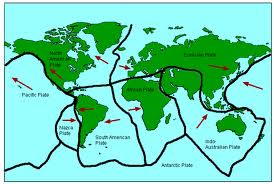
The Earth's Crust
- Plates
- Oceanic Plate
- made of Basalt
- are between 5Km and 10Km thick
- 'Floats on a very hot mantle
- Continental Plate
- made of Granite
- between 25Km and 90Km thick
- 'floats' on a very hot mantle
- Oceanic Plate
- Plate Margins
- Destructive
- Oceanic and Continental plates are pushed together
- Earthquakes occur here due to fault line
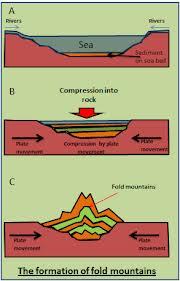
- Fold Mountains are made
- Constructive
- Oceanic or Continental plates pull apart
- Creates Volcanoes
- Conservative
- Plates are pushed in different directions
- Earthquakes occur here due to a fault line made
- Destructive
- Restless Earth
- Fold Mountains
- formed on destructive plate margins
- Geosyncline
- A very large downfold in the Earth's crust which fills up over time with sediment
- the rocks in the crust are compressed and folded into ANTICLINES (upfolds) and SYNCLINES (downfolds)
- Volcanoes
- Types of volcanoes
- Shield Volcanoes
- Found on Constructive plate margins
- Basic Lava (1200C)
- runny and flows long distances before cooling and soldifying
- many eruptions form a coneshaped mountain with gently sloped sides
- E.G Mauna Loa, Hawaii, USA
- Composite Volcanoes
- Acid Lava (800C)
- thick and sticky
- alternate eruptions cause ash followed by lava to build up a cone shape with steep sides
- Found on Destructive plate margins
- E.G Mt St Helens, Washington, USA
- Acid Lava (800C)
- Supervolcanoes
- found on Destructive plate margins
- Massive explosions of ash form a sunken crater
- ash would fall across the whole Earth killing everything
- Yellowstone Caldera, Wyoming, USA
- Shield Volcanoes
- Types of volcanoes
- Earthquakes
- The Cause
- Plates are locked together via friction and pressure builds up over many years
- the Crustal rock breaks suddenly underground causing a focus point in the rock
- stored energy is released in seconds and travels outwards from the epicentre as shock waves
- recorded in SEISOMETER
- RICHTER SCALE measures the energy released
- MERCALLI SCALE measures the damage done
- The Cause
- Fold Mountains
- Plates
Coasts
- Waves
- Destructive Waves
- remove beach material
- form in strong winds
- BACKWASH is STRONGER than SWASH
- a frequency of 11-15per minute
- Constructive Waves
- deposit beach material
- form in light winds with calm conditions
- SWASH is STRONGER than BACKWASH
- frequency of 6-9per minute
- Destructive Waves
- Erosion
- Hydraulic Power
- force of the waves crashing in the cliff
- air trapped in the cliff is compressed and fractures the rock
- Solution
- Rocks containing calcium carbonate slowly dissolve because of acidic water.
- Attrition
- pebbles are rolled backwards and forwards by waves
- as they rub against each other they're slowly worn away
- Abrasion
- Sand and pebbles are thrown against cliffs by breaking waves and wear them away
- Hydraulic Power
- Transportation and Deposition
- Traction
- boulders and cobbles are rolled along by powerful waves
- Saltation
- pebbles and sand are bounced around
- Suspension
- silt and clay are suspended in moving sea water
- Solution
- minerals are dissolved in sea water
- Longshore Drift is the movement of material along a beach
- Traction
- Mass movement and Weathering
- Sliding
- Blocks of rock or loose material slide rapidly down the slope
- Slumping
- a mass of soil or clay slides downwards a curve slip-pane,
- forms a scar on the upslope and a toe on the downslope
- Sliding
- Landforms
- Headlands and Bays
- a headland is an area of land that sticks out into the sea
- a bay is a curved coastal inlet
- Headlands and Bays
- Hard engineering
- building structures or machinery to control the natural processes
- Sea walls
- concrete walls designed to reflect the wave energy
- Groynes
- wooden built barriers built across the beach to trap the sand and pebbles transported via longshore drift
- Rock armour
- large boulders or resistant rock placed at the base of the cliff to prevent erosion
- Soft engineering
- working with the environment to modify or prepare for natural processes
- Beach nourishment
- beach material lost throughout longshore drift is replaced with material from further along the coast
- Dune regenration
- sand dunes are damaged by walkers or picnicker. areas of sand dynes are fenced off to allow them to re-grow naturally
- Marsh Creation
- areas of low economic value allow the sea to erode and flood the land.
- this then develops mud flats, salt marshes, and beaches.
- areas of low economic value allow the sea to erode and flood the land.
- Waves
Living world
- Weather and Climate
- Depressions
- areas of low pressure formed when air masses of different temperatures meet.
- Anticyclones
- areas of high pressure formed when an air mass is slowly sinking
- Depressions
- Ecosystems
- Nutrient Cycles
- all living things need nutrients to live and grow.
- the nutrients move through the ecosystem in a cycle
- Energy Flows
- plants and animals need energy to survive.
- energy flows through an ecosystem along the food chain
- Nutrient Cycles
- Weather and Climate
Images and files in the map
Information
- Description
- none Geography (Physical) Mind Map on Physical Geography, created by Jazz Young on 30/03/2014.
- Created by
- Jazz Young
- Views
- 97
- Tags
- Rating