
Mind map
Introduction to Cells
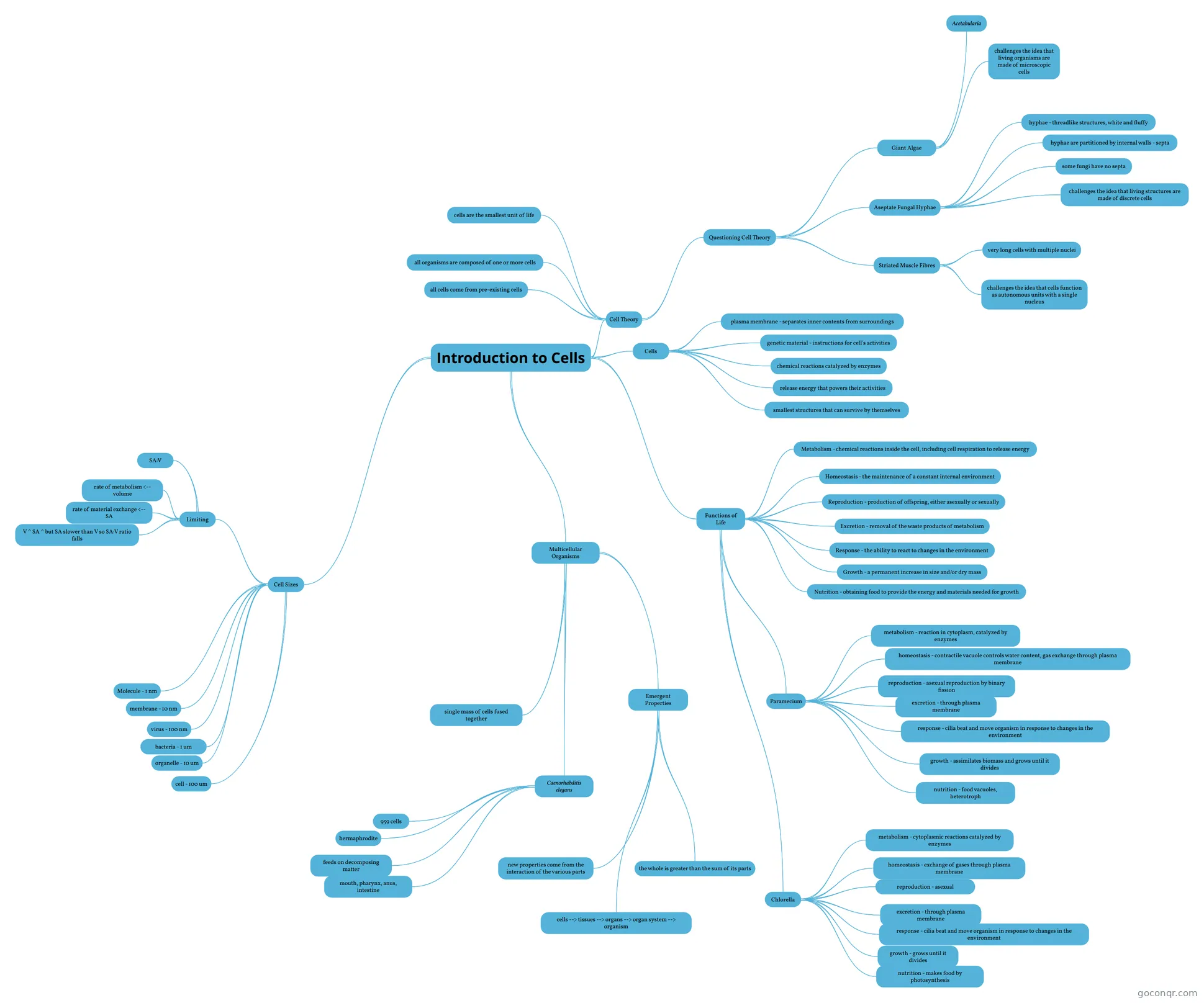
Mind map: Introduction to cells
Map content
Introduction to Cells
Cell Theory
- all organisms are composed of one or more cells
- cells are the smallest unit of life
- all cells come from pre-existing cells
- Questioning Cell Theory
- Striated Muscle Fibres
- very long cells with multiple nuclei
- challenges the idea that cells function as autonomous units with a single nucleus
- Aseptate Fungal Hyphae
- hyphae - threadlike structures, white and fluffy
- hyphae are partitioned by internal walls - septa
- some fungi have no septa
- challenges the idea that living structures are made of discrete cells
- Giant Algae
- Acetabularia
- challenges the idea that living organisms are made of microscopic cells
- Striated Muscle Fibres
Cells
- plasma membrane - separates inner contents from surroundings
- genetic material - instructions for cell's activities
- chemical reactions catalyzed by enzymes
- release energy that powers their activities
- smallest structures that can survive by themselves
Functions of Life
- Metabolism - chemical reactions inside the cell, including cell respiration to release energy
- Homeostasis - the maintenance of a constant internal environment
- Reproduction - production of offspring, either asexually or sexually
- Excretion - removal of the waste products of metabolism
- Response - the ability to react to changes in the environment
- Growth - a permanent increase in size and/or dry mass
- Nutrition - obtaining food to provide the energy and materials needed for growth
- Paramecium
- metabolism - reaction in cytoplasm, catalyzed by enzymes
- homeostasis - contractile vacuole controls water content, gas exchange through plasma membrane
- reproduction - asexual reproduction by binary fission
- excretion - through plasma membrane
- response - cilia beat and move organism in response to changes in the environment
- growth - assimilates biomass and grows until it divides
- nutrition - food vacuoles, heterotroph
- Chlorella
- metabolism - cytoplasmic reactions catalyzed by enzymes
- homeostasis - exchange of gases through plasma membrane
- reproduction - asexual
- response - cilia beat and move organism in response to changes in the environment
- excretion - through plasma membrane
- growth - grows until it divides
- nutrition - makes food by photosynthesis
Multicellular Organisms
- single mass of cells fused together
- Caenorhabditis elegans
- 959 cells
- hermaphrodite
- mouth, pharynx, anus, intestine
- feeds on decomposing matter
- Emergent Properties
- the whole is greater than the sum of its parts
- cells --> tissues --> organs --> organ system --> organism
- new properties come from the interaction of the various parts
Cell Sizes
- Molecule - 1 nm
- membrane - 10 nm
- virus - 100 nm
- bacteria - 1 um
- organelle - 10 um
- cell - 100 um
- Limiting
- SA:V
- rate of metabolism <-- volume
- rate of material exchange <-- SA
- V ^ SA ^ but SA slower than V so SA:V ratio falls
Information
- Description
- Mind Map on Introduction to Cells, created by Shreya Jayaraman on 19/11/2016.
- Created by
- Shreya Jayaraman
- Views
- 1
- Rating