
Mind map
Where we see Fault in Law
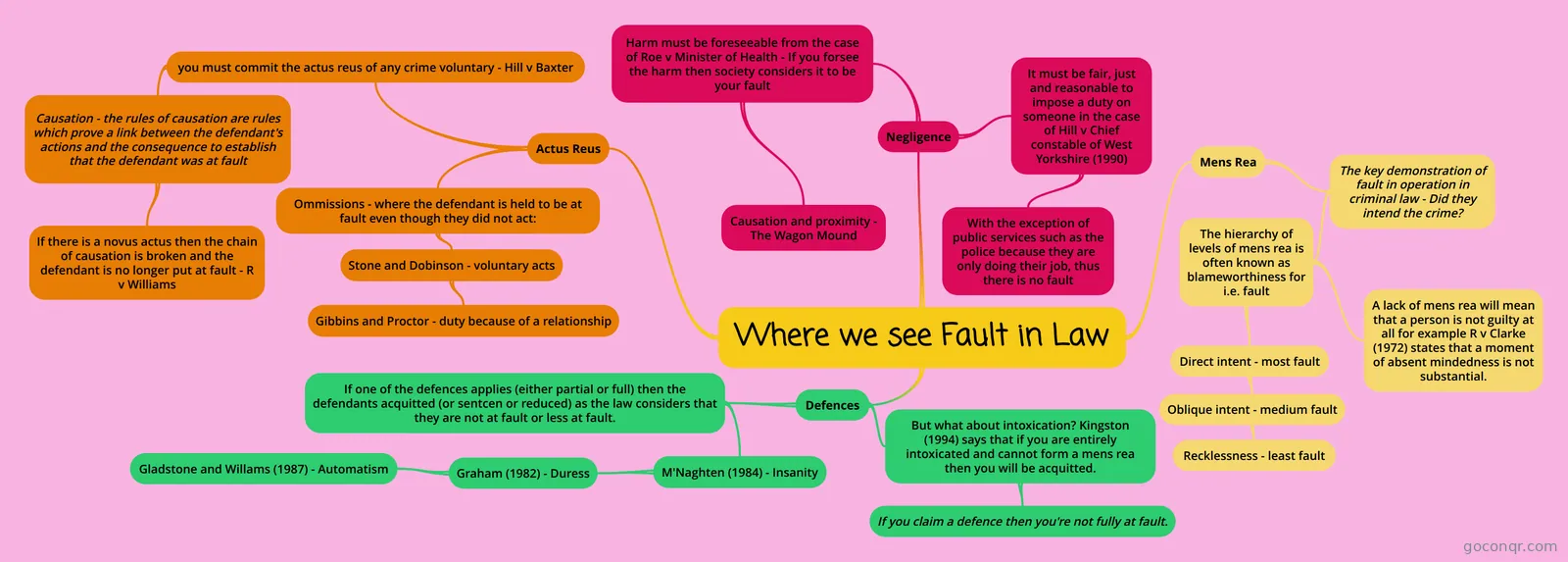
Mind map: Where we see fault in law
Map content
Where we see Fault in Law
Mens Rea
- The key demonstration of fault in operation in criminal law - Did they intend the crime?
- The hierarchy of levels of mens rea is often known as blameworthiness for i.e. fault
- Direct intent - most fault
- Oblique intent - medium fault
- Recklessness - least fault
- Oblique intent - medium fault
- A lack of mens rea will mean that a person is not guilty at all for example R v Clarke (1972) states that a moment of absent mindedness is not substantial.
- Direct intent - most fault
- The hierarchy of levels of mens rea is often known as blameworthiness for i.e. fault
- The key demonstration of fault in operation in criminal law - Did they intend the crime?
Negligence
- It must be fair, just and reasonable to impose a duty on someone in the case of Hill v Chief constable of West Yorkshire (1990)
- With the exception of public services such as the police because they are only doing their job, thus there is no fault
- Harm must be foreseeable from the case of Roe v Minister of Health - If you forsee the harm then society considers it to be your fault
- Causation and proximity - The Wagon Mound
- It must be fair, just and reasonable to impose a duty on someone in the case of Hill v Chief constable of West Yorkshire (1990)
Defences
- If one of the defences applies (either partial or full) then the defendants acquitted (or sentcen or reduced) as the law considers that they are not at fault or less at fault.
- M'Naghten (1984) - Insanity
- Graham (1982) - Duress
- Gladstone and Willams (1987) - Automatism
- Graham (1982) - Duress
- M'Naghten (1984) - Insanity
- But what about intoxication? Kingston (1994) says that if you are entirely intoxicated and cannot form a mens rea then you will be acquitted.
- If you claim a defence then you're not fully at fault.
- If one of the defences applies (either partial or full) then the defendants acquitted (or sentcen or reduced) as the law considers that they are not at fault or less at fault.
Actus Reus
- you must commit the actus reus of any crime voluntary - Hill v Baxter
- Causation - the rules of causation are rules which prove a link between the defendant's actions and the consequence to establish that the defendant was at fault
- If there is a novus actus then the chain of causation is broken and the defendant is no longer put at fault - R v Williams
- Causation - the rules of causation are rules which prove a link between the defendant's actions and the consequence to establish that the defendant was at fault
- Ommissions - where the defendant is held to be at fault even though they did not act:
- Stone and Dobinson - voluntary acts
- Gibbins and Proctor - duty because of a relationship
- Stone and Dobinson - voluntary acts
- you must commit the actus reus of any crime voluntary - Hill v Baxter
Information
- Description
- A-Level Law (UNIT 4) Mind Map on Where we see Fault in Law, created by Molly Hope on 22/03/2017.
- Created by
- Molly Hope
- Views
- 26
- Tags
- Rating