
Mind map
Cognitive psychology
Map content
Cognitive psychology
Key concepts
- Input->Encoding->Storage-Retrieval->Output
- Mnemonic:
- Insane Elephants See Running Oreos
- Mnemonic:
- Accessibility
- It's there, but you can't quite remember it, tip of the tongue
- Availability
- The information is not there: It has been forgotten
- Displacement
- New piece of information pushes out old piece, past capacity of 7+/-2
- 15s/7+/-2=Short Term Memory (STM)
- Long Term Memory (LTM)= potentially unlimited.
- 15s/7+/-2=Short Term Memory (STM)
- New piece of information pushes out old piece, past capacity of 7+/-2
- Decay
- Information not rehearsed, forgotten. Past 15s.
- 15s/7+/-2=Short Term Memory (STM)
- Information not rehearsed, forgotten. Past 15s.
- Input->Encoding->Storage-Retrieval->Output
Theories
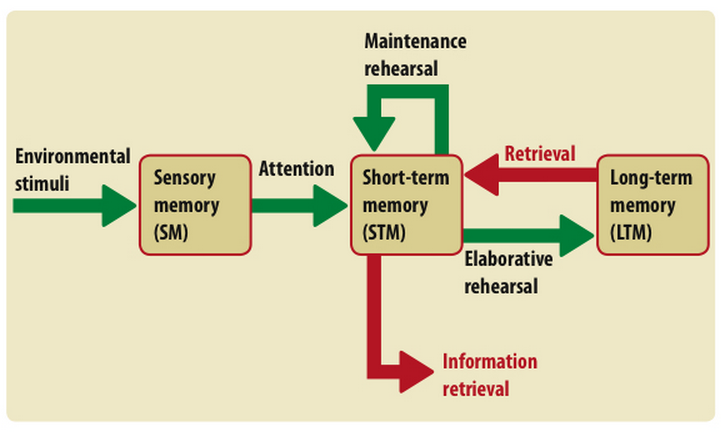
- Core Theory: Multi-store model
- Environmental Stimuli
- Sensory memory (SM)
- Attention
- STM
- Maintenance rehearsal
- (repetition)
- Encoding->
- LTM
- <-Retrieval
- STM
- Output (Decay or retrieval of information)
- STM
- <-Retrieval
- LTM
- Maintenance rehearsal
- STM
- Decay
- Attention
- Sensory memory (SM)
- Limitations
- The theory focuses too much on rehearsal
- Some events go straight into LTM without rehearsal
- Theory is too simplistic on the LTM and STM
- It is argued that they play more than just a passive role
- Theory is too generic
- Doesn't explain how some people have better memory than others, it does not focus on the individual
- The theory focuses too much on rehearsal
- Environmental Stimuli
- Alternative theory: Levels of Processing
- Memory is based on understanding
- The better I know something the more I remember it.
- Remembering word:
- Visual (worst)
- Acoustic
- Semantic (best)
- Remembering word:
- The better I know something the more I remember it.
- No criticisms needed.
- Shallow processing
- Not really thinking about it, colour, voice recognition
- Deep processing
- Understanding what it means
- Memory is based on understanding
- Core Theory: Multi-store model
Core study