
Mind map
Virtue Ethics
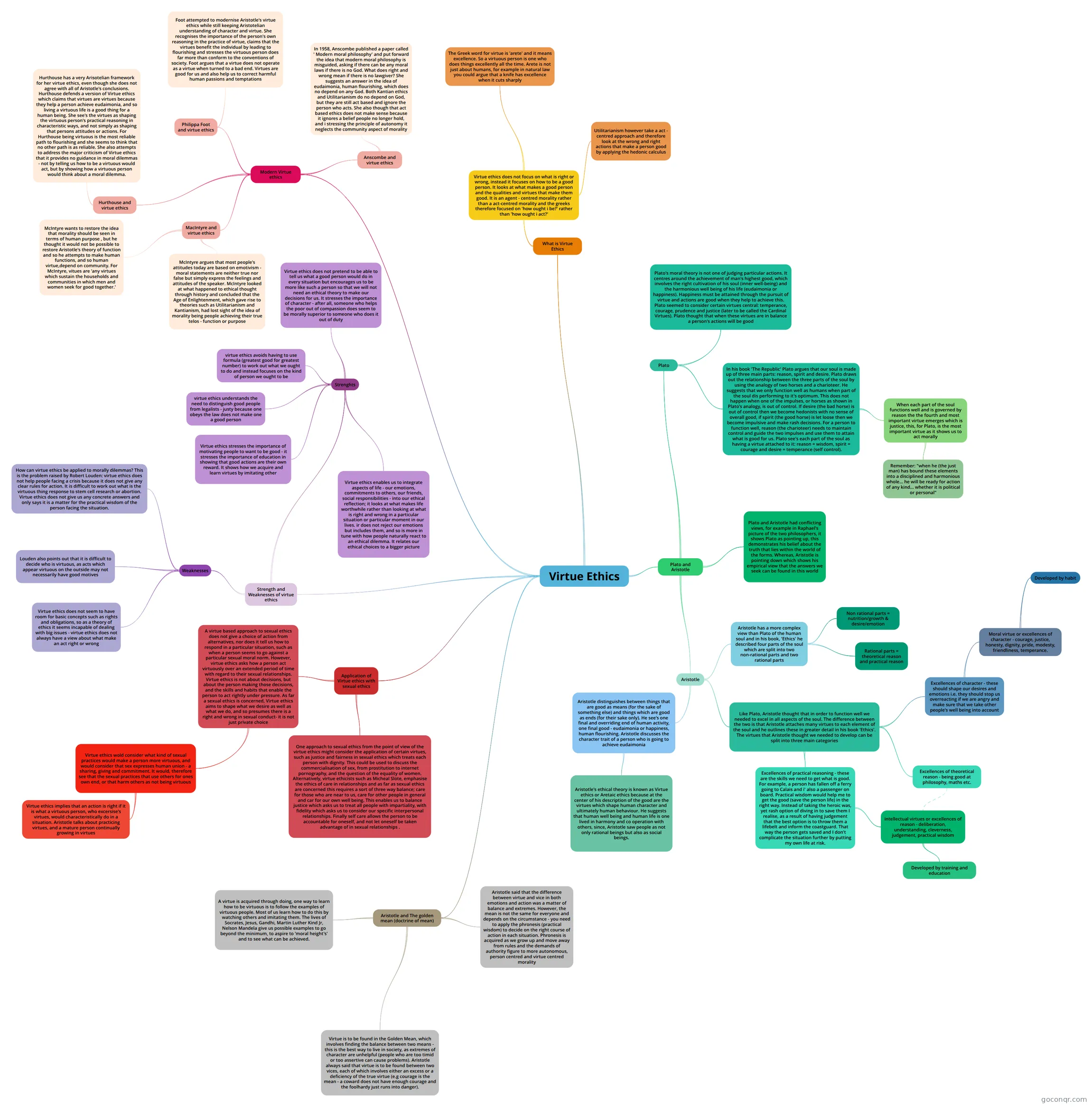
Mind map: Virtue ethics
Map content
Virtue Ethics
What is Virtue Ethics
- Virtue ethics does not focus on what is right or wrong, instead it focuses on how to be a good person. It looks at what makes a good person and the qualities and virtues that make them good. It is an agent - centred morality rather than a act-centred morality and the greeks therefore focused on 'how ought i be?' rather than 'how ought i act?'
- Utilitarianism however take a act - centred approach and therefore look at the wrong and right actions that make a person good by applying the hedonic calculus
- The Greek word for virtue is 'arete' and it means excellence. So a virtuous person is one who does things excellently all the time. Arete is not just about humans, for example in natural law you could argue that a knife has excellence when it cuts sharply
- Virtue ethics does not focus on what is right or wrong, instead it focuses on how to be a good person. It looks at what makes a good person and the qualities and virtues that make them good. It is an agent - centred morality rather than a act-centred morality and the greeks therefore focused on 'how ought i be?' rather than 'how ought i act?'
Plato and Aristotle
- Plato
- Plato's moral theory is not one of judging particular actions. It centres around the achievement of man's highest good, which involves the right cultivation of his soul (inner well-being) and the harmonious well being of his life (eudaimonia or happiness). Happiness must be attained through the pursuit of virtue and actions are good when they help to achieve this. Plato seemed to consider certain virtues central: temperance, courage, prudence and justice (later to be called the Cardinal Virtues). Plato thought that when these virtues are in balance a person's actions will be good
- In his book 'The Republic' Plato argues that our soul is made up of three main parts: reason, spirit and desire. Plato draws out the relationship between the three parts of the soul by using the analogy of two horses and a charioteer. He suggests that we only function well as humans when part of the soul dis performing to it's optimum. This does not happen when one of the impulses, or horses as shown in Plato's analogy, is out of control. If desire (the bad horse) is out of control then we become hedonists with no sense of overall good, if spirit (the good horse) is let loose then we become impulsive and make rash decisions. For a person to function well, reason (the charioteer) needs to maintain control and guide the two impulses and use them to attain what is good for us. Plato see's each part of the soul as having a virtue attached to it: reason = wisdom, spirit = courage and desire = temperance (self control).
- When each part of the soul functions well and is governed by reason the the fourth and most important virtue emerges which is justice, this, for Plato, is the most important virtue as it shows us to act morally
- Remember: "when he (the just man) has bound these elements into a disciplined and harmonious whole... he will be ready for action of any kind... whether it is political or personal"
- When each part of the soul functions well and is governed by reason the the fourth and most important virtue emerges which is justice, this, for Plato, is the most important virtue as it shows us to act morally
- Aristotle
- Aristotle has a more complex view than Plato of the human soul and in his book, 'Ethics' he described four parts of the soul which are split into two non-rational parts and two rational parts
- Non rational parts = nutrition/growth & desire/emotion
- Rational parts = theoretical reason and practical reason
- Like Plato, Aristotle thought that in order to function well we needed to excel in all aspects of the soul. The difference between the two is that Aristotle attaches many virtues to each element of the soul and he outlines these in greater detail in his book 'Ethics'. The virtues that Aristotle thought we needed to develop can be split into three main categories
- Excellences of character - these should shape our desires and emotions i.e. they should stop us overreacting if we are angry and make sure that we take other people's well being into account
- Moral virtue or excellences of character - courage, justice, honesty, dignity, pride, modesty, friendliness, temperance.
- Developed by habit
- Moral virtue or excellences of character - courage, justice, honesty, dignity, pride, modesty, friendliness, temperance.
- Excellences of practical reasoning - these are the skills we need to get what is good. For example, a person has fallen off a ferry going to Calais and i' also a passenger on board. Practical wisdom would help me to get the good (save the person life) in the right way. Instead of taking the heroic was, yet rash option of diving in to save them I realise, as a result of having judgement that the best option is to throw them a lifebelt and inform the coastguard. That way the person gets saved and I don't complicate the situation further by putting my own life at risk.
- intellectual virtues or excellences of reason - deliberation, understanding, cleverness, judgement, practical wisdom
- Developed by training and education
- intellectual virtues or excellences of reason - deliberation, understanding, cleverness, judgement, practical wisdom
- Excellences of theoretical reason - being good at philosophy, maths etc.
- Excellences of character - these should shape our desires and emotions i.e. they should stop us overreacting if we are angry and make sure that we take other people's well being into account
- Aristotle distinguishes between things that are good as means (for the sake of something else) and things which are good as ends (for their sake only). He see's one final and overriding end of human activity, one final good - eudaimonia or happiness, human flourishing. Aristotle discusses the character trait of a person who is going to achieve eudaimonia
- Aristotle's ethical theory is known as Virtue ethics or Aretaic ethics because at the center of his description of the good are the virtues which shape human character and ultimately human behaviour. He suggests that human well being and human life is one lived in harmony and co operation with others, since, Aristotle saw people as not only rational beings but also as social beings.
- Aristotle has a more complex view than Plato of the human soul and in his book, 'Ethics' he described four parts of the soul which are split into two non-rational parts and two rational parts
- Plato and Aristotle had conflicting views, for example in Raphael's picture of the two philosophers, it shows Plato as pointing up, this demonstrates his belief about the truth that lies within the world of the forms. Whereas, Aristotle is pointing down which shows his empirical view that the answers we seek can be found in this world
- Plato
Aristotle and The golden mean (doctrine of mean)
- Virtue is to be found in the Golden Mean, which involves finding the balance between two means - this is the best way to live in society, as extremes of character are unhelpful (people who are too timid or too assertive can cause problems). Aristotle always said that virtue is to be found between two vices, each of which involves either an excess or a deficiency of the true virtue (e.g courage is the mean - a coward does not have enough courage and the foolhardy just runs into danger).
- Aristotle said that the difference between virtue and vice in both emotions and action was a matter of balance and extremes. However, the mean is not the same for everyone and depends on the circumstance - you need to apply the phronesis (practical wisdom) to decide on the right course of action in each situation. Phronesis is acquired as we grow up and move away from rules and the demands of authority figure to more autonomous, person centred and virtue centred morality
- A virtue is acquired through doing, one way to learn how to be virtuous is to follow the examples of virtuous people. Most of us learn how to do this by watching others and imitating them. The lives of Socrates, Jesus, Gandhi, Martin Luther Kind Jr, Nelson Mandela give us possible examples to go beyond the minimum, to aspire to 'moral height's' and to see what can be achieved.
Modern Virtue ethics
- Anscombe and virtue ethics
- In 1958, Anscombe published a paper called ' Modern moral philosophy' and put forward the idea that modern moral philosophy is misguided, asking if there can be any moral laws if there is no God. What does right and wrong mean if there is no lawgiver? She suggests an answer in the idea of eudaimonia, human flourishing, which does no depend on any God. Both Kantian ethics and Utilitarianism do no depend on God, but they are still act based and ignore the person who acts. She also though that act based ethics does not make sense because it ignores a belief people no longer hold, and i stressing the principle of autonomy it neglects the community aspect of morality
- Philippa Foot and virtue ethics
- Foot attempted to modernise Aristotle's virtue ethics while still keeping Aristotelian understanding of character and virtue. She recognises the importance of the person's own reasoning in the practice of virtue, claims that the virtues benefit the individual by leading to flourishing and stresses the virtuous person does far more than conform to the conventions of society. Foot argues that a virtue does not operate as a virtue when turned to a bad end. Virtues are good for us and also help us to correct harmful human passions and temptations
- Hurthouse and virtue ethics
- Hurthouse has a very Arisotelian framework for her virtue ethics, even though she does not agree with all of Aristotle's conclusions. Hurthouse defends a version of Virtue ethics which claims that virtues are virtues because they help a person achieve eudaimonia, and so living a virtuous life is a good thing for a human being. She see's the virtues as shaping the virtuous person's practical reasoning in characteristic ways, and not simply as shaping that persons attitudes or actions. For Hurthouse being virtuous is the most reliable path to flourishing and she seems to think that no other path is as reliable. She also attempts to address the major criticism of Virtue ethics that it provides no guidance in moral dilemmas - not by telling us how to be a virtuous would act, but by showing how a virtuous person would think about a moral dilemma.
- MacIntyre and virtue ethics
- McIntyre argues that most people's attitudes today are based on emotivism - moral statements are neither true nor false but simply express the feelings and attitudes of the speaker. McIntyre looked at what happened to ethical thought through history and concluded that the Age of Enlightenment, which gave rise to theories such as Utilitarianism and Kantianism, had lost sight of the idea of morality being people achieving their true telos - function or purpose
- McIntyre wants to restore the idea that morality should be seen in terms of human purpose , but he thought it would not be possible to restore Aristotle's theory of function and so he attempts to make human functions, and so human virtue,depend on community. For McIntyre, vitues are 'any virtues which sustain the households and communities in which men and women seek for good together.'
- Anscombe and virtue ethics
Strength and Weaknesses of virtue ethics
- Strenghts
- virtue ethics avoids having to use formula (greatest good for greatest number) to work out what we ought to do and instead focuses on the kind of person we ought to be
- virtue ethics understands the need to distinguish good people from legalists - justy because one obeys the law does not make one a good person
- Virtue ethics stresses the importance of motivating people to want to be good - it stresses the importance of education in showing that good actions are their own reward. It shows how we acquire and learn virtues by imitating other
- Virtue ethics enables us to integrate aspects of life - our emotions, commitments to others, our friends, social responsibilities - into our ethical reflection; it looks at what makes life worthwhile rather than looking at what is right and wrong in a particular situation or particular moment in our lives. ir does not reject our emotions but includes them, and so is more in tune with how people naturally react to an ethical dilemma. It relates our ethical choices to a bigger picture
- Virtue ethics does not pretend to be able to tell us what a good person would do in every situation but encourages us to be more like such a person so that we will not need an ethical theory to make our decisions for us. It stresses the importance of character - after all, someone who helps the poor out of compassion does seem to be morally superior to someone who does it out of duty
- Weaknesses
- How can virtue ethics be applied to morally dilemmas? This is the problem raised by Robert Louden: virtue ethics does not help people facing a crisis because it does not give any clear rules for action. It is difficult to work out what is the virtuous thing response to stem cell research or abortion. Virtue ethics does not give us any concrete answers and only says it is a matter for the practical wisdom of the person facing the situation.
- Louden also points out that it is difficult to decide who is virtuous, as acts which appear virtuous on the outside may not necessarily have good motives
- Virtue ethics does not seem to have room for basic concepts such as rights and obligations, so as a theory of ethics it seems incapable of dealing with big issues - virtue ethics does not always have a view about what make an act right or wrong
- Strenghts
Application of Virtue ethics with sexual ethics
- A virtue based approach to sexual ethics does not give a choice of action from alternatives, nor does it tell us how to respond in a particular situation, such as when a person seems to go against a particular sexual moral norm. However, virtue ethics asks how a person act virtuously over an extended period of time with regard to their sexual relationships. Virtue ethics is not about decisions, but about the person making those decisions, and the skills and habits that enable the person to act rightly under pressure. As far a sexual ethics is concerned, Virtue ethics aims to shape what we desire as well as what we do, and so presumes there is a right and wrong in sexual conduct- it is not just private choice
- Virtue ethics wold consider what kind of sexual practices would make a person more virtuous, and would consider that sex expresses human union - a sharing, giving and commitment. It would, therefore see that the sexual practices that use others for ones own end, or that harm others as not being virtuous
- Virtue ethics implies that an action is right if it is what a virtuous person, who excersise's virtues, would characteristically do in a situation. Aristotle talks about practicing virtues, and a mature person continually growing in virtues
- Virtue ethics wold consider what kind of sexual practices would make a person more virtuous, and would consider that sex expresses human union - a sharing, giving and commitment. It would, therefore see that the sexual practices that use others for ones own end, or that harm others as not being virtuous
- One approach to sexual ethics from the point of view of the virtue ethics might consider the application of certain virtues, such as justice and fairness in sexual ethics which treats each person with dignity. This could be used to discuss the commercialisation of sex, from prostitution to internet pornography, and the question of the equality of women. Alternatively, virtue ethicists such as Micheal Slote, emphasise the ethics of care in relationships and as far as sexual ethics are concerned this requires a sort of three way balance; care for those who are near to us, care for other people in general and car for our own well being. This enables us to balance justice which asks us to treat all people with impartiality, with fidelity which asks us to consider our specific interpersonal relationships. Finally self care allows the person to be accountable for oneself, and not let oneself be taken advantage of in sexual relationships .
- A virtue based approach to sexual ethics does not give a choice of action from alternatives, nor does it tell us how to respond in a particular situation, such as when a person seems to go against a particular sexual moral norm. However, virtue ethics asks how a person act virtuously over an extended period of time with regard to their sexual relationships. Virtue ethics is not about decisions, but about the person making those decisions, and the skills and habits that enable the person to act rightly under pressure. As far a sexual ethics is concerned, Virtue ethics aims to shape what we desire as well as what we do, and so presumes there is a right and wrong in sexual conduct- it is not just private choice
Information
- Description
- Mind Map on Virtue Ethics, created by Brielle Coulthard-Gaunt on 13/04/2017.
- Created by
- Brielle Coulthard-Gaunt
- Views
- 0
- Rating