
Mind map
How is time used to shape meaning?
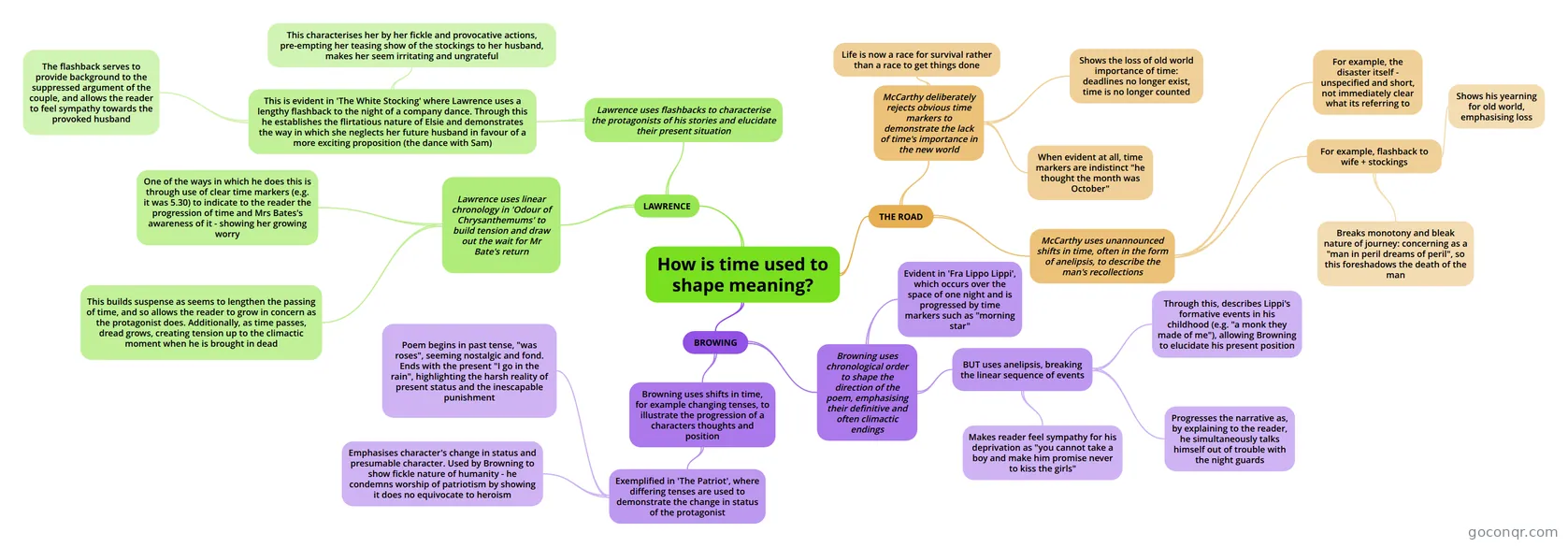
Mind map: How is time used to shape meaning
Map content
How is time used to shape meaning?
THE ROAD
- McCarthy deliberately rejects obvious time markers to demonstrate the lack of time's importance in the new world
- When evident at all, time markers are indistinct "he thought the month was October"
- Shows the loss of old world importance of time: deadlines no longer exist, time is no longer counted
- Life is now a race for survival rather than a race to get things done
- McCarthy uses unannounced shifts in time, often in the form of anelipsis, to describe the man's recollections
- For example, the disaster itself - unspecified and short, not immediately clear what its referring to
- For example, flashback to wife + stockings
- Shows his yearning for old world, emphasising loss
- Breaks monotony and bleak nature of journey: concerning as a "man in peril dreams of peril", so this foreshadows the death of the man
- McCarthy deliberately rejects obvious time markers to demonstrate the lack of time's importance in the new world
LAWRENCE
- Lawrence uses flashbacks to characterise the protagonists of his stories and elucidate their present situation
- This is evident in 'The White Stocking' where Lawrence uses a lengthy flashback to the night of a company dance. Through this he establishes the flirtatious nature of Elsie and demonstrates the way in which she neglects her future husband in favour of a more exciting proposition (the dance with Sam)
- This characterises her by her fickle and provocative actions, pre-empting her teasing show of the stockings to her husband, makes her seem irritating and ungrateful
- The flashback serves to provide background to the suppressed argument of the couple, and allows the reader to feel sympathy towards the provoked husband
- This is evident in 'The White Stocking' where Lawrence uses a lengthy flashback to the night of a company dance. Through this he establishes the flirtatious nature of Elsie and demonstrates the way in which she neglects her future husband in favour of a more exciting proposition (the dance with Sam)
- Lawrence uses linear chronology in 'Odour of Chrysanthemums' to build tension and draw out the wait for Mr Bate's return
- One of the ways in which he does this is through use of clear time markers (e.g. it was 5.30) to indicate to the reader the progression of time and Mrs Bates's awareness of it - showing her growing worry
- This builds suspense as seems to lengthen the passing of time, and so allows the reader to grow in concern as the protagonist does. Additionally, as time passes, dread grows, creating tension up to the climactic moment when he is brought in dead
- Lawrence uses flashbacks to characterise the protagonists of his stories and elucidate their present situation
BROWING
- Browning uses chronological order to shape the direction of the poem, emphasising their definitive and often climactic endings
- Evident in 'Fra Lippo Lippi', which occurs over the space of one night and is progressed by time markers such as "morning star"
- BUT uses anelipsis, breaking the linear sequence of events
- Through this, describes Lippi's formative events in his childhood (e.g. "a monk they made of me"), allowing Browning to elucidate his present position
- Progresses the narrative as, by explaining to the reader, he simultaneously talks himself out of trouble with the night guards
- Makes reader feel sympathy for his deprivation as "you cannot take a boy and make him promise never to kiss the girls"
- Browning uses shifts in time, for example changing tenses, to illustrate the progression of a characters thoughts and position
- Exemplified in 'The Patriot', where differing tenses are used to demonstrate the change in status of the protagonist
- Poem begins in past tense, "was roses", seeming nostalgic and fond. Ends with the present "I go in the rain", highlighting the harsh reality of present status and the inescapable punishment
- Emphasises character's change in status and presumable character. Used by Browning to show fickle nature of humanity - he condemns worship of patriotism by showing it does no equivocate to heroism
- Exemplified in 'The Patriot', where differing tenses are used to demonstrate the change in status of the protagonist
- Browning uses chronological order to shape the direction of the poem, emphasising their definitive and often climactic endings
Information
- Description
- "Write about the ways in which authors have used time to shape meaning in the three texts you have studied"
- Created by
- peggyhughes
- Views
- 62
- Rating