
Mind map
TRANSITION METALS
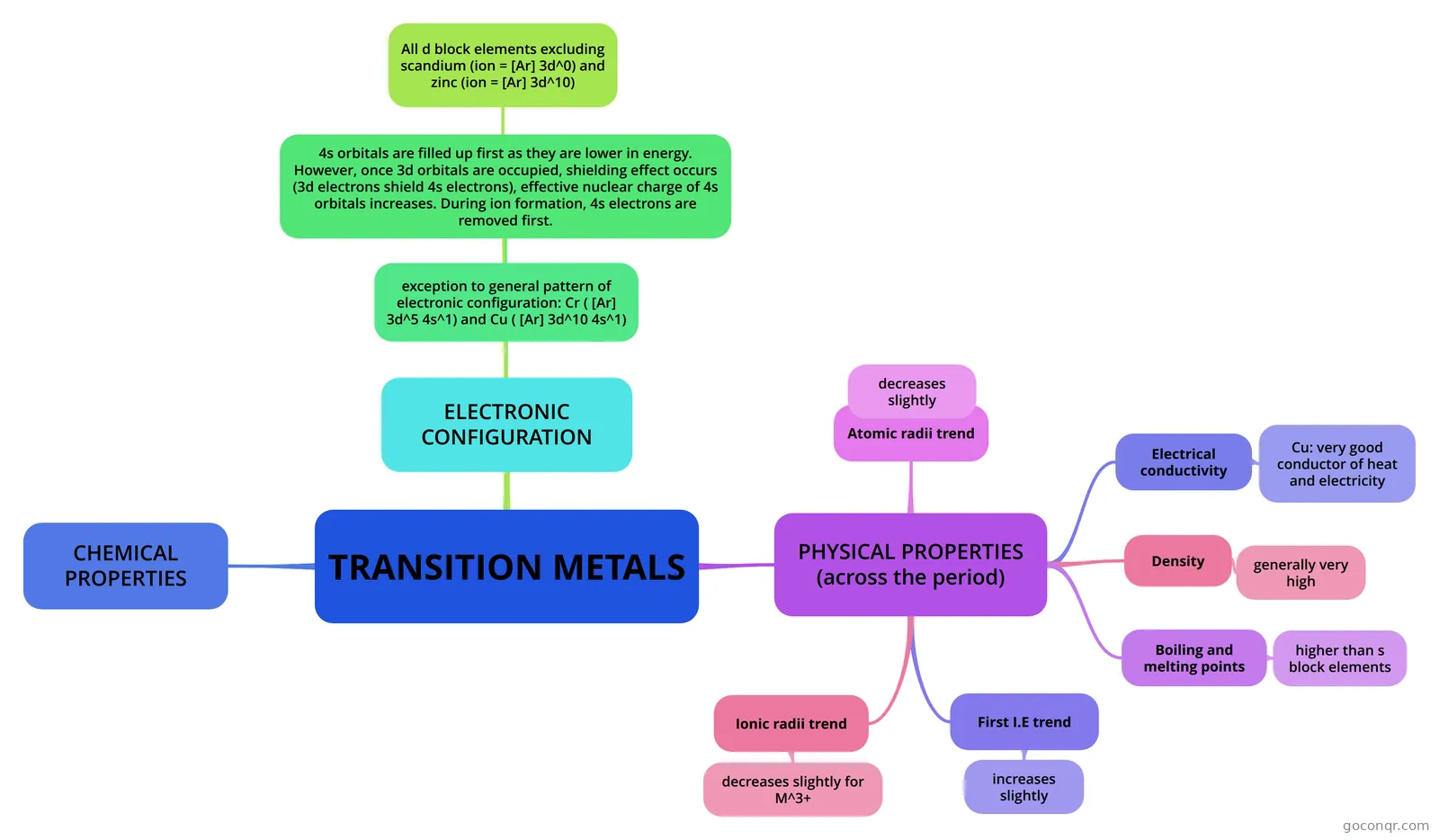
Mind map: transition metals
Map content
TRANSITION METALS
All d block elements excluding scandium (ion = [Ar] 3d^0) and zinc (ion = [Ar] 3d^10)
4s orbitals are filled up first as they are lower in energy. However, once 3d orbitals are occupied, shielding effect occurs (3d electrons shield 4s electrons), effective nuclear charge of 4s orbitals increases. During ion formation, 4s electrons are removed first.
exception to general pattern of electronic configuration: Cr ( [Ar] 3d^5 4s^1) and Cu ( [Ar] 3d^10 4s^1)
ELECTRONIC CONFIGURATION
PHYSICAL PROPERTIES (across the period)
- Atomic radii trend
- decreases slightly
- -Across the period: * nuclear charge increases * shielding effect increases (unlike s block elements which remain constant) due to filling in of d orbitals (unlike s block metals which fills in outermost orbital) -effective nuclear charge increases slightly -atomic radii decreases slightly
- decreases slightly
- Ionic radii trend
- decreases slightly for M^3+
- no explanation for this, no trend for M^2+
- decreases slightly for M^3+
- Boiling and melting points
- higher than s block elements
- -able to use both 3d and 4s electrons for metallic bonding due to close proximity in their energies (s block elements can only use their valence electrons i.e. 1-2 electrons) -more energy needed to break the stronger metallic bond
- higher than s block elements
- First I.E trend
- increases slightly
- -slight increase in effective nuclear charge only -therefore slight increase in energy needed to remove a 4s electron
- increases slightly
- Density
- generally very high
- -higher atomic mass and small atomic radius -across the period, atomic radii (vol.) decreases and atomic mass (mass) increases -density increases
- generally very high
- Electrical conductivity
- Cu: very good conductor of heat and electricity
- -due to ability to use both 3d and 4s electrons due to their close proximity in energies -unlike block s elements that are unable to use inner shell electrons due to very diff energies from the valence electrons
- Cu: very good conductor of heat and electricity
- Atomic radii trend
CHEMICAL PROPERTIES
Information
- Description
- A levels CHEMISTRY (TRANSITION METALS) Mind Map on TRANSITION METALS, created by ruyi :) on 01/06/2014.
- Created by
- ruyi :)
- Views
- 33
- Rating