
Mind map
Cold in the Earth - Emily Bronte
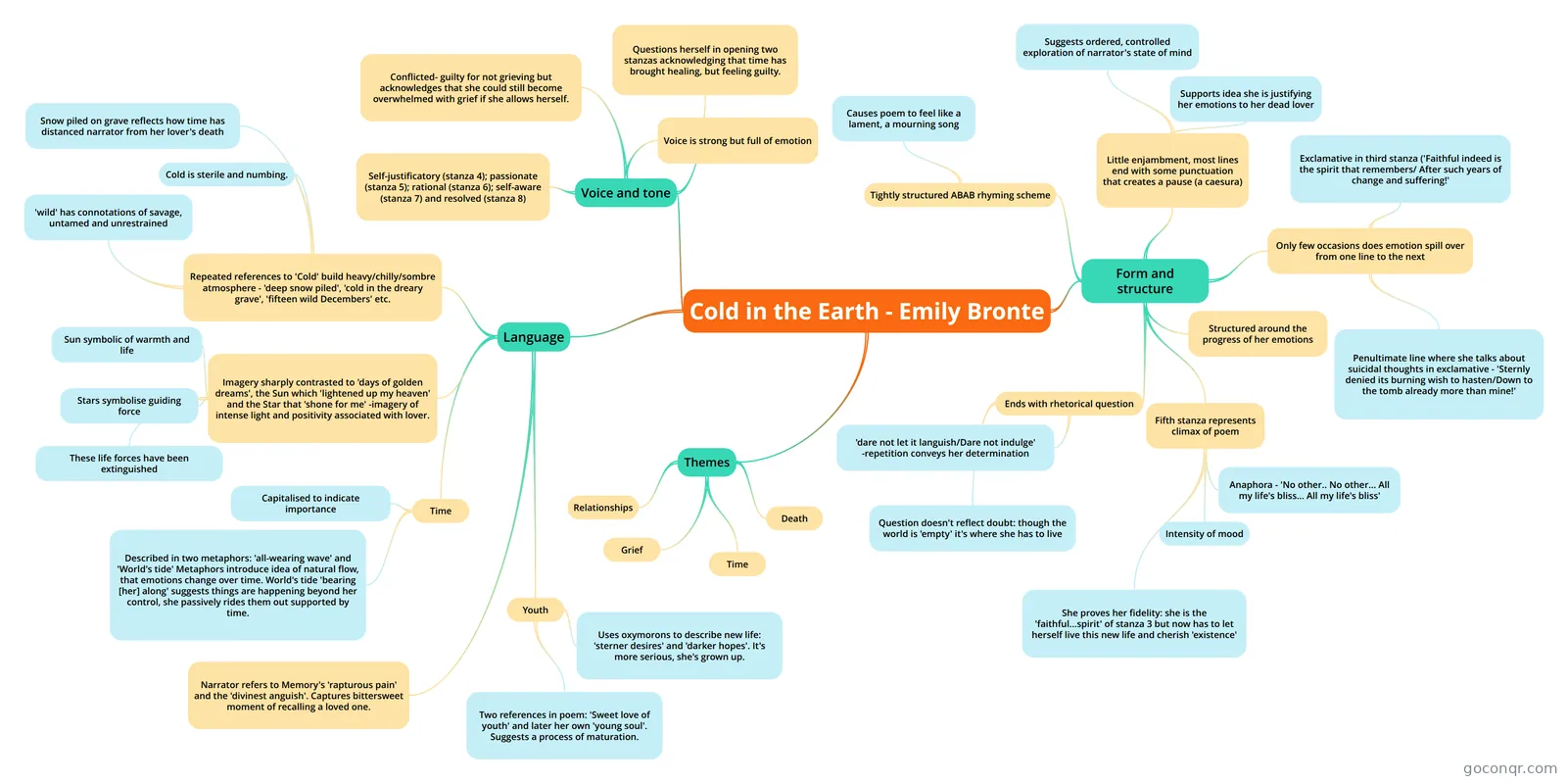
Mind map: Cold in the Earth by Emily Brontë
Map content
Cold in the Earth - Emily Bronte
Form and structure
- Tightly structured ABAB rhyming scheme
- Causes poem to feel like a lament, a mourning song
- Little enjambment, most lines end with some punctuation that creates a pause (a caesura)
- Suggests ordered, controlled exploration of narrator's state of mind
- Supports idea she is justifying her emotions to her dead lover
- Only few occasions does emotion spill over from one line to the next
- Exclamative in third stanza ('Faithful indeed is the spirit that remembers/ After such years of change and suffering!'
- Penultimate line where she talks about suicidal thoughts in exclamative - 'Sternly denied its burning wish to hasten/Down to the tomb already more than mine!'
- Structured around the progress of her emotions
- Fifth stanza represents climax of poem
- Anaphora - 'No other.. No other... All my life's bliss... All my life's bliss'
- Intensity of mood
- She proves her fidelity: she is the 'faithful...spirit' of stanza 3 but now has to let herself live this new life and cherish 'existence'
- Ends with rhetorical question
- 'dare not let it languish/Dare not indulge' -repetition conveys her determination
- Question doesn't reflect doubt: though the world is 'empty' it's where she has to live
- Tightly structured ABAB rhyming scheme
Themes
- Death
- Grief
- Time
- Relationships
Voice and tone
- Voice is strong but full of emotion
- Questions herself in opening two stanzas acknowledging that time has brought healing, but feeling guilty.
- Conflicted- guilty for not grieving but acknowledges that she could still become overwhelmed with grief if she allows herself.
- Self-justificatory (stanza 4); passionate (stanza 5); rational (stanza 6); self-aware (stanza 7) and resolved (stanza 8)
Language
- Repeated references to 'Cold' build heavy/chilly/sombre atmosphere - 'deep snow piled', 'cold in the dreary grave', 'fifteen wild Decembers' etc.
- Cold is sterile and numbing.
- 'wild' has connotations of savage, untamed and unrestrained
- Snow piled on grave reflects how time has distanced narrator from her lover's death
- Imagery sharply contrasted to 'days of golden dreams', the Sun which 'lightened up my heaven' and the Star that 'shone for me' -imagery of intense light and positivity associated with lover.
- Sun symbolic of warmth and life
- Stars symbolise guiding force
- These life forces have been extinguished
- Time
- Capitalised to indicate importance
- Described in two metaphors: 'all-wearing wave' and 'World's tide' Metaphors introduce idea of natural flow, that emotions change over time. World's tide 'bearing [her] along' suggests things are happening beyond her control, she passively rides them out supported by time.
- Youth
- Two references in poem: 'Sweet love of youth' and later her own 'young soul'. Suggests a process of maturation.
- Uses oxymorons to describe new life: 'sterner desires' and 'darker hopes'. It's more serious, she's grown up.
- Narrator refers to Memory's 'rapturous pain' and the 'divinest anguish'. Captures bittersweet moment of recalling a loved one.
- Repeated references to 'Cold' build heavy/chilly/sombre atmosphere - 'deep snow piled', 'cold in the dreary grave', 'fifteen wild Decembers' etc.
Information
- Description
- IGCSE English Literature Mind Map on Cold in the Earth - Emily Bronte, created by Lucy Klein on 17/10/2017.
- Created by
- Lucy Klein
- Views
- 37
- Rating