
Mind map
Product Design
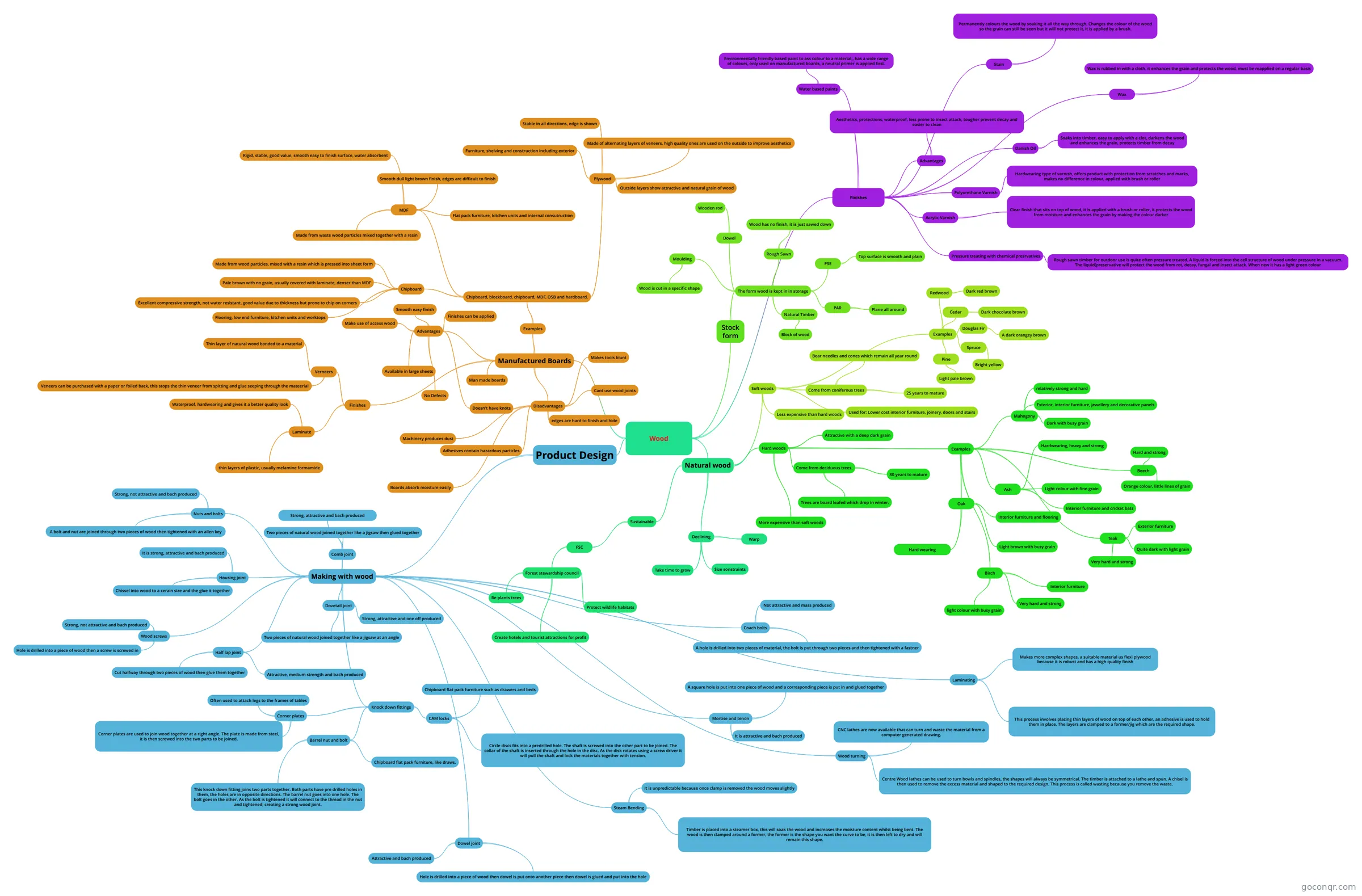
Mind map: Product design wood
Map content
Product Design
Wood
- Natural wood
- Sustainable
- FSC
- Forest stewardship council
- Protect wildlife habitats
- Create hotels and tourist attractions for profit
- Re plants trees
- Forest stewardship council
- FSC
- Declining
- Take time to grow
- Size sonstraints
- Warp
- Hard woods
- Come from deciduous trees.
- Trees are board leafed which drop in winter.
- 80 years to mature
- Attractive with a deep dark grain
- More expensive than soft woods
- Examples
- Oak
- Hard wearing
- Light brown with busy grain
- Interior furniture and flooring
- Ash
- Hardwearing, heavy and strong
- Light colour with fine grain
- Interior furniture and cricket bats
- Mahogony
- relatively strong and hard
- Dark with busy grain
- Exterior, interior furniture, jewellery and decorative panels
- Beech
- Hard and strong
- Orange colour, little lines of grain
- Teak
- Very hard and strong
- Quite dark with light grain
- Exterior furniture
- Birch
- Very hard and strong
- light colour with busy grain
- Interior furniture
- Oak
- Come from deciduous trees.
- Soft woods
- Come from coniferous trees
- Bear needles and cones which remain all year round
- 25 years to mature
- Less expensive than hard woods
- Examples
- Pine
- Light pale brown
- Spruce
- Bright yellow
- Douglas Fir
- A dark orangey brown
- Cedar
- Dark chocolate brown
- Redwood
- Dark red brown
- Pine
- Used for: Lower cost interior furniture, joinery, doors and stairs
- Come from coniferous trees
- Sustainable
- Stock form
- The form wood is kept in in storage
- Rough Sawn
- Wood has no finish, it is just sawed down
- PSE
- Top surface is smooth and plain
- PAR
- Plane all around
- Natural Timber
- Block of wood
- Moulding
- Wood is cut in a specific shape
- Dowel
- Wooden rod
- Rough Sawn
- The form wood is kept in in storage
- Manufactured Boards
- Man made boards
- Examples
- Chipboard, blockboard. chipboard, MDF, OSB and hardboard.
- MDF
- Made from waste wood particles mixed together with a resin
- Smooth dull light brown finish, edges are difficult to finish
- Flat pack furniture, kitchen units and internal consutruction
- Rigid, stable, good value, smooth easy to finish surface, water absorbent
- Plywood
- Made of alternating layers of veneers, high quality ones are used on the outside to improve aesthetics
- Outside layers show attractive and natural grain of wood
- Stable in all directions, edge is shown
- Furniture, shelving and construction including exterior
- Chipboard
- Made from wood particles, mixed with a resin which is pressed into sheet form
- Pale brown with no grain, usually covered with laminate, denser than MDF
- Excellent compressive strength, not water resistant. good value due to thickness but prone to chip on corners
- Flooring, low end furniture, kitchen units and worktops
- MDF
- Chipboard, blockboard. chipboard, MDF, OSB and hardboard.
- Advantages
- Available in large sheets
- No Defects
- Doesn't have knots
- Smooth easy finish
- Make use of access wood
- Finishes can be applied
- Disadvantages
- Adhesives contain hazardous particles
- Machinery produces dust
- Makes tools blunt
- Cant use wood joints
- edges are hard to finish and hide
- Boards absorb moisture easily
- Finishes
- Laminate
- thin layers of plastic, usually melamine formamide
- Waterproof, hardwearing and gives it a better quality look
- Verneers
- Thin layer of natural wood bonded to a material
- Veneers can be purchased with a paper or foiled back, this stops the thin veneer from spitting and glue seeping through the mateerial
- Laminate
- Finishes
- Advantages
- Aesthetics, protections, waterproof, less prone to insect attack, tougher prevent decay and easier to clean
- Acrylic Varnish
- Clear finish that sits on top of wood, it is applied with a brush or roller, it protects the wood from moisture and enhances the grain by making the colour darker
- Polyurethane Varnish
- Hardwearing type of varnish, offers product with protection from scratches and marks, makes no difference in colour, applied with brush or roller
- Danish Oil
- Soaks into timber, easy to apply with a clot, darkens the wood and enhances the grain, protects timber from decay
- Pressure treating with chemical presrvatives
- Rough sawn timber for outdoor use is quite often pressure treated. A liquid is forced into the cell structure of wood under pressure in a vacuum. The liquid(preservative will protect the wood from rot, decay, fungal and insect attack. When new it has a light green colour
- Water based paints
- Environmentally friendly based paint to ass colour to a material;, has a wide range of colours, only used on manufactured boards, a neutral primer is applied first.
- Stain
- Permanently colours the wood by soaking it all the way through. Changes the colour of the wood so the grain can still be seen but it will not protect it, it is applied by a brush.
- Wax
- Wax is rubbed in with a cloth, it enhances the grain and protects the wood, must be reapplied on a regular basis
- Advantages
- Natural wood
Making with wood
- Dovetail joint
- Two pieces of natural wood joined together like a jigsaw at an angle
- Strong, attractive and one off produced
- Comb joint
- Two pieces of natural wood joined together like a jigsaw then glued together
- Strong, attractive and bach produced
- Housing joint
- Chissel into wood to a cerain size and the glue it together
- It is strong, attractive and bach produced
- Half lap joint
- Cut halfway through two pieces of wood then glue them together
- Attractive, medium strength and bach produced
- Wood screws
- Hole is drilled into a piece of wood then a screw is screwed in
- Strong, not attractive and bach produced
- Nuts and bolts
- A bolt and nut are joined through two pieces of wood then tightened with an allen key
- Strong, not attractive and bach produced
- Knock down fittings
- Barrel nut and bolt
- This knock down fitting joins two parts together. Both parts have pre drilled holes in them, the holes are in opposite directions. The barrel nut goes into one hole. The bolt goes in the other. As the bolt is tightened it will connect to the thread in the nut and tightened; creating a strong wood joint.
- Chipboard flat pack furniture, like draws.
- CAM locks
- Chipboard flat pack furniture such as drawers and beds
- Circle discs fits into a predrilled hole. The shaft is screwed into the other part to be joined. The collar of the shaft is inserted through the hole in the disc. As the disk rotates using a screw driver it will pull the shaft and lock the materials together with tension.
- Corner plates
- Often used to attach legs to the frames of tables
- Corner plates are used to join wood together at a right angle. The plate is made from steel, it is then screwed into the two parts to be joined.
- Barrel nut and bolt
- Dowel joint
- Hole is drilled into a piece of wood then dowel is put onto another piece then dowel is glued and put into the hole
- Attractive and bach produced
- Mortise and tenon
- A square hole is put into one piece of wood and a corresponding piece is put in and glued together
- It is attractive and bach produced
- Coach bolts
- A hole is drilled into two pieces of material, the bolt is put through two pieces and then tightened with a fastner
- Not attractive and mass produced
- Steam Bending
- Timber is placed into a steamer box, this will soak the wood and increases the moisture content whilst being bent. The wood is then clamped around a former, the former is the shape you want the curve to be, it is then left to dry and will remain this shape.
- It is unpredictable because once clamp is removed the wood moves slightly
- Laminating
- This process involves placing thin layers of wood on top of each other, an adhesive is used to hold them in place. The layers are clamped to a former/jig which are the required shape.
- Makes more complex shapes, a suitable material us flexi plywood because it is robust and has a high quality finish
- Wood turning
- Centre Wood lathes can be used to turn bowls and spindles, the shapes will always be symmetrical. The timber is attached to a lathe and spun. A chisel is then used to remove the excess material and shaped to the required design. This process is called wasting because you remove the waste.
- CNC lathes are now available that can turn and waste the material from a computer generated drawing.
- Dovetail joint
Information
- Description
- A level product & design Mind Map on Product Design, created by Lewis Heeley on 11/01/2018.
- Created by
- Lewis Heeley
- Views
- 12
- Rating