
Mind map
Frankenstein Themes
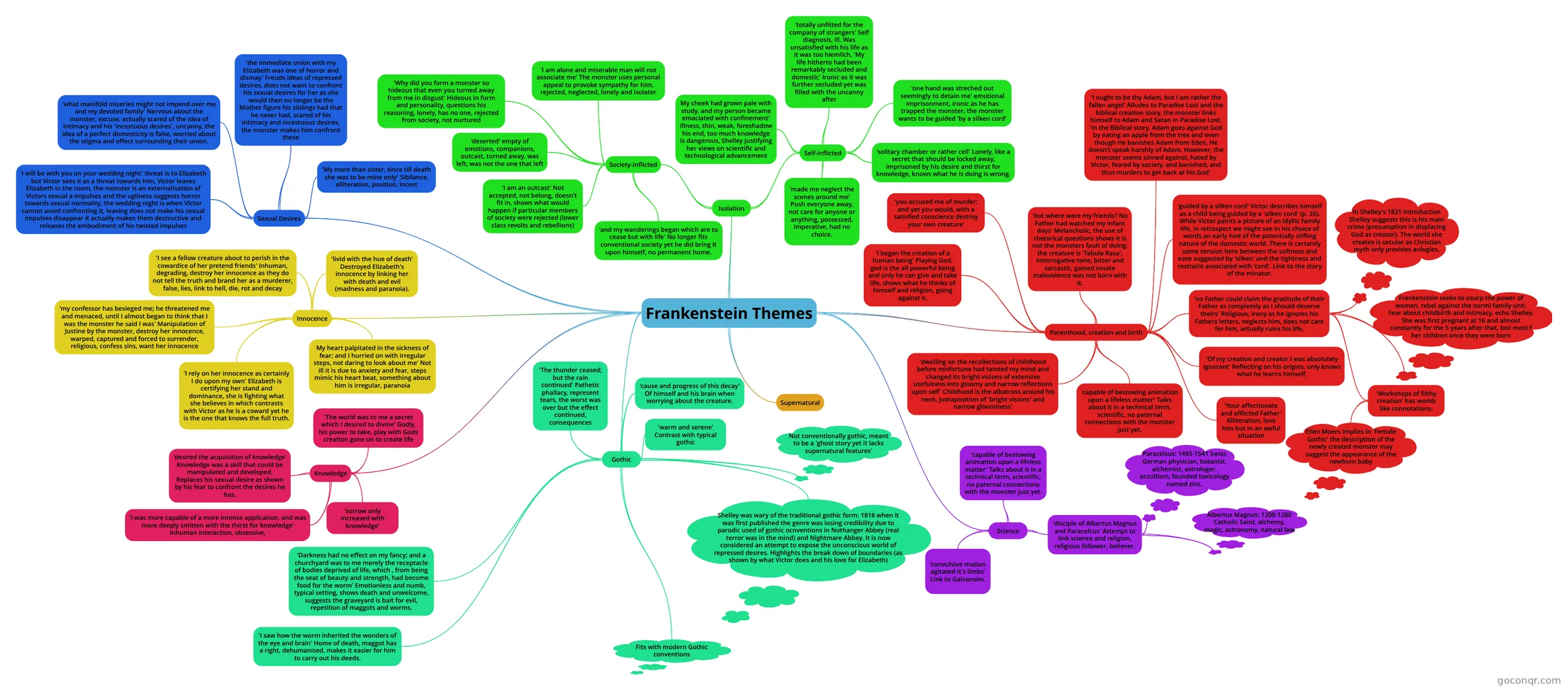
Mind map: Frankenstein themes
Map content
Frankenstein Themes
Isolation
- Society-inflicted
- 'I am alone and miserable man will not associate me' The monster uses personal appeal to provoke sympathy for him, rejected, neglected, lonely and isolater
- 'Why did you form a monster so hideous that even you turned away from me in disgust' Hideous in form and personality, questions his reasoning, lonely, has no one, rejected from society, not nurtured
- 'deserted' empty of emotions, companions, outcast, turned away, was left, was not the one that left
- 'I am an outcast' Not accepted, not belong, doesn't fit in, shows what would happen if particular members of society were rejected (lower class revolts and rebellions)
- 'and my wanderings began which are to cease but with life' No longer fits conventional society yet he did bring it upon himself, no permanent home.
- Self-inflicted
- My cheek had grown pale with study, and my person became emaciated with confinement' Illness, thin, weak, foreshadow his end, too much knowledge is dangerous, Shelley justifying her views on scientific and technological advancement
- 'one hand was streched out seemingly to detain me' emotional imprisonment, ironic as he has trapped the monster, the monster wants to be guided 'by a silken cord'
- 'solitary chamber or rather cell' Lonely, like a secret that should be locked away, imprisoned by his desire and thirst for knowledge, knows what he is doing is wrong.
- 'totally unfitted for the company of strangers' Self diagnosis, ill. Was unsatisfied with his life as it was too hiemlich, 'My life hitherto had been remarkably secluded and domestic' Ironic as it was further secluded yet was filled with the uncanny after
- 'made me neglect the scenes around me' Push everyone away, not care for anyone or anything, possessed, imperative, had no choice.
- Society-inflicted
Parenthood, creation and birth
- 'I began the creation of a human being' Playing God, god is the all powerful being and only he can give and take life, shows what he thinks of himself and religion, going against it.
- 'capable of bestowing animation upon a lifeless matter' Talks about it in a technical term, scientific, no paternal connections with the monster just yet.
- 'I ought to be thy Adam, but I am rather the fallen angel' Alludes to Paradise Lost and the biblical creation story, the monster links himself to Adam and Satan in Paradise Lost. 'In the Biblical story, Adam goes against God by eating an apple from the tree and even though He banishes Adam from Eden, He doesn't speak harshly of Adam. However, the monster seems sinned against, hated by Victor, feared by society, and banished, and thus murders to get back at his God'
- 'guided by a silken cord' Victor describes himself as a child being guided by a 'silken cord' (p. 35). While Victor paints a picture of an idyllic family life, in retrospect we might see in his choice of words an early hint of the potentially stifling nature of the domestic world. There is certainly some tension here between the softness and ease suggested by 'silken' and the tightness and restraint associated with 'cord'. Link to the story of the minator.
- 'no Father could claim the gratitude of their Father as completely as I should deserve theirs' Religious, irony as he ignores his Fathers letters, neglects him, does not care for him, actually ruins his life,
- In Shelley's 1831 Introduction Shelley suggests this is his main crime (presumption in displacing God as creator). The world she creates is secular as Christian myth only provides anlogies,
- Frankenstein seeks to usurp the power of women, rebel against the norml family unti. Fear about childbirth and intimacy, echo Shelley. She was first pregnant at 16 and almost constantly for the 5 years after that, lost most f her children once they were born
- 'Workshops of filthy creation' has womb like connotations.
- Ellen Moers implies in 'Female Gothic' the description of the newly created monster may suggest the appearance of the newborn baby
- 'you accused me of murder; and yet you would, with a satisfied conscience destroy your own creature'
- 'dwelling on the recollections of childhood before misfortune had tainted my mind and changed its bright visions of extensive usefulness into gloomy and narrow reflections upon self' Childhood is the albatross around his neck, juxtaposition of 'bright visions' and narrow gloominess'
- 'Of my creation and creator I was absolutely ignorant' Reflecting on his origins, only knows what he learns himself,
- 'but where were my friends? No Father had watched my infant days' Melancholic, the use of rhetorical questions shows it is not the monsters fault of doing, the creature is 'Tabula Rasa', interrogative tone, bitter and sarcastic, gained innate malevolence was not born with it.
- 'Your affectionate and afflicted Father' Alliteration, love him but in an awful situation
Science
- 'capable of bestowing animation upon a lifeless matter' Talks about it in a technical term, scientific, no paternal connections with the monster just yet.
- 'convulsive motion agitated it's limbs' Link to Galvansim.
- 'disciple of Albertus Magnus and Paracelcus' Attempt to link science and religion, religious follower, believer.
- Paracelsus: 1493-1541 Swiss German physician, botanist, alchemist, astrologer, occultism, founded toxicology named zinc.
- Albertus Magnus: 1200-1280 Catholic Saint, alchemy, magic, astronomy, natural law
Supernatural
Knowledge
- 'desired the acquisition of knowledge' Knowledge was a skill that could be manipulated and developed. Replaces his sexual desire as shown by his fear to confront the desires he has.
- 'I was more capable of a more intense application, and was more deeply smitten with the thirst for knowledge' Inhuman interaction, obsessive,
- 'The world was to me a secret which I desired to divine' Godly, his power to take, play with Gods creation gone on to create life
- 'sorrow only increased with knowledge'
Innocence
- 'I rely on her innocence as certainly I do upon my own' Elizabeth is certifying her stand and dominance, she is fighting what she believes in which contrasts with Victor as he is a coward yet he is the one that knows the full truth.
- 'my confessor has besieged me; he threatened me and menaced, until I almost began to think that I was the monster he said I was' Manipulation of Justine by the monster, destroy her innocence, warped, captured and forced to surrender, religious, confess sins, want her innocence
- 'I see a fellow creature about to perish in the cowardice of her pretend friends' Inhuman, degrading, destroy her innocence as they do not tell the truth and brand her as a murderer, false, lies, link to hell, die, rot and decay
- 'livid with the hue of death' Destroyed Elizabeth's innocence by linking her with death and evil (madness and paranoia).
- My heart palpitated in the sickness of fear; and I hurried on with irregular steps, not daring to look about me' Not ill it is due to anxiety and fear, steps mimic his heart beat, something about him is irregular, paranoia
Sexual Desires
- 'the immediate union with my Elizabeth was one of horror and dismay' Freuds ideas of repressed desires, does not want to confront his sexual desires for her as she would then no longer be the Mother figure his siblings had that he never had, scared of his intimacy and incestuous desires, the monster makes him confront these
- 'what manifold miseries might not impend over me and my devoted family' Nervous about the monster, excuse, actually scared of the idea of intimacy and his 'incestuous desires', uncanny, the idea of a perfect domesticity is false, worried about the stigma and effect surrounding their union.
- 'My more than sister, since till death she was to be mine only' Sibilance, alliteration, position, incest
- 'I will be with you on your wedding night' threat is to Elizabeth but Victor sees it as a threat towards him, Victor leaves Elizabeth in the room, the monster is an externalisation of Victors sexual a impulses and the ugliness suggests horror towards sexual normality, the wedding night is when Victor cannot avoid confronting it, leaving does not make his sexual impulses disappear it actually makes them destructive and releases the embodiment of his twisted impulses
Gothic
- 'Darkness had no effect on my fancy; and a churchyard was to me merely the receptacle of bodies deprived of life, which , from being the seat of beauty and strength, had become food for the worm' Emotionless and numb, typical setting, shows death and unwelcome, suggests the graveyard is bait for evil, repetition of maggots and worms.
- 'cause and progress of this decay' Of himself and his brain when worrying about the creature.
- 'I saw how the worm inherited the wonders of the eye and brain' Home of death, maggot has a right, dehumanised, makes it easier for him to carry out his deeds.
- 'warm and serene' Contrast with typical gothic
- 'The thunder ceased; but the rain continued' Pathetic phallacy, represent tears, the worst was over but the effect continued, consequences
- Not conventionally gothic, meant to be a 'ghost story yet it lacks supernatural features'
- Shelley was wary of the traditional gothic form: 1818 when it was first published the genre was losing credibility due to parodic used of gothic ocnventions in Nothanger Abbey (real terror was in the mind) and Nightmare Abbey. It is now considered an attempt to expose the unconscious world of repressed desires. Highlights the break down of boundaries (as shown by what Victor does and his love for Elizabeth)
- Fits with modern Gothic conventions
Information
- Description
- A-Level English Literature Mind Map on Frankenstein Themes, created by Sophie Conisbee on 16/01/2018.
- Created by
- Sophie Conisbee
- Views
- 5
- Rating