
Mind map
Private Nuisance
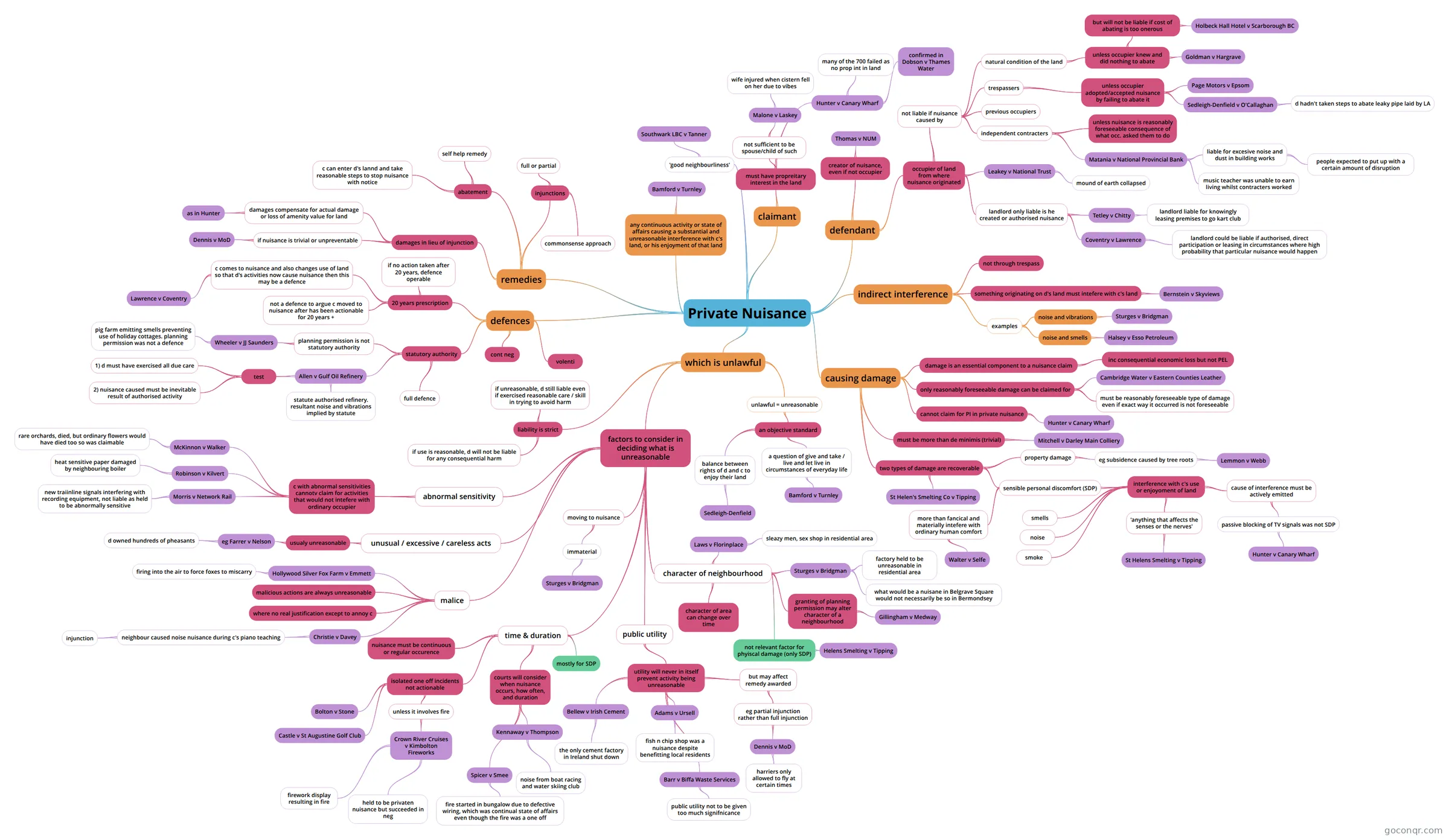
Mind map: Private nuisance
Map content
Private Nuisance
any continuous activity or state of affairs causing a substantial and unreasonable interference with c's land, or his enjoyment of that land
- Bamford v Turnley
claimant
- must have propreitary interest in the land
- not sufficient to be spouse/child of such
- Malone v Laskey
- wife injured when cistern fell on her due to vibes
- Malone v Laskey
- Hunter v Canary Wharf
- many of the 700 failed as no prop int in land
- confirmed in Dobson v Thames Water
- not sufficient to be spouse/child of such
- must have propreitary interest in the land
defendant
- creator of nuisance, even if not occupier
- Thomas v NUM
- occupier of land from where nuisance originated
- Leakey v National Trust
- mound of earth collapsed
- not liable if nuisance caused by
- independent contracters
- unless nuisance is reasonably foreseeable consequence of what occ. asked them to do
- Matania v National Provincial Bank
- liable for excesive noise and dust in building works
- people expected to put up with a certain amount of disruption
- music teacher was unable to earn living whilst contracters worked
- liable for excesive noise and dust in building works
- previous occupiers
- trespassers
- unless occupier adopted/accepted nuisance by failing to abate it
- Page Motors v Epsom
- Sedleigh-Denfield v O'Callaghan
- d hadn't taken steps to abate leaky pipe laid by LA
- unless occupier adopted/accepted nuisance by failing to abate it
- natural condition of the land
- unless occupier knew and did nothing to abate
- Goldman v Hargrave
- but will not be liable if cost of abating is too onerous
- Holbeck Hall Hotel v Scarborough BC
- unless occupier knew and did nothing to abate
- independent contracters
- landlord only liable is he created or authorised nuisance
- Tetley v Chitty
- landlord liable for knowingly leasing premises to go kart club
- Coventry v Lawrence
- landlord could be liable if authorised, direct participation or leasing in circumstances where high probability that particular nuisance would happen
- Tetley v Chitty
- Leakey v National Trust
- creator of nuisance, even if not occupier
indirect interference
- not through trespass
- something originating on d's land must intefere with c's land
- Bernstein v Skyviews
- examples
- noise and vibrations
- Sturges v Bridgman
- noise and smells
- Halsey v Esso Petroleum
- noise and vibrations
causing damage
- damage is an essential component to a nuisance claim
- inc consequential economic loss but not PEL
- only reasonably foreseeable damage can be claimed for
- Cambridge Water v Eastern Counties Leather
- must be reasonably foreseeable type of damage even if exact way it occurred is not foreseeable
- cannot claim for PI in private nuisance
- Hunter v Canary Wharf
- two types of damage are recoverable
- property damage
- eg subsidence caused by tree roots
- Lemmon v Webb
- eg subsidence caused by tree roots
- sensible personal discomfort (SDP)
- interference with c's use or enjoyoment of land
- smells
- noise
- smoke
- 'anything that affects the senses or the nerves'
- St Helens Smelting v Tipping
- cause of interference must be actively emitted
- passive blocking of TV signals was not SDP
- Hunter v Canary Wharf
- passive blocking of TV signals was not SDP
- more than fancical and materially intefere with ordinary human comfort
- Walter v Selfe
- interference with c's use or enjoyoment of land
- St Helen's Smelting Co v Tipping
- property damage
- must be more than de minimis (trivial)
- Mitchell v Darley Main Colliery
- damage is an essential component to a nuisance claim
which is unlawful
- unlawful = unreasonable
- an objective standard
- a question of give and take / live and let live in circumstances of everyday life
- Bamford v Turnley
- balance between rights of d and c to enjoy their land
- Sedleigh-Denfield
- a question of give and take / live and let live in circumstances of everyday life
- an objective standard
- liability is strict
- if use is reasonable, d will not be liable for any consequential harm
- if unreasonable, d still liable even if exercised reasonable care / skill in trying to avoid harm
- factors to consider in deciding what is unreasonable
- character of neighbourhood
- Sturges v Bridgman
- factory held to be unreasonable in residential area
- what would be a nuisane in Belgrave Square would not necessarily be so in Bermondsey
- character of area can change over time
- granting of planning permission may alter character of a neighbourhood
- Gillingham v Medway
- not relevant factor for phyiscal damage (only SDP)
- Helens Smelting v Tipping
- Laws v Florinplace
- sleazy men, sex shop in residential area
- Sturges v Bridgman
- public utility
- utility will never in itself prevent activity being unreasonable
- Adams v Ursell
- fish n chip shop was a nuisance despite benefitting local residents
- Bellew v Irish Cement
- the only cement factory in Ireland shut down
- but may affect remedy awarded
- eg partial injunction rather than full injunction
- Dennis v MoD
- harriers only allowed to fly at certain times
- Dennis v MoD
- eg partial injunction rather than full injunction
- Barr v Biffa Waste Services
- public utility not to be given too much signifnicance
- Adams v Ursell
- utility will never in itself prevent activity being unreasonable
- time & duration
- isolated one off incidents not actionable
- Bolton v Stone
- Castle v St Augustine Golf Club
- unless it involves fire
- Crown River Cruises v Kimbolton Fireworks
- held to be privaten nuisance but succeeded in neg
- firework display resulting in fire
- Crown River Cruises v Kimbolton Fireworks
- nuisance must be continuous or regular occurence
- courts will consider when nuisance occurs, how often, and duration
- Kennaway v Thompson
- noise from boat racing and water skiing club
- Spicer v Smee
- fire started in bungalow due to defective wiring, which was continual state of affairs even though the fire was a one off
- Kennaway v Thompson
- mostly for SDP
- isolated one off incidents not actionable
- malice
- malicious actions are always unreasonable
- where no real justification except to annoy c
- Hollywood Silver Fox Farm v Emmett
- firing into the air to force foxes to miscarry
- Christie v Davey
- neighbour caused noise nuisance during c's piano teaching
- injunction
- neighbour caused noise nuisance during c's piano teaching
- unusual / excessive / careless acts
- usualy unreasonable
- eg Farrer v Nelson
- d owned hundreds of pheasants
- eg Farrer v Nelson
- usualy unreasonable
- abnormal sensitivity
- c with abnormal sensitivities cannotv claim for activities that would not intefere with ordinary occupier
- Robinson v Kilvert
- heat sensitive paper damaged by neighbouring boiler
- Morris v Network Rail
- new traiinline signals interfering with recording equipment, not liable as held to be abnormally sensitive
- McKinnon v Walker
- rare orchards, died, but ordinary flowers would have died too so was claimable
- Robinson v Kilvert
- c with abnormal sensitivities cannotv claim for activities that would not intefere with ordinary occupier
- moving to nuisance
- immaterial
- Sturges v Bridgman
- immaterial
- character of neighbourhood
- unlawful = unreasonable
defences
- volenti
- cont neg
- statutory authority
- full defence
- Allen v Gulf Oil Refinery
- statute authorised refinery. resultant noise and vibrations implied by statute
- test
- 1) d must have exercised all due care
- 2) nuisance caused must be inevitable result of authorised activity
- planning permission is not statutory authority
- Wheeler v JJ Saunders
- pig farm emitting smells preventing use of holiday cottages. planning permission was not a defence
- Wheeler v JJ Saunders
- 20 years prescription
- not a defence to argue c moved to nuisance after has been actionable for 20 years +
- c comes to nuisance and also changes use of land so that d's activities now cause nuisance then this may be a defence
- Lawrence v Coventry
- if no action taken after 20 years, defence operable
remedies
- injunctions
- full or partial
- commonsense approach
- damages in lieu of injunction
- if nuisance is trivial or unpreventable
- Dennis v MoD
- damages compensate for actual damage or loss of amenity value for land
- as in Hunter
- if nuisance is trivial or unpreventable
- abatement
- self help remedy
- c can enter d's lannd and take reasonable steps to stop nuisance with notice
- injunctions
'good neighbourliness'
- Southwark LBC v Tanner
Information
- Description
- Tort Mind Map on Private Nuisance, created by Tan Nah on 01/08/2018.
- Created by
- Tan Nah
- Views
- 1
- Rating